


Early resumption of sexual activity following voluntary medical male circumcision in Botswana: A qualitative study
- PMID: 29136009
- PMCID: PMC5685600
- DOI: 10.1371/journal.pone.0186831
Early resumption of sexual activity following voluntary medical male circumcision in Botswana: A qualitative study
Abstract
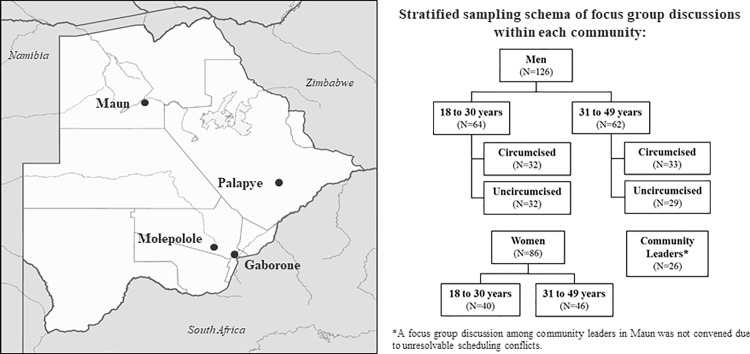
Unprotected sexual intercourse after undergoing voluntary medical male circumcision but prior to complete wound healing can lead to major adverse events including HIV acquisition. To better understand perceptions related to early resumption of sex prior to wound healing, 27 focus group discussions were conducted among 238 adult men, women, and community leaders in Botswana. Median age among all participants was 31 years of whom 60% were male and 51% were either employed and receiving salary or self-employed. Only 12% reported being currently married. Pain, not risk of HIV acquisition, was perceived as the main adverse consequence of early resumption of sex. In fact, no participant mentioned that early resumption of sex could lead to an increase in HIV risk. Demonstrating masculinity and virility, fear of losing female partners, and misperception about post-operative wound healing also played key roles in the decision to resume sex prior to complete wound healing. Findings from this study highlight a potentially widespread lack of awareness of the increased risk of HIV acquisition during the wound healing period. Strengthening post-operative counseling and identifying strategies to discourage the early resumption of sex will be increasingly important as older men and HIV-positive men seek voluntary medical male circumcision services.
Conflict of interest statement
Figures
References
-
- World Health Organization, UNAIDS, editors. New Data on Male Circumcision and HIV Prevention: Policy and Programme Implications. WHO/UNAIDS Technical Consultation on Male Circumcision and HIV Prevention: Research Implications for Policy and Programming; 2007; Montreux, France: World Health Organization and UNAIDS.
-
- Auvert B, Taljaard D, Lagarde E, Sobngwi-Tambekou J, Sitta R, Puren A. Randomized, controlled intervention trial of male circumcision for reduction of HIV infection risk: the ANRS 1265 Trial. PLoS medicine. 2005;2(11):e298 doi: 10.1371/journal.pmed.0020298 ; PubMed Central PMCID: PMC1262556. - DOI - PMC - PubMed
-
- Bailey RC, Moses S, Parker CB, Agot K, Maclean I, Krieger JN, et al. Male circumcision for HIV prevention in young men in Kisumu, Kenya: a randomised controlled trial. Lancet. 2007;369(9562):643–56. doi: 10.1016/S0140-6736(07)60312-2 . - DOI - PubMed
-
- Gray RH, Kigozi G, Serwadda D, Makumbi F, Watya S, Nalugoda F, et al. Male circumcision for HIV prevention in men in Rakai, Uganda: a randomised trial. Lancet. 2007;369(9562):657–66. doi: 10.1016/S0140-6736(07)60313-4 . - DOI - PubMed
-
- Sgaier SK, Reed JB, Thomas A, Njeuhmeli E. Achieving the HIV Prevention Impact of Voluntary Medical Male Circumcision: Lessons and Challenges for Managing Programs. PLoS medicine. 2014;11(5):e1001641 Epub 2014/05/08. doi: 10.1371/journal.pmed.1001641 ; PubMed Central PMCID: PMCPmc4011573. - DOI - PMC - PubMed
MeSH terms
LinkOut - more resources
Full Text Sources
Other Literature Sources
Medical
