


Trends and Predictors of Syphilis Prevalence in the General Population: Global Pooled Analyses of 1103 Prevalence Measures Including 136 Million Syphilis Tests
- PMID: 29136161
- PMCID: PMC5888928
- DOI: 10.1093/cid/cix975
Trends and Predictors of Syphilis Prevalence in the General Population: Global Pooled Analyses of 1103 Prevalence Measures Including 136 Million Syphilis Tests
Abstract
Background: This study assessed levels, trends, and associations of observed syphilis prevalence in the general adult population using global pooled analyses.
Methods: A standardized database of syphilis prevalence was compiled by pooling systematically gathered data. Random-effects meta-analyses and meta-regressions were conducted using data from the period 1990-2016 to estimate pooled measures and assess predictors and trends. Countries were classified by World Health Organization region. Sensitivity analyses were conducted.
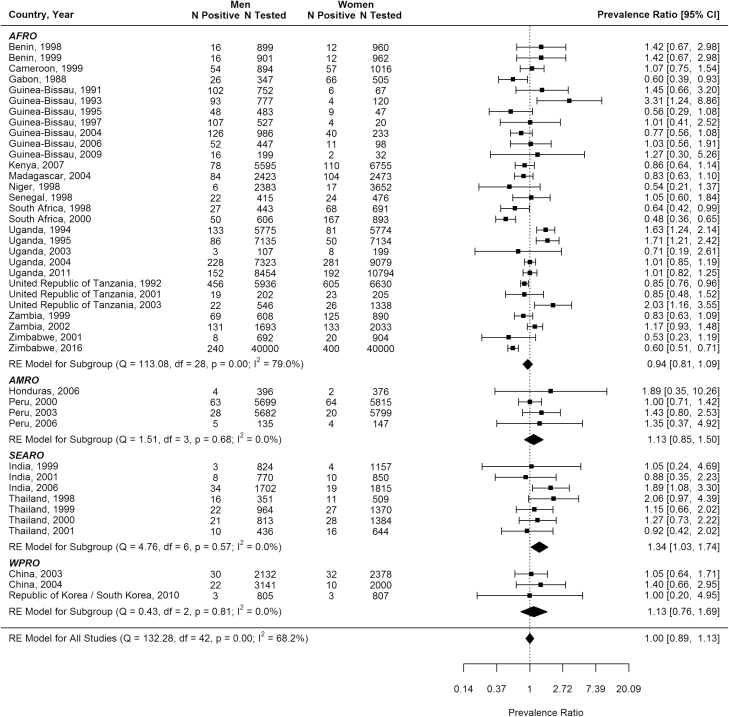
Results: The database included 1103 prevalence measures from 136 million syphilis tests across 154 countries (85% from women in antenatal care). Global pooled mean prevalence (weighted by region population size) was 1.11% (95% confidence interval [CI], .99-1.22). Prevalence predictors were region, diagnostic assay, sample size, and calendar year interacting with region. Compared to the African Region, the adjusted odds ratio (AOR) was 0.42 (95% CI, .33-.54) for the Region of the Americas, 0.13 (95% CI, .09-.19) for the Eastern Mediterranean Region, 0.05 (95% CI, .03-.07) for the European Region, 0.21 (95% CI, .16-.28) for the South-East Asia Region, and 0.41 (95% CI, .32-.53) for the Western Pacific Region. Treponema pallidum hemagglutination assay (TPHA) only or rapid plasma reagin (RPR) only, compared with dual RPR/TPHA diagnosis, produced higher prevalence (AOR >1.26), as did smaller sample-size studies (<500 persons) (AOR >2.16). Prevalence declined in all regions; the annual AORs ranged from 0.84 (95% CI, .79-.90) in the Eastern Mediterranean to 0.97 (95% CI, .97-1.01) in the Western Pacific. The pooled mean male-to-female prevalence ratio was 1.00 (95% CI, .89-1.13). Sensitivity analyses confirmed robustness of results.
Conclusions: Syphilis prevalence has declined globally over the past 3 decades. Large differences in prevalence persist among regions, with the African Region consistently the most affected.
Figures
References
-
- World Health Organization. Global health sector strategy on sexually transmitted infections 2016–2021. Geneva, Switzerland: WHO, 2016.
-
- World Health Organization. The global elimination of congenital syphilis: rationale and strategy for action. Geneva, Switzerland: WHO, 2007.
-
- Centers for Disease Control and Prevention. Sexually transmitted disease surveillance 2015. Atlanta, GA: CDC, 2016.
Publication types
MeSH terms
Substances
LinkOut - more resources
Full Text Sources
Other Literature Sources
Medical
Miscellaneous
