


Fitness, Sleep-Disordered Breathing, Symptoms of Depression, and Cognition in Inactive Overweight Children: Mediation Models
- PMID: 29136483
- PMCID: PMC5692181
- DOI: 10.1177/0033354917731308
Fitness, Sleep-Disordered Breathing, Symptoms of Depression, and Cognition in Inactive Overweight Children: Mediation Models
Abstract
Objectives: We used mediation models to examine the mechanisms underlying the relationships among physical fitness, sleep-disordered breathing (SDB), symptoms of depression, and cognitive functioning.
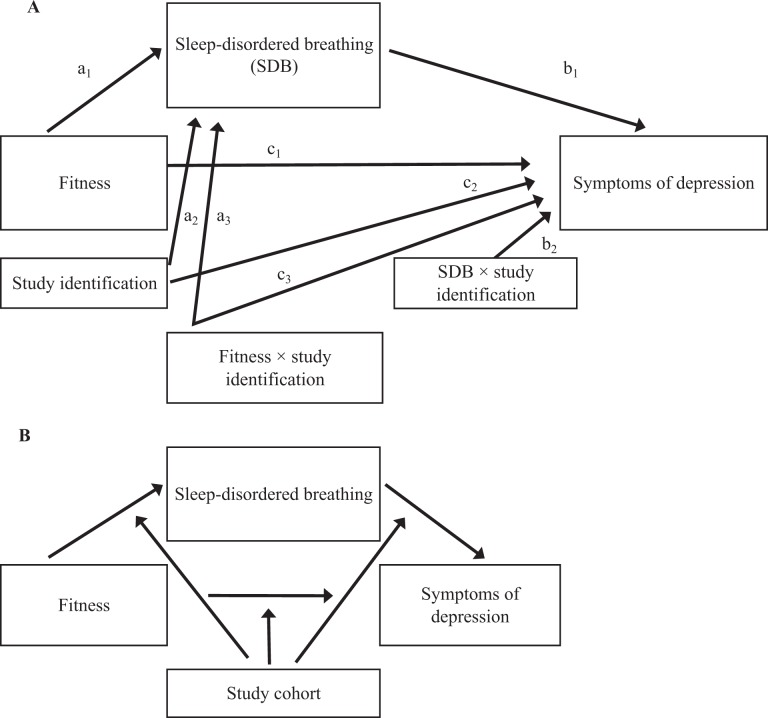
Methods: We conducted a cross-sectional secondary analysis of the cohorts involved in the 2003-2006 project PLAY (a trial of the effects of aerobic exercise on health and cognition) and the 2008-2011 SMART study (a trial of the effects of exercise on cognition). A total of 397 inactive overweight children aged 7-11 received a fitness test, standardized cognitive test (Cognitive Assessment System, yielding Planning, Attention, Simultaneous, Successive, and Full Scale scores), and depression questionnaire. Parents completed a Pediatric Sleep Questionnaire. We used bootstrapped mediation analyses to test whether SDB mediated the relationship between fitness and depression and whether SDB and depression mediated the relationship between fitness and cognition.
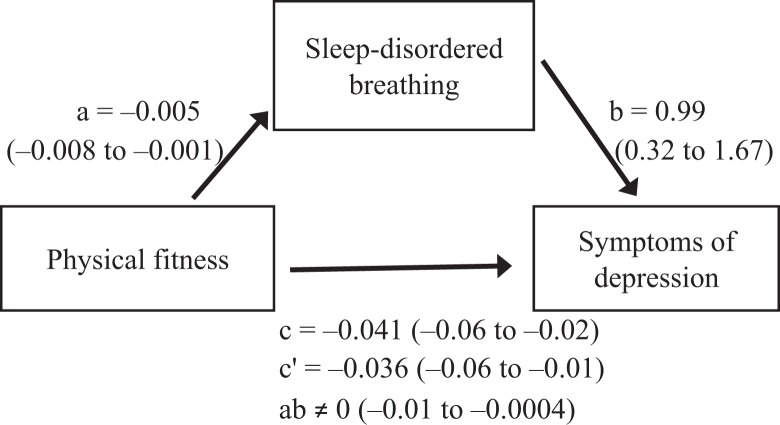
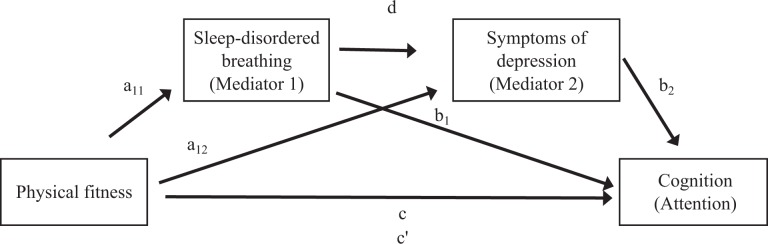
Results: Fitness was negatively associated with depression ( B = -0.041; 95% CI, -0.06 to -0.02) and SDB ( B = -0.005; 95% CI, -0.01 to -0.001). SDB was positively associated with depression ( B = 0.99; 95% CI, 0.32 to 1.67) after controlling for fitness. The relationship between fitness and depression was mediated by SDB (indirect effect = -0.005; 95% CI, -0.01 to -0.0004). The relationship between fitness and the attention component of cognition was independently mediated by SDB (indirect effect = 0.058; 95% CI, 0.004 to 0.13) and depression (indirect effect = -0.071; 95% CI, -0.01 to -0.17).
Conclusions: SDB mediates the relationship between fitness and depression, and SDB and depression separately mediate the relationship between fitness and the attention component of cognition.
Keywords: cognitive functioning; depression; pediatric obesity; physical fitness; sleep.
Conflict of interest statement
Figures
References
-
- Freedman DS, Mei Z, Srinivasan SR, Berenson GS, Dietz WH. Cardiovascular risk factors and excess adiposity among overweight children and adolescents: the Bogalusa Heart Study. J Pediatr. 2007;150(1):12–17.e2. - PubMed
-
- Whitlock EP, Williams SB, Gold R, Smith PR, Shipman SA. Screening and interventions for childhood overweight: a summary of evidence for the US Preventive Services Task Force. Pediatr. 2005;116(1):e125–e144. - PubMed
-
- Bell LM, Byrne S, Thompson A, et al. Increasing body mass index z-score is continuously associated with complications of overweight in children, even in the healthy weight range. J Clin Endocrinol Metab. 2007;92(2):517–522. - PubMed
Publication types
MeSH terms
Grants and funding
LinkOut - more resources
Full Text Sources
Other Literature Sources
Medical
