


Red and processed meat consumption and colorectal cancer risk: a systematic review and meta-analysis
- PMID: 29137344
- PMCID: PMC5669970
- DOI: 10.18632/oncotarget.20667
Red and processed meat consumption and colorectal cancer risk: a systematic review and meta-analysis
Abstract
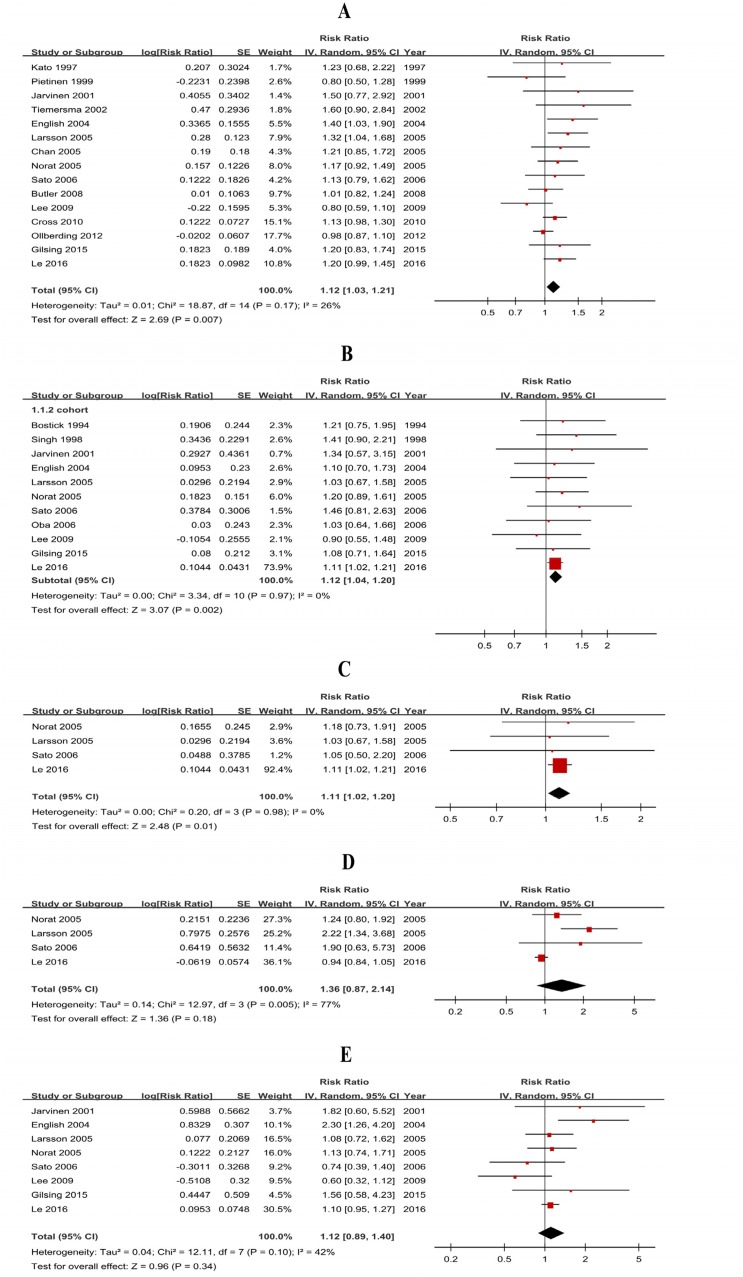
The associations between red and processed meat consumption and the risk of colorectal cancer types have not been conclusively defined. We performed a systematic review and meta-analysis to analyze these associations. We searched PubMed and EMBASE to identify studies published from inception through September 2016. Dose-response, subgroup and subtype analyses of colorectal cancer (colon cancer, proximal colon cancer, distal colon cancer and rectal cancer) were performed. We ultimately selected 60 eligible studies. Positive associations were observed for colorectal cancer in case-control studies (red meat, P<0.01; processed meat, P<0.01) and cohort studies (red meat, P<0.01; processed meat, P<0.01). However, subtype analyses yielded null results for distal colon cancer in case-control studies (P=0.41) and cohort studies (P=0.18) for red meat and null results for proximal colon cancer in case-control studies (P=0.13) and cohort studies (P=0.39) for processed meat. Additionally, although the results of case-control studies were positive (red meat, P<0.01; processed meat, P=0.04) for rectal cancer, there were no positive associations between red (P=0.34) and processed meat (P=0.06) consumption and the risk in cohort studies. In a systematic review and meta-analysis, we found consumption of red and processed meat was associated with the risk of overall colorectal cancer but not rectal cancer. Additionally, there were no associations between the consumption of red meat and distal colon cancer risk and between the consumption of processed meat and proximal colon cancer risk.
Keywords: colorectal cancer; meta-analysis; nutrition; processed meat; red meat.
Conflict of interest statement
CONFLICTS OF INTEREST The authors declare that they have no conflicts of interest.
Figures


References
-
- Torre LA, Bray F, Siegel RL, Ferlay J, Lortet-Tieulent J, Jemal A. Global cancer statistics, 2012. CA Cancer J Clin. 2015;65:87–108. - PubMed
-
- He X, Sun LM. Dietary intake of flavonoid subclasses and risk of colorectal cancer: evidence from population studies. Oncotarget. 2016;7:26617–26627. https://doi.org/10.18632/oncotarget.8562. - DOI - PMC - PubMed
-
- Gan Y, Wu J, Zhang S, Li L, Cao S, Mkandawire N, Ji K, Herath C, Gao C, Xu H, Zhou Y, Song X, Chen S, et al. Association of coffee consumption with risk of colorectal cancer: a meta-analysis of prospective cohort studies. Oncotarget. 2017;8:18699–18711. https://doi.org/10.18632/oncotarget.8627. - DOI - PMC - PubMed
-
- Demeyer D, Mertens B, De Smet S, Ulens M. Mechanisms linking colorectal cancer to the consumption of (processed) red meat: a review. Crit Rev Food Sci Nutr. 2016;56:2747–2766. - PubMed
LinkOut - more resources
Full Text Sources
Other Literature Sources
