. 2018 Sep;25(9):1336-1348.
doi: 10.1177/1933719117741374. Epub 2017 Nov 14.

Environmental Manipulations as an Effective Alternative Treatment to Reduce Endometriosis Progression

Affiliations

Environmental Manipulations as an Effective Alternative Treatment to Reduce Endometriosis Progression

Annelyn Torres-Reverón et al. Reprod Sci. 2018 Sep.

Abstract

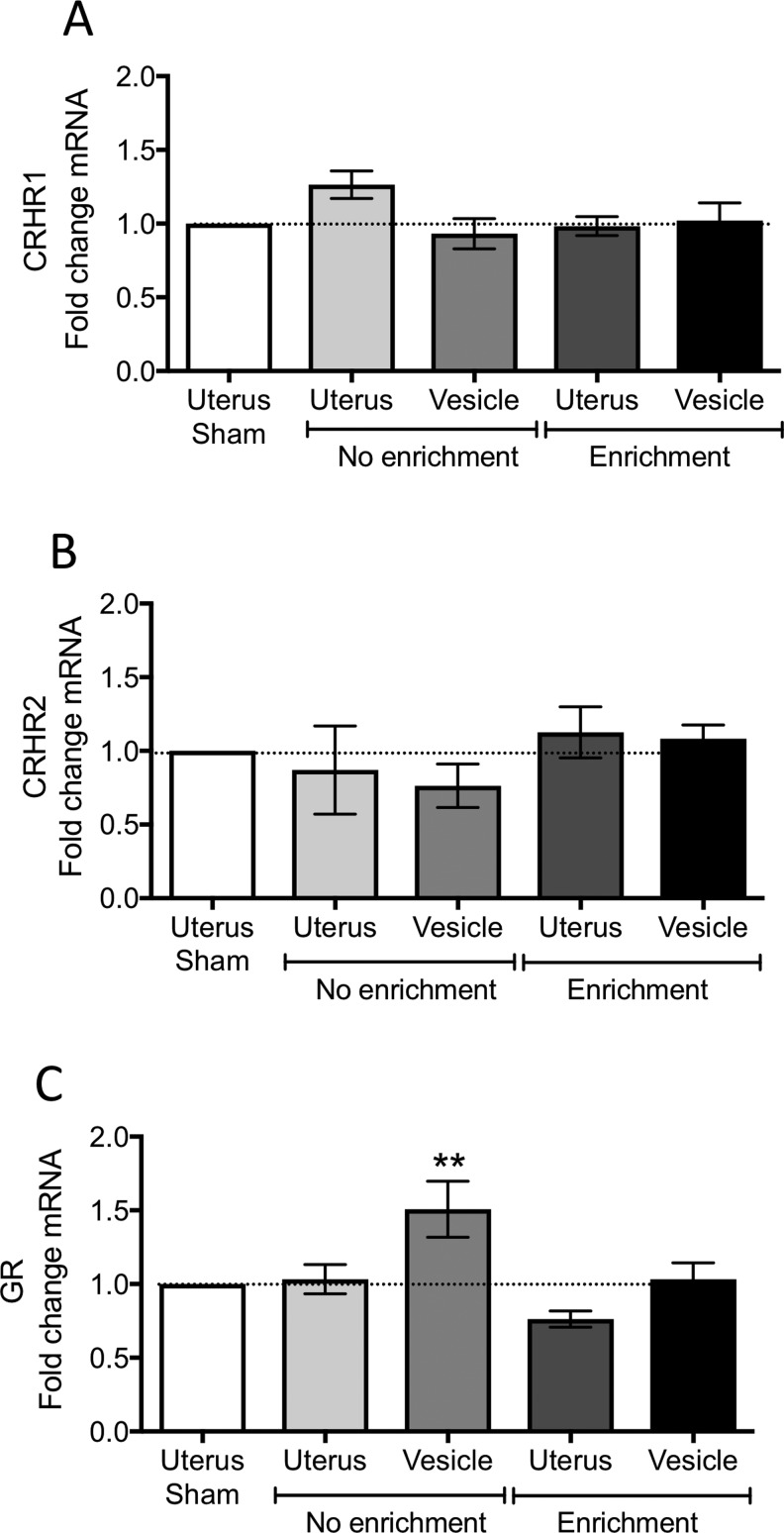
Treatments for endometriosis include pharmacological or surgical procedures that produce significant side effects. We aimed to determine how environmental enrichment (EE) could impact the progression of endometriosis using the autotransplantation rat model. Female rats were exposed to EE (endo-EE: toys and nesting materials, 4 rats per cage, larger area enclosure) or no enrichment (endo-NE: 2 rats per cage) starting on postnatal day 21. After 8 weeks, sham surgery or surgical endometriosis was induced by suturing uterine horn tissue next to the intestinal mesentery, then allowed to progress for 60 days during which EE or NE continued. At the time of killing, we measured anxiety behaviors, collected endometriotic vesicles and uterus, and processed for quantitative real-time polymerase chain reaction for corticotropin-releasing hormone (CRH), urocortin-1, CRH receptors type 1 and type 2, and glucocorticoid receptor (GR). Endometriosis did not affect anxiety-like behaviors, yet rats in enriched conditions showed lower basal anxiety behaviors than the nonenriched group. Importantly, the endo-EE group showed a 28% reduction in the number of endometriosis vesicles and the vesicles were significantly smaller compared to the endo-NE group. Endometriosis increased CRH and GR only in the vesicles of endo-NE, and this increase was dampened in the endo-EE. However, urocortin 1 was increased in the vesicles of the endo-EE group, suggesting different pathways of activation of CRH receptors in this group. Our results suggest that the use of multimodal complementary therapies that reduce stress in endometriosis could be an effective and safe treatment alternative, with minimal side effects.

Keywords: HPA axis; alternative medicine; environment; reduction; stress.


Conflict of interest statement

Declaration of Conflicting Interests: The author(s) declared the following potential conflicts of interest with respect to the research, authorship, and/or publication of this article: Dr Torres-Reveron and Dr Appleyard declare that part of the work presented herein is under review for a patent in the United States.

Figures

Figure 1.
Figure 1.
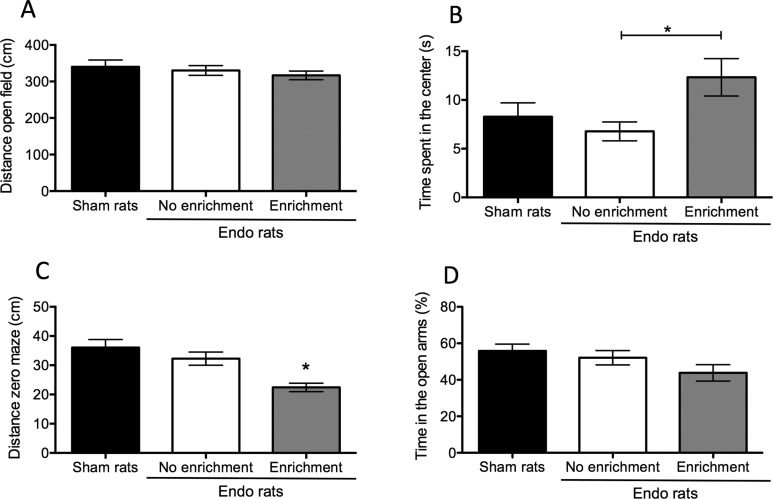
Behavioral assessment of anxiety in rats with endometriosis and sham controls. A, There was no difference in locomotor activity for the rats with endometriosis or sham controls in the open field test. B, Rats belonging to the endo-enrichment group (EE) spent significantly more time in the center of the arena compared to the endo-no enrichment (NE) group suggesting decreased anxiety. C, In the zero maze, rats belonging to the endo-EE group had decreased locomotor activity compared to the sham and the endo-NE groups. D, Despite the difference in locomotor activity, there was no difference between groups in the percentage of time spent in the open arms of the zero maze. In this and subsequent graphs, bars represent average ± standard error of the mean (SEM). * P < .05.
Figure 2.
Figure 2.
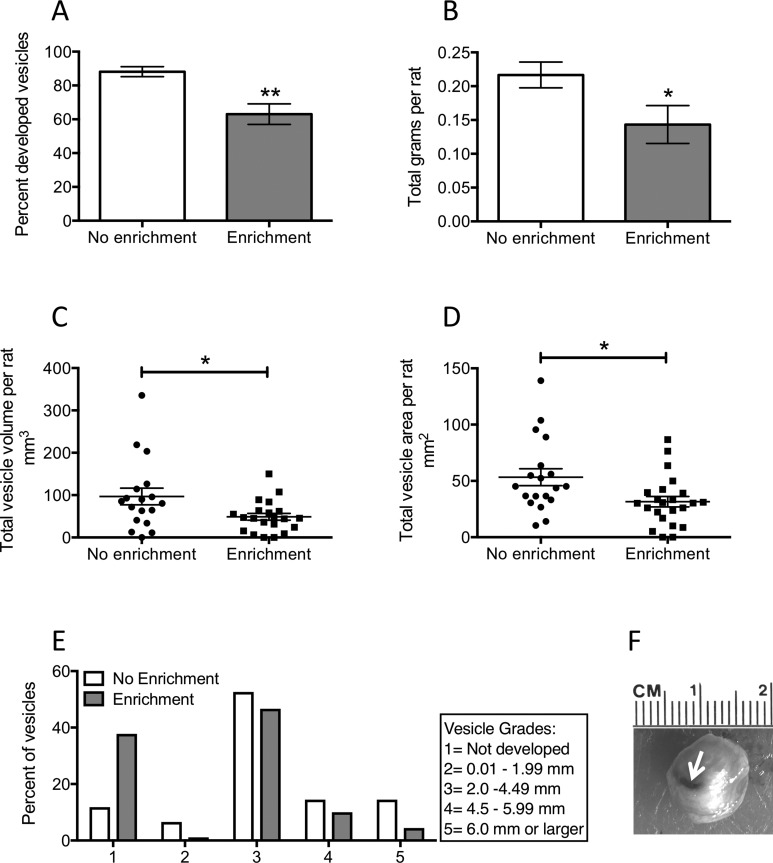
Morphological characteristics of endometriosis vesicles. A, The percentage of implants that developed into vesicles was significantly lower in the endo-enrichment (EE) group compared to the endo-no enrichment (NE). B, The total weight of all vesicles per rat was smaller for the endo-EE group. C, The total vesicle volume per rat was significantly smaller for the endo-EE group compared to the endo-NE group. D, Similar to volume, the total vesicle area per rat was significantly smaller in the endo-EE compared to the endo-NE group. E, Vesicles that developed were classified by grade based on a scale by size. F, Example of a grade 5 vesicle. The white arrow is pointing toward the silk suture used to attach the uterine tissue to the mesentery, which got completely enveloped in the vesicle as it developed. *P < .05; **P < 0.01.
Figure 3.
Figure 3.
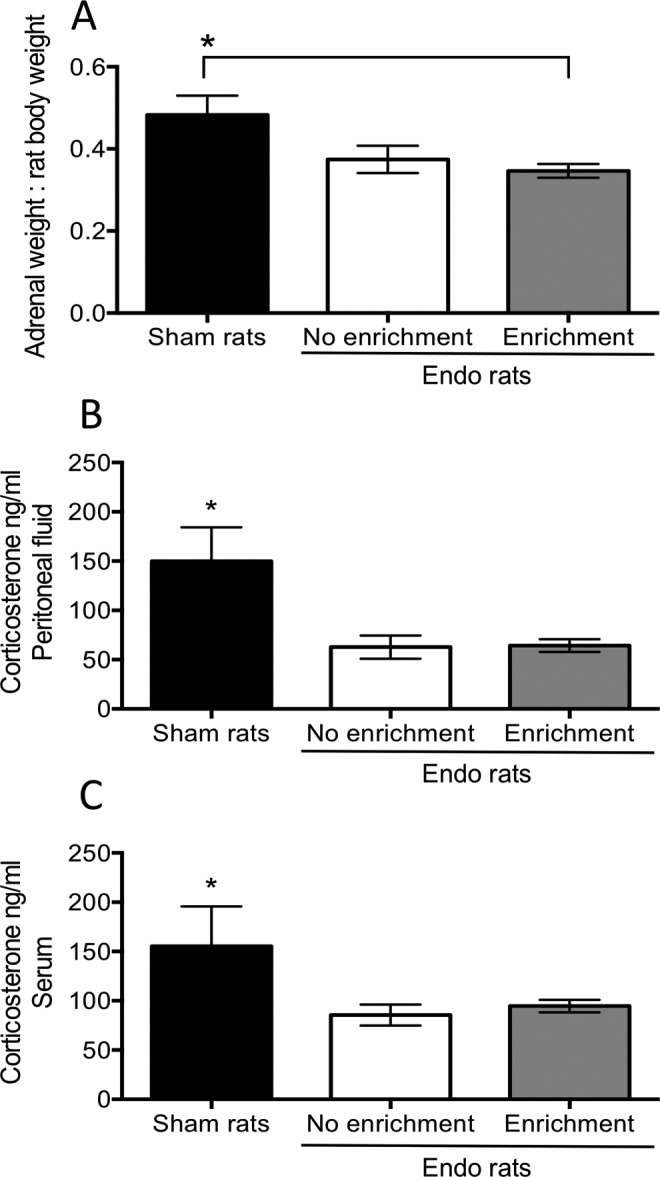
Adrenal weight and corticosterone measurements in peritoneal fluid and plasma. A, The weight of both adrenal glands normalized to the total body weight at killing. The size for the adrenal glands in endo-enrichment (EE) group was significantly smaller than that of the sham group. B, Corticosterone levels in peritoneal fluid measured by enzyme-linked immunosorbent assay (ELISA) showed a significant decrease for both groups with endometriosis compared to sham control group. C, Similar to peritoneal fluid, corticosterone in plasma was also decreased for both groups of rats with endometriosis compared to sham control rats. *P < .05.
Figure 4.
Figure 4.
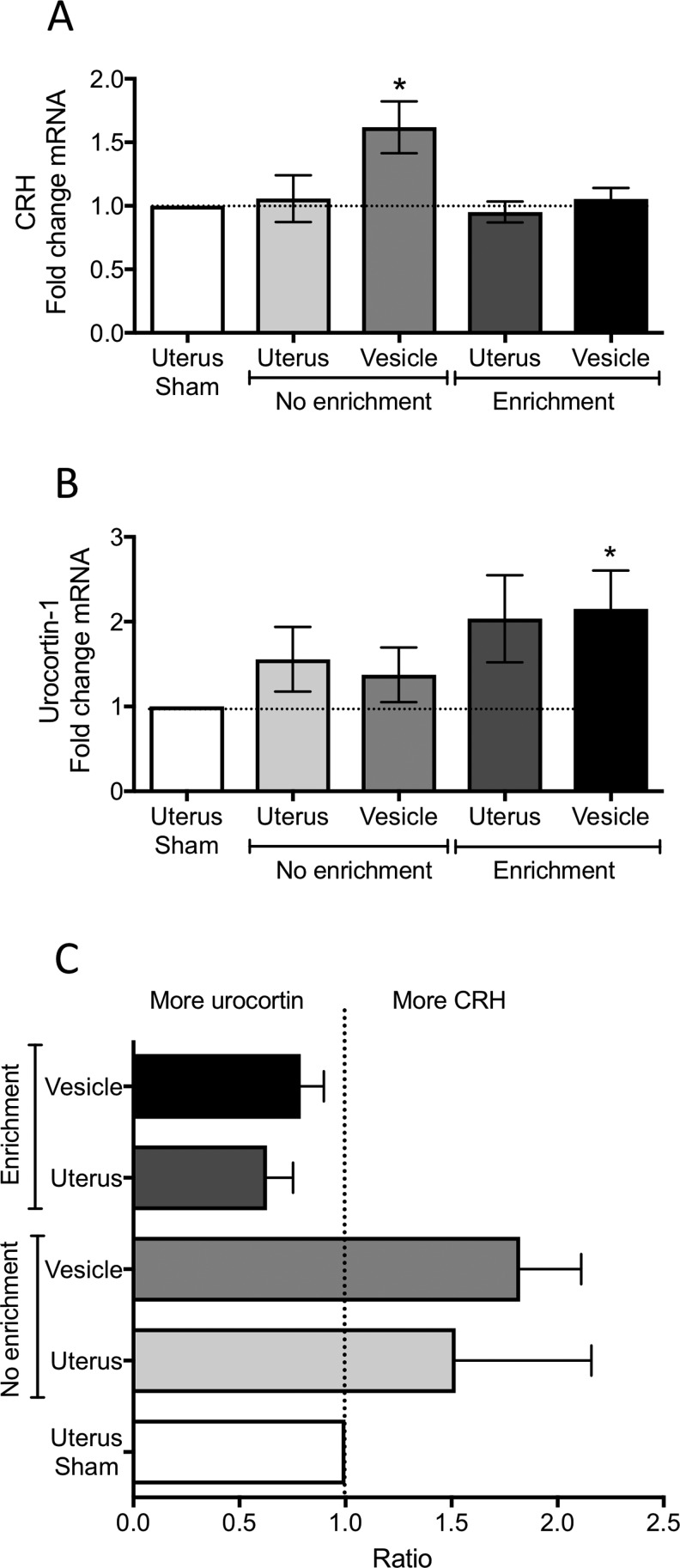
Messenger RNA (mRNA) levels of corticotropin-releasing hormone (CRH) and urocortin 1 measured by qRT-PCR from the uterus and endometriosis vesicles. A, Corticotropin releasing hormone. B, Urocortin 1. C, Ratio of CRH to urocortin 1 in uterus and vesicles, illustrating the comparative amount of peptides in each group. Data normalized to the uterus of sham rats. *P < .05 from sham levels.
Figure 5.
Figure 5.
Messenger RNA (mRNA) levels of corticotropin-releasing hormone (CRH) receptors and glucocorticoid receptor measured by qRT-PCR from the uterus and endometriosis vesicles. A, Corticotropin-releasing hormone receptor type 1 (CRHR1). B, Corticotropin-releasing hormone receptor type 2 (CRHR2). C, Glucocorticoid receptor (GR). Data normalized to the uterus of sham rats. *P < .05 from sham levels.

References

    1. Abu Hashim H. Gonadotrophin-releasing hormone analogues and endometriosis: current strategies and new insights. Gynecol Endocrinol. 2012;28(4):314–321. - PubMed
    1. Raffi F, Metwally M, Amer S. The impact of excision of ovarian endometrioma on ovarian reserve: a systematic review and meta-analysis. J Clin Endocrinol Metab. 2012;97(9):3146–3154. - PubMed
    1. Schrager S, Falleroni J, Edgoose J. Evaluation and treatment of endometriosis. Am Fam Physician. 2013;87(2):107–113. - PubMed
    1. Fourquet J, Baez L, Figueroa M, Iriarte RI, Flores I. Quantification of the impact of endometriosis symptoms on health-related quality of life and work productivity. Fertil Steril. 2011;96(1):107–112. - PMC - PubMed
    1. De Graaff AA, D’Hooghe TM, Dunselman GAJ, Dirksen CD, Hummelshoj L, Simoens S. The significant effect of endometriosis on physical, mental and social wellbeing: results from an international cross-sectional survey. Hum Reprod. 2013;28(10):2677–2685. - PubMed

Publication types

MeSH terms

Substances