Review
. 2018 Feb;176(2):1025-1038.
doi: 10.1104/pp.17.01384. Epub 2017 Nov 14.

Phytochromes and Phytochrome Interacting Factors

Affiliations
Review

Phytochromes and Phytochrome Interacting Factors

Vinh Ngoc Pham et al. Plant Physiol. 2018 Feb.

Abstract

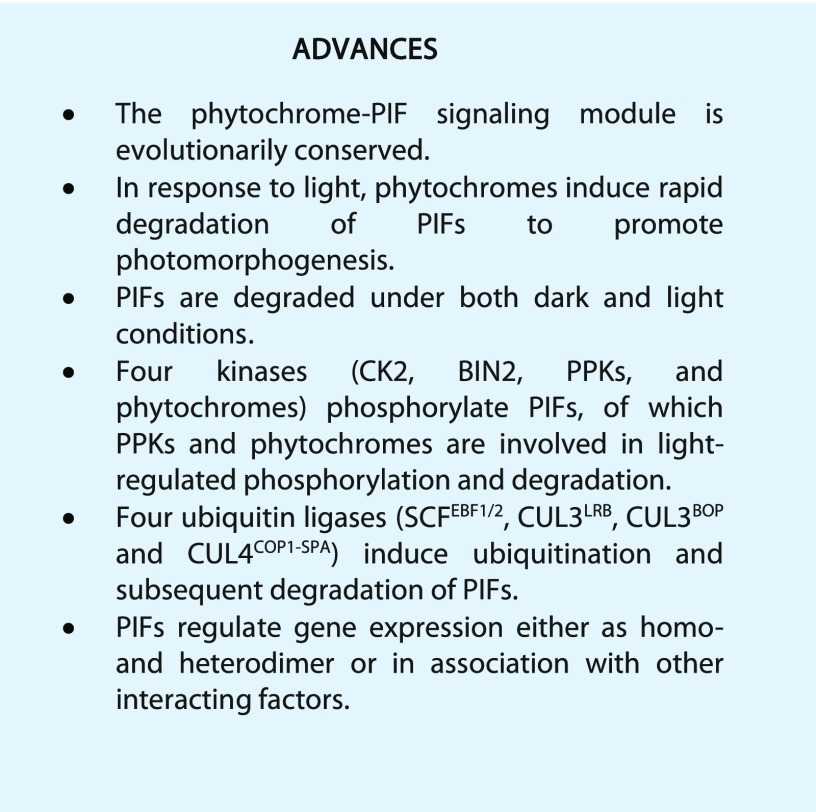
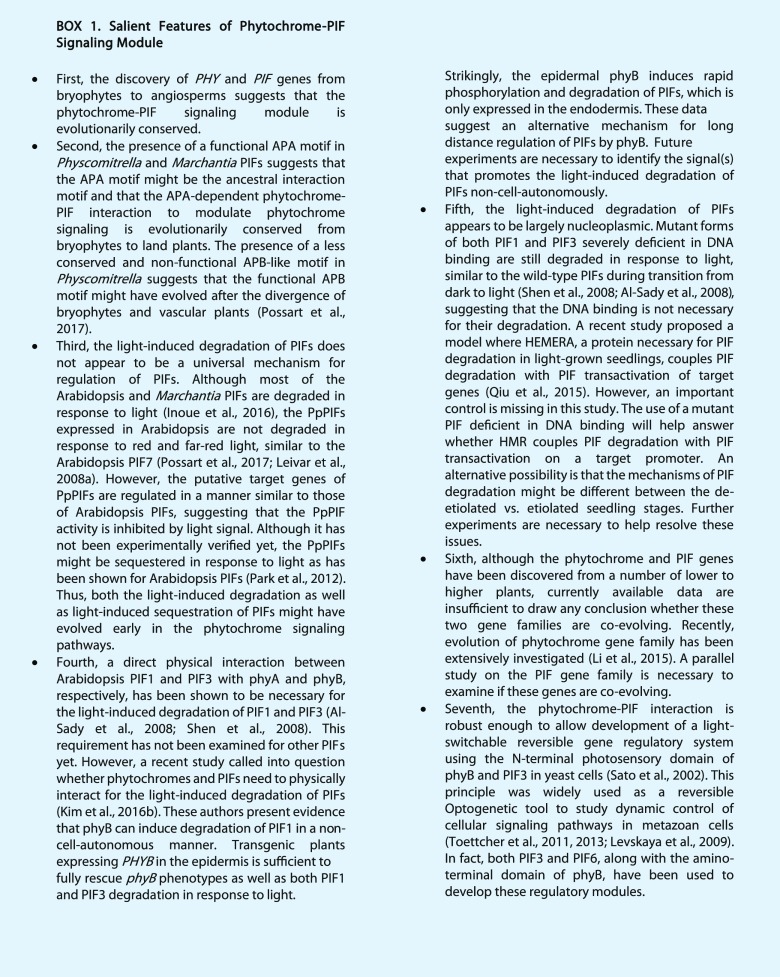
The basic helix-loop-helix domain-containing transcription factors that interact physically with the red and far-red light photoreceptors, phytochromes, are called PHYTOCHROME INTERACTING FACTORS (PIFs). In the last two decades, the phytochrome-PIF signaling module has been shown to be conserved from Physcomitrella patens to higher plants. Exciting recent studies highlight the discovery of at least four distinct kinases (PPKs, CK2, BIN2, and phytochrome itself) and four families of ubiquitin ligases (SCFEBF1/2, CUL3LRB, CUL3BOP, and CUL4COP1-SPA) that regulate PIF abundance both in dark and light conditions. This review discusses these recent discoveries with a focus on the central phytochrome signaling mechanisms that have a profound impact on plant growth and development in response to light.


Figures

Figure 1.
Figure 1.
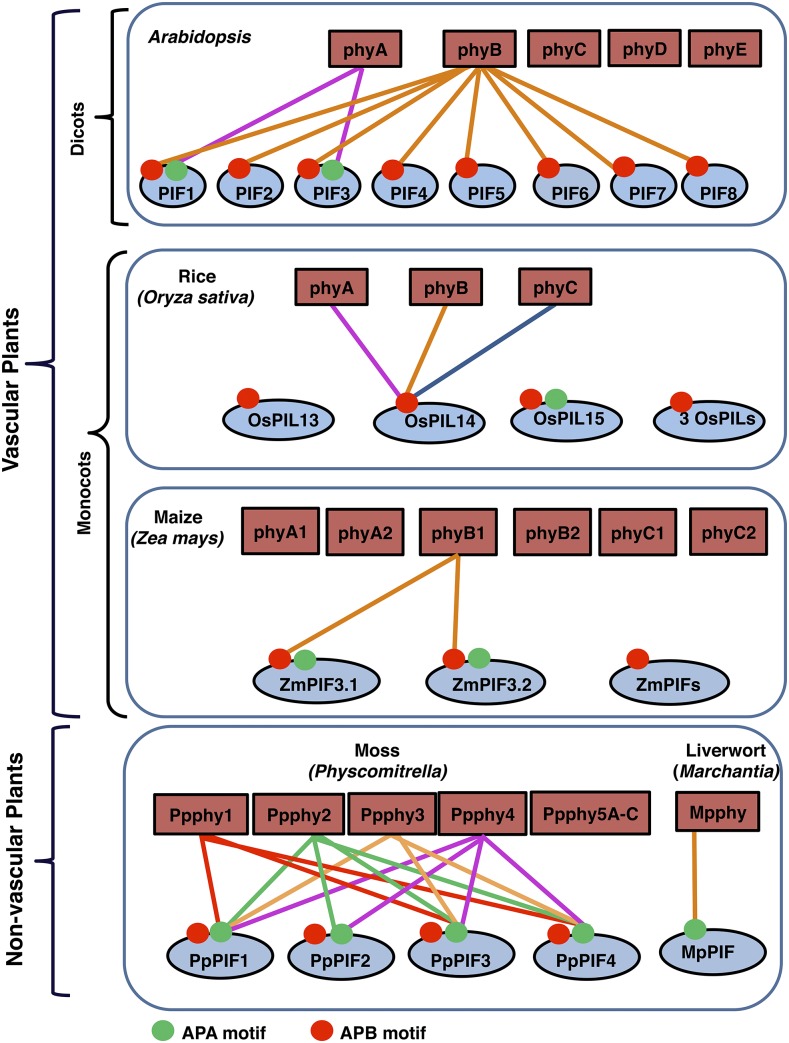
The phytochrome-PIF signaling module in land plants. Schematic illustration shows the interactions between various phytochromes and PIFs from nonvascular plants to vascular plants. The schematic is based on available data on the diversification of phytochromes and PIFs in land plants. Connecting lines with the same color illustrate the interaction of each phytochrome with different PIFs. The red and green circles on different PIFs indicate the active phyB-binding (APB) and active phyA-binding (APA) motifs, respectively.
Figure 2.
Figure 2.
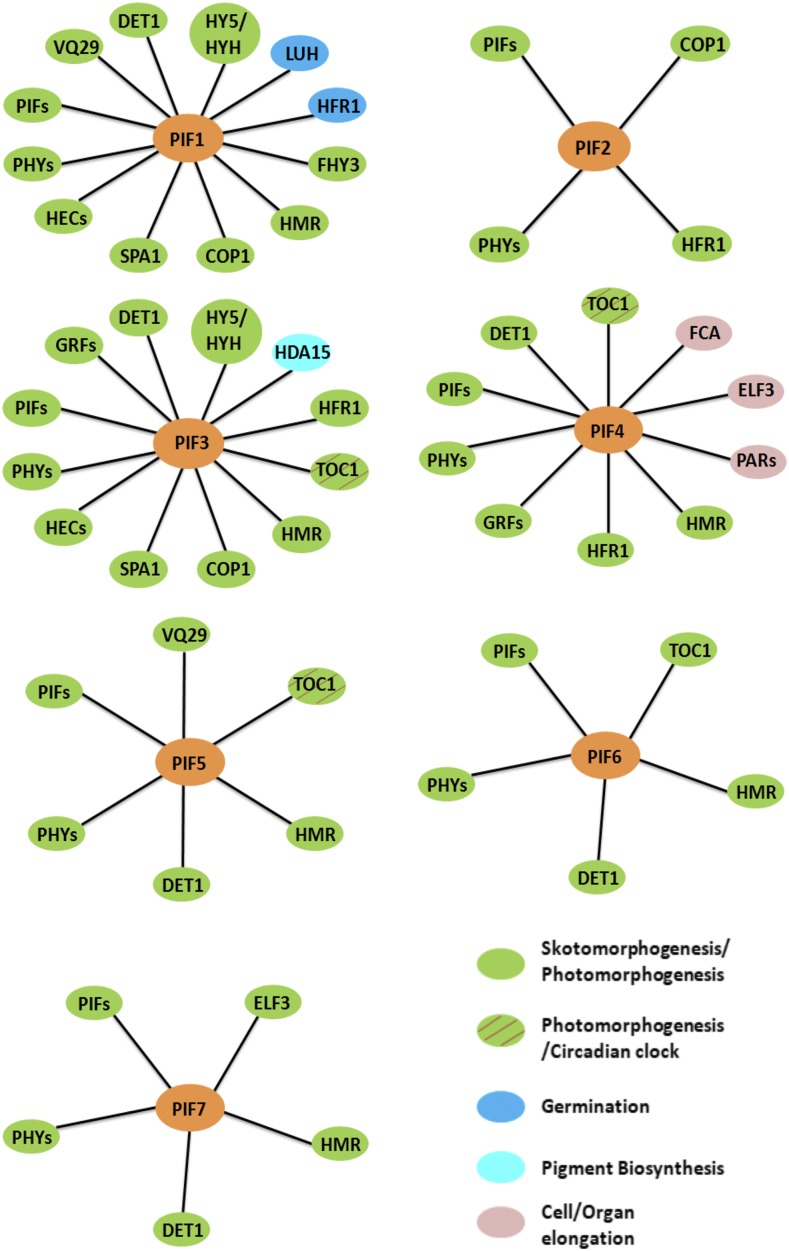
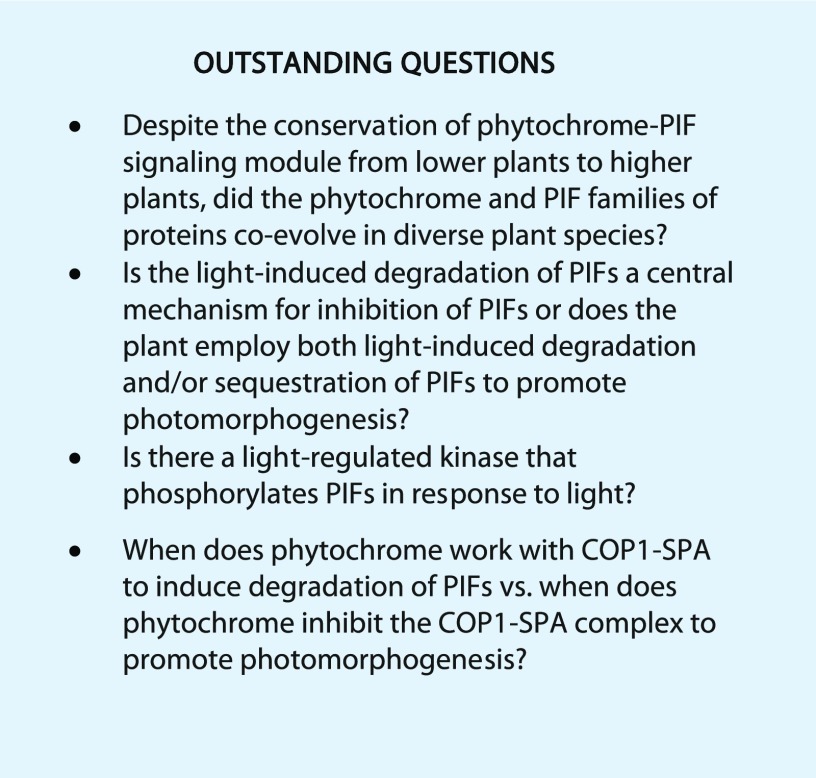
Distinct and shared biological functions of PIFs in Arabidopsis. PIFs function as negative regulators of light signaling as well as important modulators of plant growth and development. Different PIFs interact with a number of common but also distinct interacting partners to regulate seed germination, cell and organ elongation, photosynthesis, pigment biosynthesis, and also the integration of light and circadian clock signaling. Contrary to the generally accepted functions of PIFs as negative regulators of photomorphogenesis, PIF6 functions as a positive regulator of photomorphogenesis. The distinct and shared biological functions of PIF-interacting proteins are shown in solid color ovals and/or hatched ovals.
Figure 3.
Figure 3.
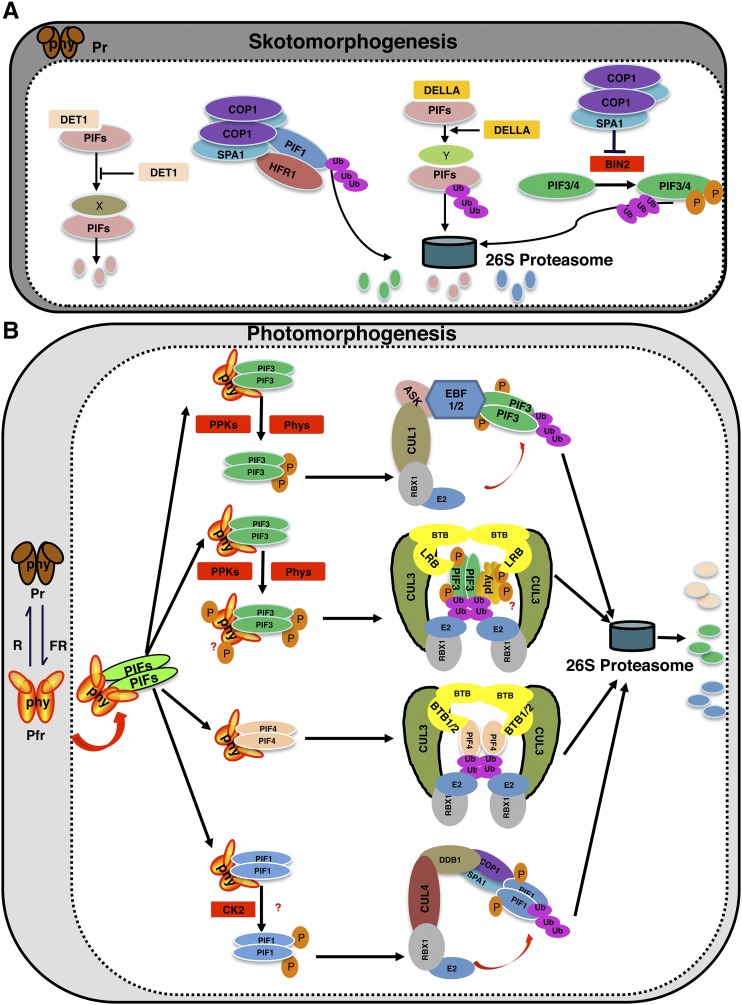
Dynamic regulation of PIF levels in dark and light. Model shows the mechanisms of light-dependent phosphorylation and degradation of PIFs by various kinases and E3 ubiquitin ligases. A, In the dark, DET1 interacts with PIFs and stabilizes them by an unknown mechanism. PIF1 also forms a heterodimer with HFR1, thereby triggering the codegradation of both HFR1 and PIF1. COP1 function is necessary for this codegradation of PIF1 and HFR1. Moreover, DELLAs negatively regulate PIF abundance by promoting PIF degradation through the 26S proteasome-dependent pathway both in dark and light conditions. In addition, the COP1-SPA complex promotes the stability of PIF3 by inhibiting the BIN2-mediated phosphorylation and degradation of PIF3 and PIF4. X and Y indicate unknown factors necessary for DET1- and DELLA-induced degradation of PIFs in the dark, respectively. B, Upon light exposure, different PIFs are phosphorylated by different protein kinases, including PPKs, phytochromes, and possibly other kinases, which triggers ubiquitination by different E3 ubiquitin ligase complexes followed by degradation through the 26S proteasome pathway. The ubiquitination and degradation of PIF1, PIF3, and PIF4 involve CUL4, CUL1, and CUL3-based E3 ubiquitin ligase complexes, respectively.
Figure 4.
Figure 4.
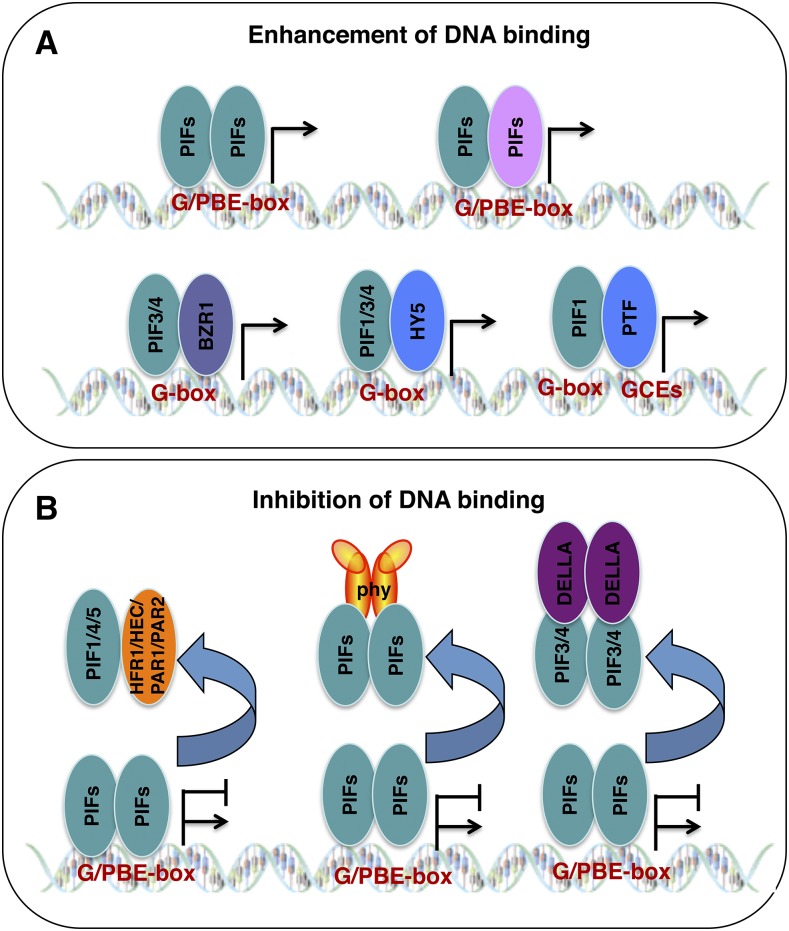
Modulation of the DNA-binding and transcriptional activities of PIFs. PIF-interacting proteins control the transcriptional activities of PIFs either by activating or inhibiting PIF’s capacity to bind directly to DNA. A, PIFs can bind to the G/PBE-box as a homodimer and/or a heterodimer with other PIFs. PIF interactions with other proteins, including BZR1 and HY5, regulate the DNA-binding and transcriptional activities of PIFs. In addition, PIF-interacting transcription factors (PTFs; e.g. group A bZIP proteins) modulate the DNA-binding and transcriptional activities of PIFs by binding to nearby G-box coupling elements (GCEs). B, Various factors inhibit the DNA-binding and subsequent transcriptional activities of PIFs either by forming heterodimers (e.g. HFR1/HEC2/PAR1/PAR2) or by direct physical interactions with PIFs followed by sequestration (e.g. phytochromes and DELLA proteins).
None
None
None

References

    1. Al-Sady B, Kikis EA, Monte E, Quail PH (2008) Mechanistic duality of transcription factor function in phytochrome signaling. Proc Natl Acad Sci USA 105: 2232–2237 - PMC - PubMed
    1. Al-Sady B, Ni W, Kircher S, Schäfer E, Quail PH (2006) Photoactivated phytochrome induces rapid PIF3 phosphorylation prior to proteasome-mediated degradation. Mol Cell 23: 439–446 - PubMed
    1. Bae G, Choi G (2008) Decoding of light signals by plant phytochromes and their interacting proteins. Annu Rev Plant Biol 59: 281–311 - PubMed
    1. Bernardo-García S, de Lucas M, Martínez C, Espinosa-Ruiz A, Davière JM, Prat S (2014) BR-dependent phosphorylation modulates PIF4 transcriptional activity and shapes diurnal hypocotyl growth. Genes Dev 28: 1681–1694 - PMC - PubMed
    1. Bu Q, Castillon A, Chen F, Zhu L, Huq E (2011a) Dimerization and blue light regulation of PIF1 interacting bHLH proteins in Arabidopsis. Plant Mol Biol 77: 501–511 - PubMed

Publication types

MeSH terms