. 2017 Nov 14;8(1):1290.
doi: 10.1038/s41467-017-01410-w.

Strategies for feeding the world more sustainably with organic agriculture

Affiliations

Strategies for feeding the world more sustainably with organic agriculture

Adrian Muller et al. Nat Commun. .

Abstract

Organic agriculture is proposed as a promising approach to achieving sustainable food systems, but its feasibility is also contested. We use a food systems model that addresses agronomic characteristics of organic agriculture to analyze the role that organic agriculture could play in sustainable food systems. Here we show that a 100% conversion to organic agriculture needs more land than conventional agriculture but reduces N-surplus and pesticide use. However, in combination with reductions of food wastage and food-competing feed from arable land, with correspondingly reduced production and consumption of animal products, land use under organic agriculture remains below the reference scenario. Other indicators such as greenhouse gas emissions also improve, but adequate nitrogen supply is challenging. Besides focusing on production, sustainable food systems need to address waste, crop-grass-livestock interdependencies and human consumption. None of the corresponding strategies needs full implementation and their combined partial implementation delivers a more sustainable food future.


Conflict of interest statement

The authors declare no competing financial interests.

Figures
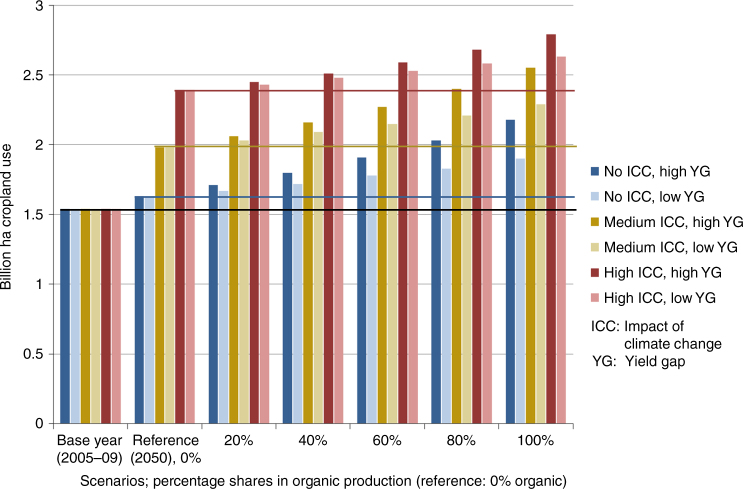
Fig. 1
Fig. 1
Cropland occupation. Cropland occupation (billion ha) for the base year (average 2005–09), the reference scenario 2050 (0% organic) and scenarios with increasing percentages of organic production. Displays scenarios with low and high yield gaps, without, with medium and with full impacts of climate change on yields (no/medium/high ICC)
Fig. 2
Fig. 2
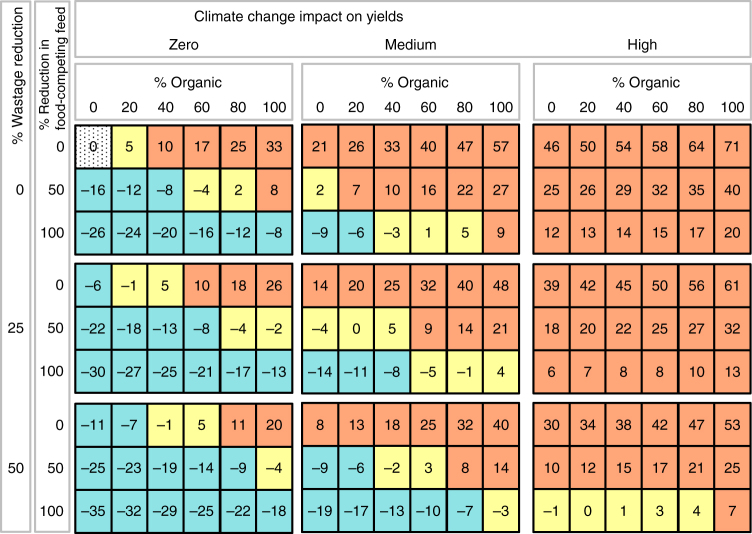
Cropland area change. Percentage change in cropland areas with respect to the reference scenario. Scenarios differ in: organic shares (0–100%), impacts of climate change on yields (low, medium, high), food-competing feed reductions (0, 50, 100% reduced from the levels in the reference scenario), and wastage reduction (0, 25, 50% compared to the reference scenario). Colour code for comparison to the reference scenario value (i.e. 0% organic agriculture, no changes in livestock feed and food waste, dotted grey): > +5%: red, < −5% blue, between −5% and +5% yellow; in the reference scenario, cropland areas are 6% higher than in the baseline today
Fig. 3
Fig. 3
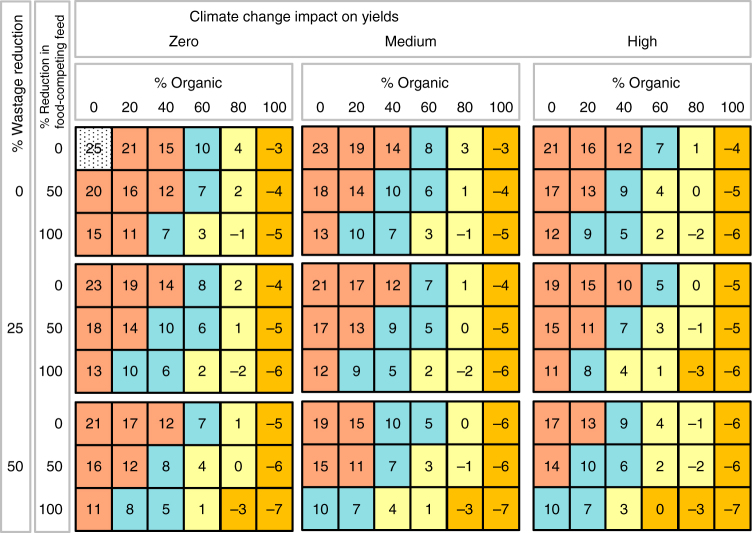
Nitrogen balance. N-surplus (positive values) or deficit (negative values) in kg N/ha. Scenarios differ in: organic shares (0–100%), climate change impacts (low, medium, high), food-competing feed reductions (0, 50, 100% reduced from the levels in the reference scenario), and wastage reduction (0, 25, 50% compared to the reference scenario). Colour code for comparison to the reference scenario value (i.e. 0% organic agriculture, no changes in livestock feed and food waste, dotted grey): >10 kg/ha: red (unsustainably high), between 10 kg/ha and 5 kg/ha blue (optimum, reduction from current average surplus by 60–80%,, ), between 5 kg/ha and −2kg /ha yellow (critical, rather low), < −2 kg/ha orange (deficit)
Fig. 4
Fig. 4
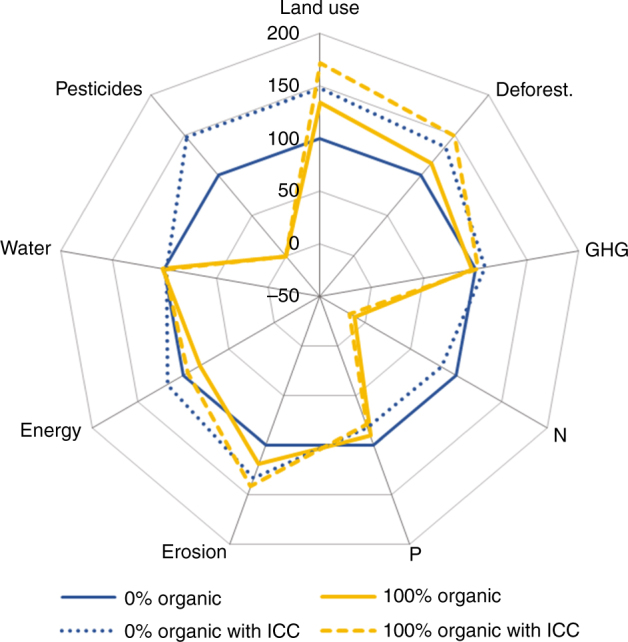
Year 2050 environmental impacts of a full conversion to organic agriculture. Environmental impacts of organic scenarios (100% organic agriculture, yellow lines) are shown relative to the reference scenario (0% organic agriculture, blue lines), with (dotted lines) and without (solid lines) impacts of climate change on yields; Calories are kept constant for all scenarios. Indicators displayed: cropland use, deforestation, GHG emissions (incl. deforestation, organic soils), N-surplus and P-surplus, water use, non-renewable energy use, soil erosion, pesticide use
Fig. 5
Fig. 5
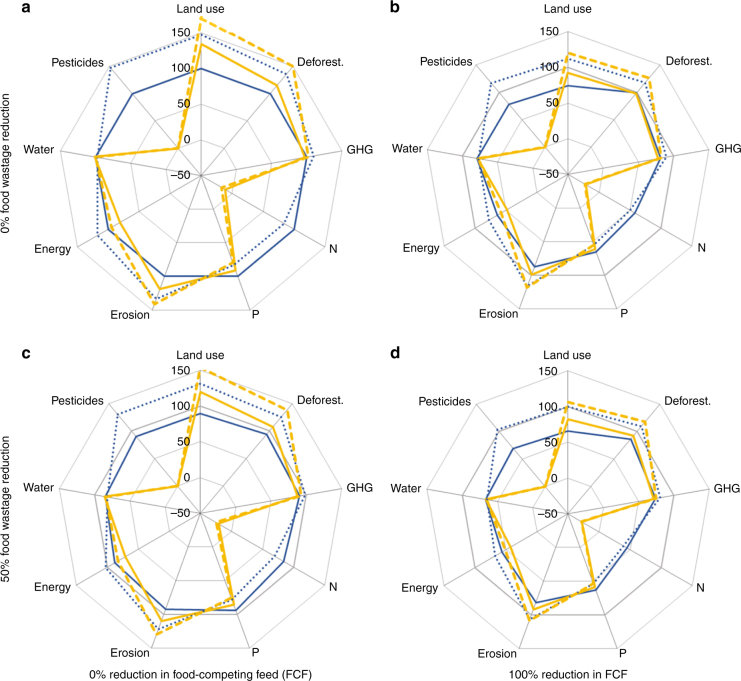
Year 2050 relative environmental impacts of a full conversion to organic agriculture in combination with complementary food systems strategies. Environmental impacts of organic (100% organic agriculture, yellow lines) and conventional (0% organic agriculture, blue lines) scenarios with concomitant changes in livestock feed and food waste strategies. All scenarios are shown relative to the reference scenario (i.e. 0% organic agriculture, no changes in livestock feed and food waste; dark grey line), with (dotted lines) and without (solid lines) impacts of climate change on yields; Calories are kept constant for all scenarios. The numbers on the axis indicate % impact, relative to the reference scenario; Calories are kept constant for all scenarios without food wastage reduction. Food-competing feed (FCF) use is at the levels of the reference scenario on the left, a and c, and changes towards zero FCF use to the right, b and d; wastage reduction changes from 0%, top a and b, to 50%, bottom c and d. Indicators displayed: cropland use, deforestation, GHG emissions (incl. deforestation, organic soils), N-surplus and P-surplus, water use, non-renewable energy use, soil erosion, pesticide use. Results for intermediate scenarios (50% reduction in FCF and 25% food wastage reduction) are displayed in Supplementary Fig. 10

References

    1. Canfield D, Glazer A, Falkowski P. The evolution and future of earth’s nitrogen cycle. Science. 2010;330,:192–196. doi: 10.1126/science.1186120. - DOI - PubMed
    1. Smith P, et al. How much land based greenhouse gas mitigation can be achieved without compromising food security and environmental goals? Global Change Biol. 2013;19:18. - PubMed
    1. Evenson RE, Gollin D. Assessing the impact of the green revolution, 1960–2000. Science. 2003;300:758–762. doi: 10.1126/science.1078710. - DOI - PubMed
    1. IAASTD. Agriculture at a Crossroads: The Global Report (Island Press, Washington DC, USA, 2009).
    1. Pingali PL. Green revolution: impacts, limits, and the path ahead. Proc. Natl Acad. Sci. USA. 2012;109:12302–12308. doi: 10.1073/pnas.0912953109. - DOI - PMC - PubMed

Publication types

LinkOut - more resources