. 2017 Nov 14;7(1):15557.
doi: 10.1038/s41598-017-15871-y.

TALEN-mediated shift of mitochondrial DNA heteroplasmy in MELAS-iPSCs with m.13513G>A mutation

Affiliations

TALEN-mediated shift of mitochondrial DNA heteroplasmy in MELAS-iPSCs with m.13513G>A mutation

Naoki Yahata et al. Sci Rep. .

Erratum in

Abstract

Induced pluripotent stem cells (iPSCs) are suitable for studying mitochondrial diseases caused by mitochondrial DNA (mtDNA) mutations. Here, we generated iPSCs from a patient with mitochondrial myopathy, encephalopathy, lactic acidosis, and stroke-like episodes (MELAS) with the m.13513G>A mutation. The patient's dermal fibroblasts were reprogrammed, and we established two iPSC clones with and without mutant mtDNA. Furthermore, we tried to decrease mutant mtDNA level in iPSCs using transcription activator-like effector nucleases (TALENs). We originally engineered platinum TALENs, which were transported into mitochondria, recognized the mtDNA sequence including the m.13513 position, and preferentially cleaved G13513A mutant mtDNA (G13513A-mpTALEN). The m.13513G>A heteroplasmy level in MELAS-iPSCs was decreased in the short term by transduction of G13513A-mpTALEN. Our data demonstrate that this mtDNA-targeted nuclease would be a powerful tool for changing the heteroplasmy level in heteroplasmic iPSCs, which could contribute to elucidation of the pathological mechanisms of mitochondrial diseases caused by mtDNA mutations.


Conflict of interest statement

The authors declare that they have no competing interests.

Figures
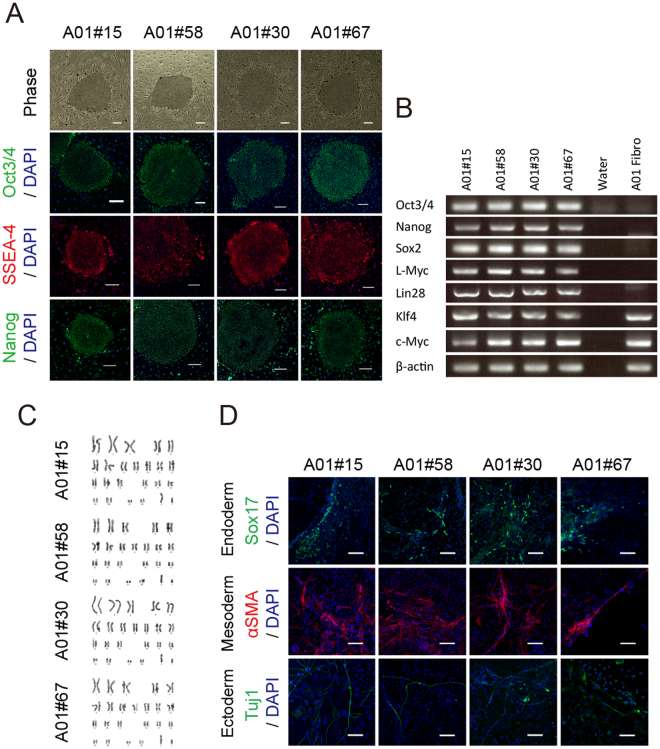
Figure 1
Figure 1
Establishment of human iPSCs from MELAS patient with m.13513G>A mutation. (A) Morphological features and expression of human ESC markers. All A01 MELAS-iPSC clones are identical to human ESCs. All iPSC clones expressed the human ESC markers Oct3/4 (green), SSEA-4 (red) and Nanog (green) analyzed by immunocytochemical analysis. Phase, phase-contrast image. Scale bar, 200 μm. (B) RT-PCR analyses of pluripotency markers and reprogramming factors (Oct3/4, Nanog, Sox2, L-Myc, Lin28, Klf4 and c-Myc). β-actin serves as a loading control. (C) Karyotype analysis revealed that all hiPSCs had a preserved normal karyotype. (D) In vitro differentiation of MELAS-iPSCs into all three germ layers. Sox17 (endoderm, green), αSMA (mesoderm, red) and Tuj1 (ectoderm, green). Scale bar, 100 μm.
Figure 2
Figure 2
Characterization of mtDNA in A01 MELAS-iPSCs. (A) Genetic analysis of A01 fibroblasts and MELAS-iPSCs at passage 5 by Sanger sequencing. Arrows indicate m.13513 position. (B) RFLP analysis of A01 fibroblasts and MELAS-iPSCs. The 120 bp and 93 bp + 27 bp fragments indicate the presence of mutant and wild-type mtDNA, respectively. Heteroplasmy level of m.13513G>A mtDNA (C) analyzed by ARMS-qPCR and mtDNA copy number (D) in A01 fibroblasts and MELAS-iPSCs. MELAS-iPSCs were collected at the following passage numbers: #15 at p5 and p20; #58 at p5 and p20; #30 at p5, p12, p20, p31 and p43; #67 at p5, p12, p21, p33 and p45.
Figure 3
Figure 3
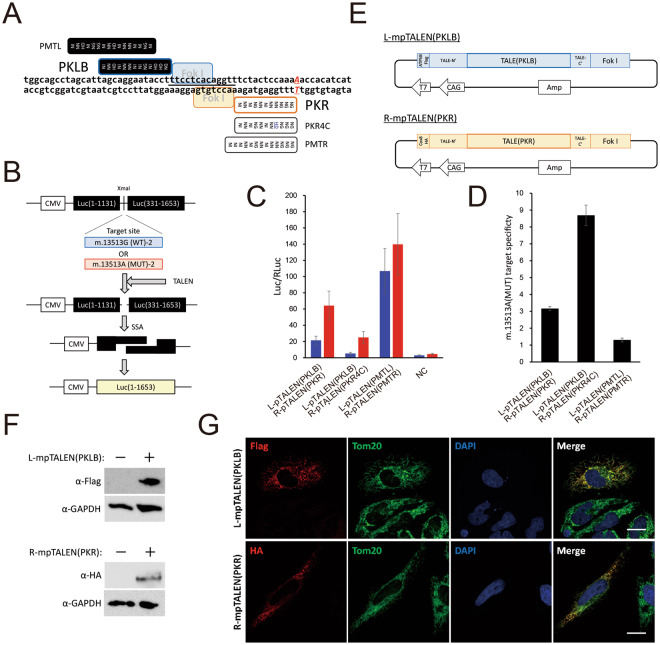
Generation of G13513A-mpTALEN. (A) Schematic illustration of target site of G13513A-pTALEN. Black and white boxes indicate RVDs of L-pTALEN and R-pTALEN, respectively. Letters beside box indicate TALE’s name. Black bar indicates spacer region of L-pTALEN(PKLB)/R-pTALEN(PKR) pair. (B) Scheme of SSA assay. The reporter plasmid encodes a part of the mtDNA sequence including m.13513G or m.13513A, named m.13513 G(WT)-2 or m.13513A(MUT)-2, which is sandwiched by two split inactive parts of the luciferase gene with overlapping repeated sequences. Following a double strand break caused by TALENs, a functional luciferase gene is generated by an SSA reaction. (C) Evaluation of SSA activity (Luc/RLuc) of pTALEN pairs. Blue and red bars reflect cleaving activity against m.13513 G(WT)-2 and m.13513A(MUT)-2, respectively. NC, negative control. Data are expressed as mean SEM (n = 3). (D) m.13513A(MUT) target specificity of each L-pTALEN/R-pTALEN pair. Data are expressed as mean SEM (n = 3). (E) Components of plasmids used to express L-mpTALEN(PKLB) and R-mpTALEN(PKR) monomers. (F) Western blotting of lysed HEK293T cells transfected with plasmid coding L-mpTALEN(PKLB) or R-mpTALEN(PKR) for 2 days. L-mpTALEN(PKLB) or R-mpTALEN(PKR) was detected using anti-Flag or anti-HA antibodies, respectively. GAPDH serves as a loading control. (G) Intracellular localization of mpTALENs analyzed by immunocytochemical analysis. L-mpTALEN(PKLB) or R-mpTALEN (PKR) was transiently expressed in HeLa cells. Two days after transfection, L-mpTALEN(PKLB) or R-mpTALEN(PKR) was stained using anti-Flag or anti-HA antibodies, respectively (red). Mitochondria were stained using anti-TOM20 antibodies (green). Nuclei were stained with DAPI (blue). Scale bar, 20 μm.
Figure 4
Figure 4
Decrease of m.13513G>A heteroplasmy level in MELAS-iPSCs by G13513A-mpTALEN. (A) Experimental scheme. MELAS-iPSCs (#67) subcultured at the same time were transfected with plasmids coding L-mpTALEN(PKLB) and R-mpTALEN(PKR) and EGFP (n = 3). EGFP-positive and live cells sorted at day 2 after transfection, named L-mpTALEN(PKLB)/R-mpTALEN(PKR), were compared with sorted cells transfected with twice the amount of plasmid coding L-mpTALEN(PKLB), named L-mpTALEN(PKLB)/L-mpTALEN(PKLB), and untreated cells. (B; left) m.13513G>A heteroplasmy level was analyzed by ARMS-qPCR. Data are expressed as mean ± SEM (n = 3). *p < 0.05, **p < 0.01, Tukey’s test. (B; right) Sanger-sequence analysis. Arrow indicates m.13513 position. (C) MtDNA copy numbers of L-mpTALEN(PKLB)/R-mpTALEN(PKR) are represented relative to those of L-mpTALEN(PKLB)/L-mpTALEN(PKLB). Data are expressed as mean ± SEM (n = 3). ***p < 0.005, Student’s t-test.

References

    1. Stewart JB, Chinnery PF. The dynamics of mitochondrial DNA heteroplasmy: implications for human health and disease. Nature reviews. Genetics. 2015;16:530–542. doi: 10.1038/nrg3966. - DOI - PubMed
    1. Iizuka, T. & Sakai, F. Pathogenesis of stroke-like episodes in MELAS: analysis of neurovascular cellular mechanisms. Current neurovascular research2, 29–45, https://doi.org/10.2174/1567202052773544 (2005). - DOI - PubMed
    1. Wang YX, Le WD. Progress in diagnosing mitochondrial myopathy, encephalopathy, lactic acidosis, and stroke-like episodes. Chinese medical journal. 2015;128:1820–1825. doi: 10.4103/0366-6999.159360. - DOI - PMC - PubMed
    1. Takahashi, K. et al. Induction of pluripotent stem cells from adult human fibroblasts by defined factors. Cell131, 861–872, 10.1016/j.cell.2007.11.019 (2007). - PubMed
    1. Gaj T, Gersbach CA, Barbas CF., 3rd ZFN, TALEN, and CRISPR/Cas-based methods for genome engineering. Trends in biotechnology. 2013;31:397–405. doi: 10.1016/j.tibtech.2013.04.004. - DOI - PMC - PubMed

Substances