


Early postoperative delirium after hemiarthroplasty in elderly patients aged over 70 years with displaced femoral neck fracture
- PMID: 29138544
- PMCID: PMC5680947
- DOI: 10.2147/CIA.S147585
Early postoperative delirium after hemiarthroplasty in elderly patients aged over 70 years with displaced femoral neck fracture
Abstract
Purpose: Postoperative delirium is a risk factor for worse outcome after hip fracture surgery in elderly patients. Postoperative delirium is associated with anesthesia, postoperative pain, and patient factors. We investigated the incidence, predictors, and prognostic implications of post-operative delirium after hemiarthroplasty (HA) in elderly patients with femoral neck fracture.
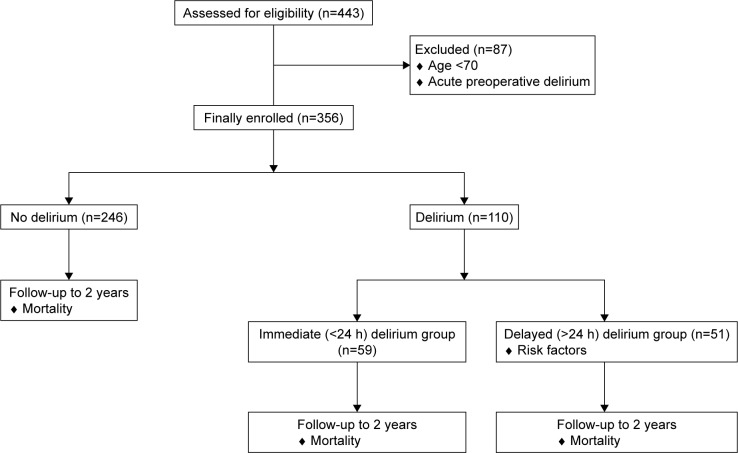
Patients and methods: A total of 356 consecutive patients aged >70 years who underwent HA for femoral neck fracture were enrolled. Diagnosis of delirium was made by a psychiatrist based on patient status and an objective scoring system. The patients were divided into 2 categories according to the HA onset time (immediate [≤24 h after surgery] vs delayed delirium [>24 h after surgery]) and its incidence, predictors and mortality were evaluated.
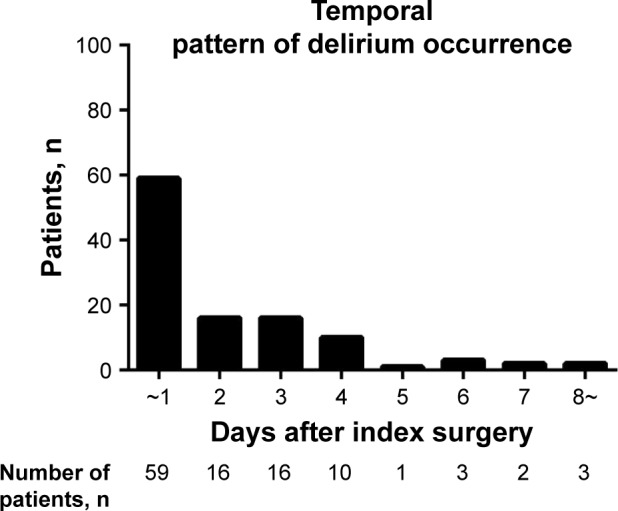
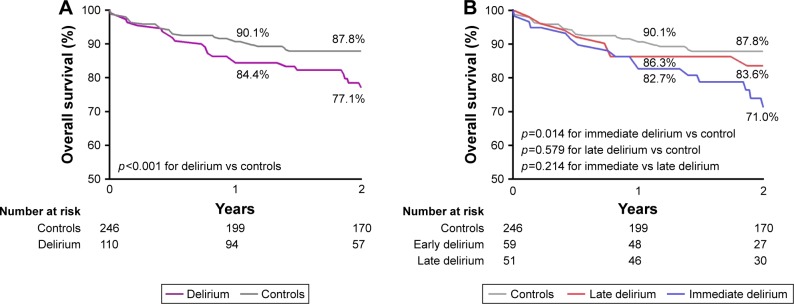
Results: Postoperative delirium was diagnosed in 110 patients (30.9%) during hospitalization. Immediate and delayed delirium occurred in 59 (53.6%), and 51 (46.4%) patients, respectively. The independent predictors of immediate delirium included age (odds ratio [OR] 1.47, 95% CI 0.98-2.23, p=0.066), and general anesthesia (OR 2.25, 95% CI 1.17-4.43, p=0.015). The independent predictors of delayed delirium were parkinsonism (OR 5.75, 95% CI 1.66-19.96, p=0.006), intensive care unit stay (OR 1.85, 95% CI 0.97-3.56, p=0.064), and higher American Society of Anesthesiologists grade (OR 2.33, 95% CI 0.90-6.07, p=0.083). On Kaplan-Meier survival analysis, the 2-year survival rate was significantly lower in the immediate delirium group than those in the delayed and control groups (71.0% vs 83.6% vs 87.8%, respectively; p=0.031).
Conclusion: Immediate and delayed delirium after HA for femoral neck fracture had different predictors and immediate delirium was associated with worse prognosis.
Keywords: delirium; elderly patients; femoral neck fracture; hemiarthroplasty.
Conflict of interest statement
Disclosure All authors report no conflict of interest in this work.
Figures
References
-
- Zlowodzki M, Tornetta P, III, Haidukewych G, et al. Femoral neck fractures: evidence versus beliefs about predictors of outcome. Orthopedics. 2009;32(4):260–267. - PubMed
-
- Foss NB, Kehlet H. Mortality analysis in hip fracture patients: implications for design of future outcome trials. Br J Anaesth. 2005;94(1):24–29. - PubMed
-
- Krenk L, Rasmussen LS. Postoperative delirium and postoperative cognitive dysfunction in the elderly-what are the differences? Minerva Anesthesiol. 2011;77(7):742–749. - PubMed
-
- Ely EW, Shintani A, Truman B, et al. Delirium as a predictor of mortality in mechanically ventilated patients in the intensive care unit. JAMA. 2004;291(14):1753–1762. - PubMed
MeSH terms
LinkOut - more resources
Full Text Sources
Other Literature Sources
Medical
