. 2017 Oct 26:12:7885-7896.
doi: 10.2147/IJN.S141882. eCollection 2017.

Photoactivatable RNAi for cancer gene therapy triggered by near-infrared-irradiated single-walled carbon nanotubes

Affiliations

Photoactivatable RNAi for cancer gene therapy triggered by near-infrared-irradiated single-walled carbon nanotubes

Xueling Ren et al. Int J Nanomedicine. .

Abstract

The efficacy of RNA interference (RNAi)-based cancer gene therapy is limited by its unexpected side effects, thus necessitating a strategy to precisely trigger conditional gene knockdown. In this study, we engineered a novel photoactivatable RNAi system, named as polyetherimide-modified single-wall carbon nanotube (PEI-SWNT)/pHSP-shT, that enables optogenetic control of targeted gene suppression in tumor cells. PEI-SWNT/pHSP-shT comprises a stimulus-responsive nanocarrier (PEI-SWNT), and an Hsp70B'-promoter-driven RNAi vector (pHSP-shT). In response to near-infrared (NIR) light irradiation, heating of PEI-SWNT in breast MCF-7 cells triggered gene knockdown targeting human telomerase reverse transcriptase through RNAi, with the gene-knockdown activity capable of being switched off by extinguishing the NIR. Furthermore, we demonstrated that the photoactivatable RNAi system exhibited higher antitumor activity by combining gene therapy and photothermal therapy, both in vitro and in vivo. Optogenetic control of RNAi based on an NIR-activated nanocarrier will potentially facilitate improved understanding of molecular-targeted gene therapy in human malignant tumors.

Keywords: Hsp70B′ promoter; RNAi; SWNT; near-infrared light response.


Conflict of interest statement

Disclosure The authors report no conflicts of interest in this work.

Figures
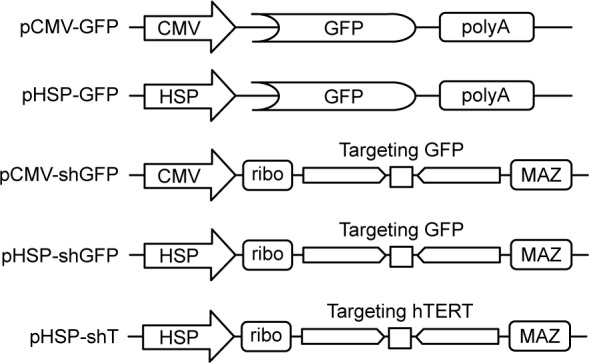
Figure 1
Figure 1
Schematic representation of plasmids used in this work. pCMV-GFP and pHSP-GFP are GFP expression plasmids with different promoters (CMV or Hsp70B′, respectively). pCMV-shGFP is a CMV-promoter-driven short hairpin RNA (shRNA) expression construct consisting of the cis-acting hammerhead ribozyme (ribo) immediately downstream of the CMV promoter, a gene-specific shRNA cassette targeting GFP, and a specific pausing site MAZ. pHSP-shGFP and pHSP-shT, structurally similar to pCMV-shGFP, are heat-inducible RNAi vectors containing the Hsp70B′ promoter. Abbreviations: GFP, green fluorescent protein; CMV, cytomegalovirus; HSP, heat-shock protein; sh, short hairpin.
Figure 2
Figure 2
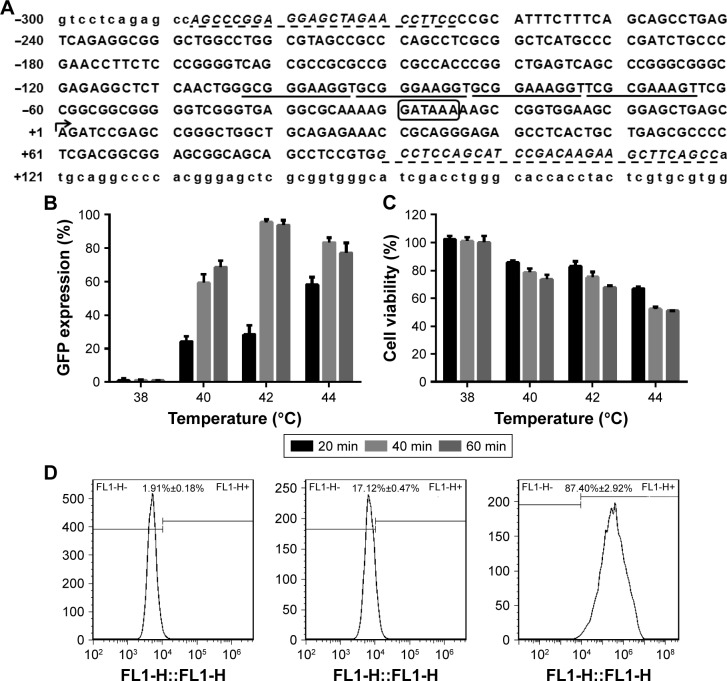
(A) The 5′-flanking sequence of the human Hsp70B′ gene (GenBank accession: NT004487). The promoter sequence used in this work is shown in uppercase letters. Nucleotides matching the primers used for PCR amplification are in italics and indicated by dashed underlines. Four consecutive heat-shock-element sequences are underlined. The GATA box sequence is shown by a solid box. The transcription start site is represented by an arrow. (B) GFP expression and (C) cell viability of MCF-7 cells transfected with pHSP-GFP after heat-shock treatment at different temperatures and times. (D) Knockdown of GFP expression by pHSP-shGFP in MCF-7 cells. The indicated RNAi plasmid pHSP-shGFP was co-transfected into MCF-7 cells with the GFP expression plasmid pCMV-GFP at a ratio of 1:1. At 24 h post-transfection, MCF-7 cells were treated with (middle) or without (right) heat-shock at 42°C for 40 min, with untransfected MCF-7 cells used as controls (left). Abbreviations: GFP, green fluorescent protein; HSP, heat-shock protein; PCR, polymerase chain reaction; sh, short hairpin.
Figure 3
Figure 3
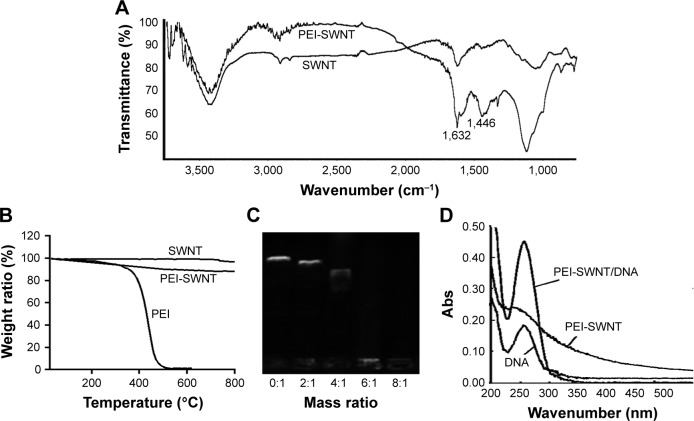
Characterization of PEI-SWNT by using (A) FTIR spectroscopy and (B) TGA. (C) Gel retardation of PEI-SWNT/DNA at different mass ratios. (D) UV-Vis spectrogram of PEI-SWNT/DNA. Abbreviations: Abs, absorbance; FTIR, Fourier transform infrared; PEI, polyetherimide; PEI-SWNT, polyetherimide-modified single-wall carbon nanotube; SWNT, single-wall carbon nanotube; TGA, thermal gravimetric analysis; UV-Vis, ultraviolet-visible.
Figure 4
Figure 4
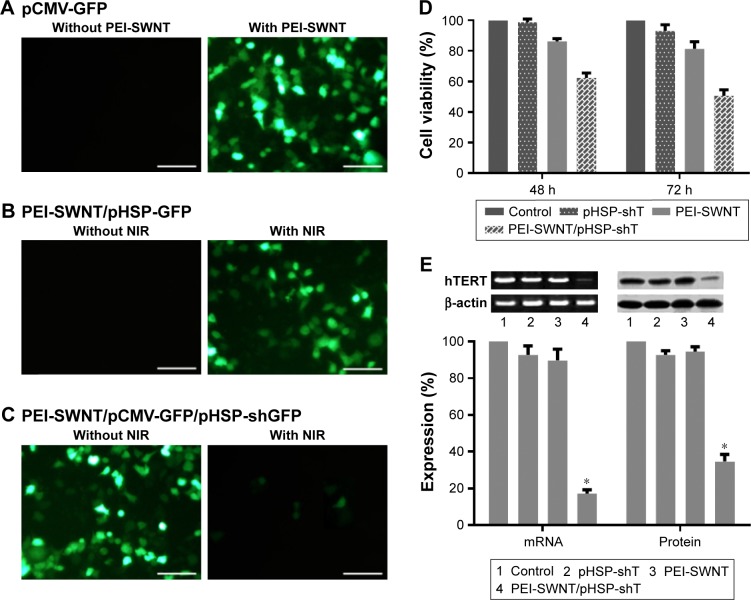
GFP expression and RNAi efficiency in MCF-7 cells. (A) The GFP expression plasmid pCMV-GFP was transfected into MCF-7 cells in the absence or presence of PEI-SWNT. (B) The Hsp70B′ promoter-driven GFP expression plasmid pHSP-GFP was loaded onto PEI-SWNT and transfected into MCF-7 cells in the absence or presence of NIR (808 nm) irradiation. (C) The heat-inducible shRNA plasmid pHSP-shGFP targeting GFP was co-transfected into MCF-7 cells with the pCMV-GFP plasmid at a ratio of 1:1, followed by conditional exposure of the transfected cells to 808 nm NIR. The scale bar is 50 μm. (D) Cell viability of MCF-7 cells transfected with pHSP-shT, PEI-SWNT, and PEI-SWNT/pHSP-shT at different times. (E) mRNA and protein expression of hTERT in MCF-7 cells. Transfections were conducted at 3 μg plasmid and 0.5 μg PEI-SWNT per well in six-well plates. Cells were treated with 808 nm laser irradiation for 45 s. *P<0.01, PEI-SWNT/pHSP-shT versus the other three groups. Abbreviations: GFP, green fluorescent protein; CMV, cytomegalovirus; HSP, heat-shock protein; NIR, near-infrared; hTERT, human telomerase reverse transcriptase; PEI-SWNT, polyetherimide-modified single-wall carbon nanotube; sh, short hairpin; shT, short hairpin RNA of human telomerase reverse transcriptase.
Figure 5
Figure 5
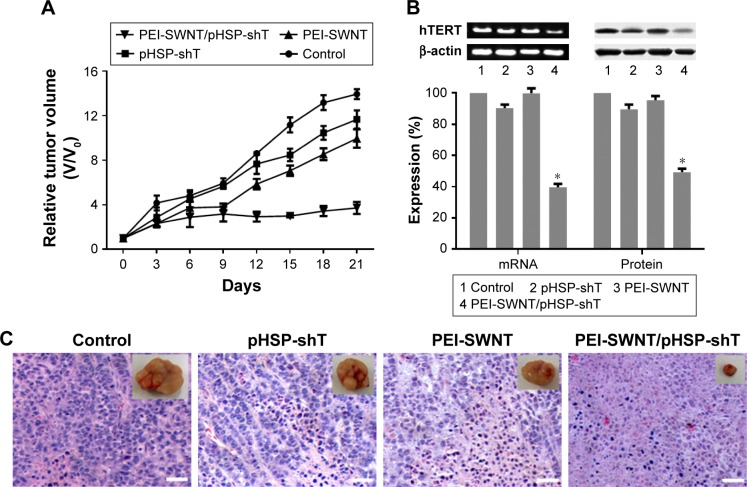
Antitumor activity in vivo. (A) Relative tumor volume in mice from different treatment groups. (B) hTERT mRNA and protein expression in MCF-7 tumor-bearing mice in vivo. *P<0.01, PEI-SWNT/pHSP-shT versus the other three groups. (C) H&E-stained tumor tissues in mice. The scale bar is 50 μm. Abbreviations: HSP, heat-shock protein; hTERT, human telomerase reverse transcriptase; PEI-SWNT, polyetherimide-modified single-wall carbon nanotube; shT, short hairpin RNA of human telomerase reverse transcriptase.
Figure 6
Figure 6
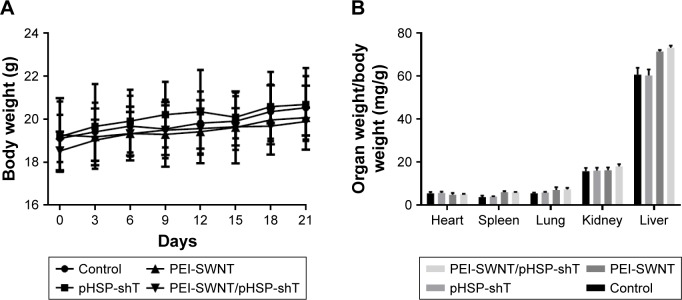
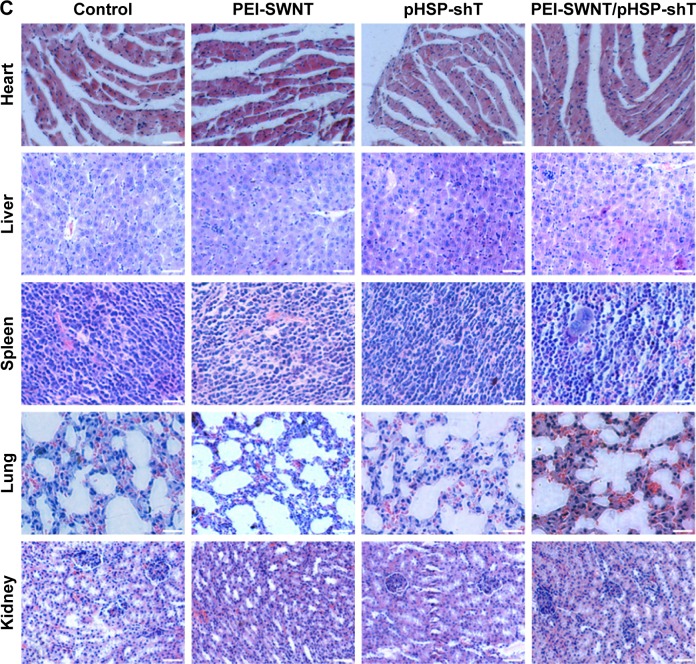
In vivo toxicity. Changes in (A) mouse body weight, and (B) organ weight. (C) H&E stained major organs harvested from mice. The scale bar is 50 μm. Abbreviations: HSP, heat-shock protein; PEI-SWNT, polyetherimide-modified single-wall carbon nanotube; shT, short hairpin RNA of human telomerase reverse transcriptase.
Figure 6
Figure 6
In vivo toxicity. Changes in (A) mouse body weight, and (B) organ weight. (C) H&E stained major organs harvested from mice. The scale bar is 50 μm. Abbreviations: HSP, heat-shock protein; PEI-SWNT, polyetherimide-modified single-wall carbon nanotube; shT, short hairpin RNA of human telomerase reverse transcriptase.

References

    1. Conde J, Ambrosome A, Hernandez Y, et al. 15 years on siRNA delivery: beyond the State-of-the-Art on inorganic nanoparticles for RNAi therapeutics. Nano Today. 2015;10(4):421–450.
    1. Guo J, Jiang X, Gui S. RNA interference-based nanosystems for inflammatory bowel disease therapy. Int J Nanomedicine. 2016;11:5287–5310. - PMC - PubMed
    1. Ding C, Tong L, Feng J, Fu J. Recent advances in stimuli-responsive release function drug delivery systems for tumor treatment. Molecules. 2016;21(12):1715. - PMC - PubMed
    1. Kim H, Chung K, Lee S, Kim DH, Lee H. Near-infrared light-responsive nanomaterials for cancer theranostics. Wiley Interdiscip Rev Nanomed Nanobiotechnol. 2016;8(1):23–45. - PubMed
    1. Li D, Ma Y, Du J, et al. Tumor acidity/NIR controlled interaction of transformable nanoparticle with biological systems for cancer therapy. Nano Lett. 2017;17(5):2871–2878. - PubMed