. 2017:2017:1092015.
doi: 10.1155/2017/1092015. Epub 2017 Sep 12.

Simvastatin Ameliorates Diabetic Cardiomyopathy by Attenuating Oxidative Stress and Inflammation in Rats

Affiliations

Simvastatin Ameliorates Diabetic Cardiomyopathy by Attenuating Oxidative Stress and Inflammation in Rats

Nawal M Al-Rasheed et al. Oxid Med Cell Longev. 2017.

Abstract

Simvastatin is a lipid-lowering agent used to treat hypercholesterolemia and to reduce the risk of heart disease. This study scrutinized the beneficial effects of simvastatin on experimental diabetic cardiomyopathy (DCM), pointing to the role of hyperglycemia-induced oxidative stress and inflammation. Diabetes was induced by intraperitoneal injection of streptozotocin and both control and diabetic rats received simvastatin for 90 days. Diabetic rats showed significant cardiac hypertrophy, body weight loss, hyperglycemia, and hyperlipidemia. Serum creatine kinase MB (CK-MB) and troponin I showed a significant increase in diabetic rats. Simvastatin significantly improved body weight, attenuated hyperglycemia and hyperlipidemia, and ameliorated CK-MB and troponin I. Simvastatin prevented histological alterations and deposition of collagen in the heart of diabetic animals. Lipid peroxidation and nitric oxide were increased in the heart of diabetic rats whereas antioxidant defenses were decreased. These alterations were significantly reversed by simvastatin. In addition, simvastatin decreased serum inflammatory mediators and expression of NF-κB in the diabetic heart. Cardiac caspase-3 was increased in the diabetic heart and decreased following treatment with simvastatin. In conclusion, our results suggest that simvastatin alleviates DCM by attenuating hyperglycemia/hyperlipidemia-induced oxidative stress, inflammation, and apoptosis.


Figures

Figure 1
Figure 1
Simvastatin attenuates body weight loss (a), cardiac hypertrophy (b), and hyperglycemia (c) in STZ-induced diabetic rats. Data are M ± SEM (N = 8). P < 05, ∗∗P < 0.01, and ∗∗∗P < 0.001. STZ: streptozotocin; SIM: simvastatin; HW: heart weight; BW: body weight; ns: nonsignificant.
Figure 2
Figure 2
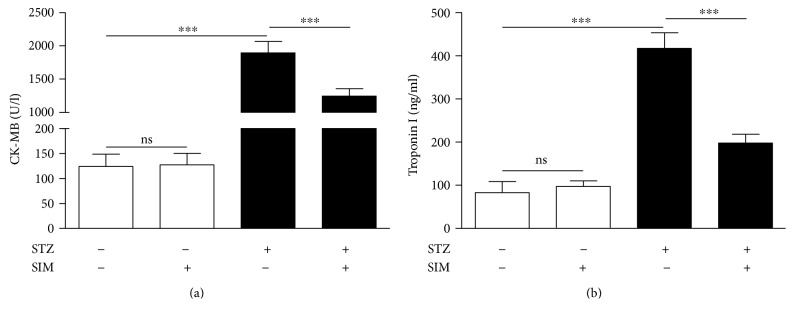
Simvastatin decreases serum CK-MB (a) and troponin I (b) levels in STZ-induced diabetic rats. Data are M ± SEM (N = 8). ∗∗∗P < 0.001. STZ: streptozotocin; SIM: simvastatin; CK-MB: creatine kinase MB; ns: nonsignificant.
Figure 3
Figure 3
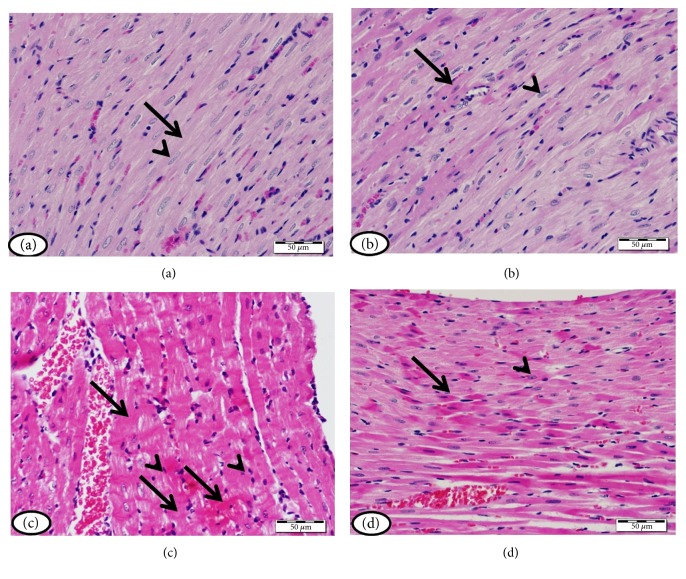
Heart of (a) normal control rats and (b) normal rats treated with simvastatin showing normal histological appearance of both myocardial cell cytoplasm (arrow) and nuclei (arrow head), (c) STZ-induced diabetic rats showing many myocardial cells with degenerated cytoplasm (arrow) and pyknotic nuclei (arrow head), and (d) diabetic rats treated with simvastatin showing decreased degeneration of myocardial cell cytoplasm (arrows) and nuclei (arrow heads). (H&E).
Figure 4
Figure 4
Heart of (a) control rats, (b) simvastatin-supplemented rats revealing normal amount and distribution of interstitial collagen (arrow), (c) STZ-induced diabetic rats with marked increase in the amount of collagen tissue in the endomysium especially surrounding blood vessels (arrows), and (d) diabetic rats treated with simvastatin showing decreased collagen deposition (arrow). (Masson's trichrome).
Figure 5
Figure 5
Simvastatin ameliorates hyperlipidemia and prevents atherogenesis in STZ-induced diabetic rats. Data are M ± SEM (N = 8). ∗∗∗P < 0.001. STZ: streptozotocin; SIM: simvastatin; T cholesterol: total cholesterol; LDL: low-density lipoprotein; HDL: high-density lipoprotein; vLDL: very low density lipoprotein; ns: nonsignificant.
Figure 6
Figure 6
Simvastatin suppresses hyperglycemia-induced oxidative stress in the heart of STZ-induced diabetic rats. Data are M ± SEM (N = 8). P < 0.05, ∗∗P < 0.01, and ∗∗∗P < 0.001. STZ: streptozotocin; SIM: simvastatin; MDA: malondialdehyde; NO: nitric oxide; GSH: reduced glutathione; SOD: superoxide dismutase; ns: nonsignificant.
Figure 7
Figure 7
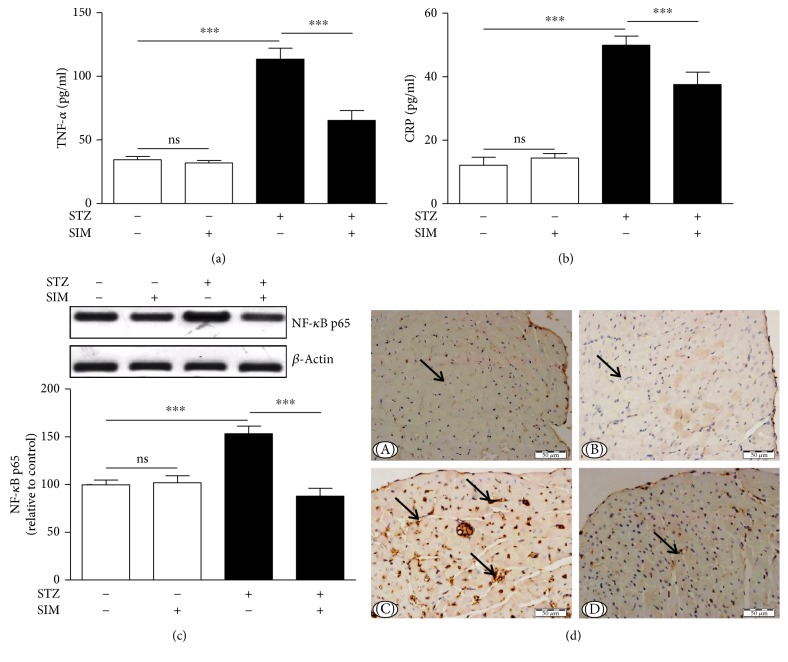
Simvastatin inhibits inflammation and myocardial apoptosis in STZ-induced diabetic rats. Simvastatin decreased serum levels of (a) TNF-α and (b) CRP and (c) NF-κB p65 expression in the heart of diabetic rats. Data are M ± SEM (N = 8). ∗∗∗P < 0.001. STZ: streptozotocin; SIM: simvastatin; TNF-α: tumor necrosis factor alpha; CRP: C-reactive protein; NF-κB: nuclear factor kappaB; ns: nonsignificant. (d) Photomicrographs of caspase-3 immunostained sections in the heart of (A) control rats, (B) normal rats treated with simvastatin showing immune-negative reaction (arrow), (C) STZ-induced diabetic rats showing strong immunopositive reaction in many myocardial cells (arrows), and (D) diabetic rats treated with simvastatin showing marked decrease in caspase-3 immune-positivity of the myocardial cells (arrow).

References

    1. Bertoni A. G., Hundley W. G., Massing M. W., Bonds D. E., Burke G. L., Goff D. C., Jr Heart failure prevalence, incidence, and mortality in the elderly with diabetes. Diabetes Care. 2004;27(3):p. 699. doi: 10.2337/diacare.27.3.699. - DOI - PubMed
    1. Boudina S., Abel E. D. Diabetic cardiomyopathy revisited. Circulation. 2007;115(25):3213–3223. doi: 10.1161/CIRCULATIONAHA.106.679597. - DOI - PubMed
    1. Lorenzo-Almoros A., Tunon J., Orejas M., Cortés M., Egido J., Lorenzo Ó. Diagnostic approaches for diabetic cardiomyopathy. Cardiovascular Diabetology. 2017;16(1):p. 28. - PMC - PubMed
    1. Saisho Y. Glycemic variability and oxidative stress: a link between diabetes and cardiovascular disease? International Journal of Molecular Sciences. 2014;15(10):18381–18406. doi: 10.3390/ijms151018381. - DOI - PMC - PubMed
    1. Khanra R., Dewanjee S., K Dua T., et al. Abroma augusta L. (Malvaceae) leaf extract attenuates diabetes induced nephropathy and cardiomyopathy via inhibition of oxidative stress and inflammatory response. Journal of Translational Medicine. 2015;13:p. 6. doi: 10.1186/s12967-014-0364-1. - DOI - PMC - PubMed

MeSH terms