Review
. 2017 Nov 15;18(11):2420.
doi: 10.3390/ijms18112420.

Molecular-Targeted Therapies for Epidermal Growth Factor Receptor and Its Resistance Mechanisms

Affiliations
Review

Molecular-Targeted Therapies for Epidermal Growth Factor Receptor and Its Resistance Mechanisms

Toshimitsu Yamaoka et al. Int J Mol Sci. .

Abstract

Cancer therapies targeting epidermal growth factor receptor (EGFR), such as small-molecule kinase inhibitors and monoclonal antibodies, have been developed as standard therapies for several cancers, such as non-small cell lung cancer, colorectal cancer, pancreatic cancer, breast cancer, and squamous cell carcinoma of the head and neck. Although these therapies can significantly prolong progression-free survival, curative effects are not often achieved because of intrinsic and/or acquired resistance. The resistance mechanisms to EGFR-targeted therapies can be categorized as resistant gene mutations, activation of alternative pathways, phenotypic transformation, and resistance to apoptotic cell death. Analysis of the processes that modulate EGFR signal transduction by EGFR-targeted inhibitors, such as tyrosine kinase inhibitors and monoclonal antibodies, has revealed new therapeutic opportunities and has elucidated novel mechanisms contributing to the discovery of more effective anticancer treatments. In this review, we discuss the roles of EGFR in cancer development, therapeutic strategies for targeting EGFR, and resistance mechanisms to EGFR-targeted therapies, with a focus on cancer therapies for individual patients.

Keywords: cancer; epidermal growth factor receptor; resistance mechanisms.


Conflict of interest statement

The authors declare no conflicts of interest.

Figures
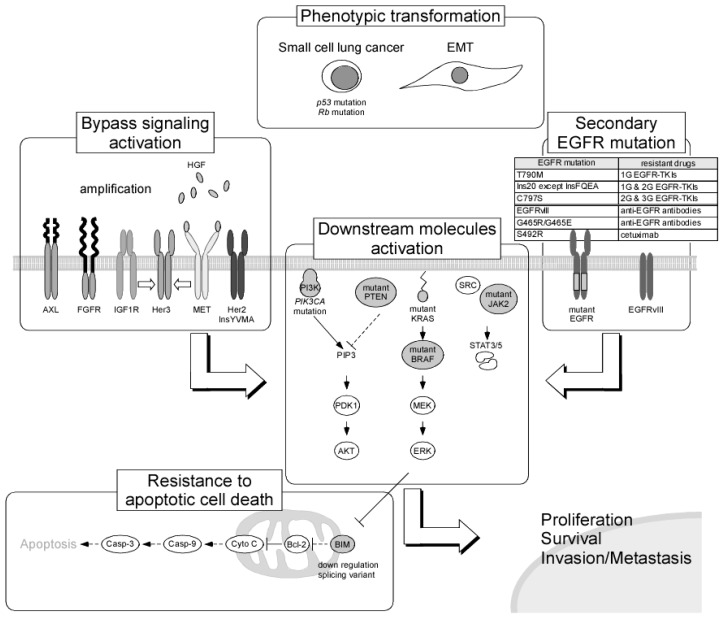
Figure 1
Figure 1
Resistance mechanisms to EGFR tyrosine kinase inhibitors (TKIs) and anti-EGFR antibodies. Abbreviations: AXL, anexelekto; FGFR, fibroblast growth factor receptor; IGF1R, insulin-like growth factor 1 receptor; HGF, hepatocyte growth factor; MET, HGF receptor; PI3K, phosphoinositide 3-kinase; PIK3CA, phosphatidylinositol-4,5-bisphosphate 3-kinase, catalytic subunit alpha; PIP3, phosphatidylinositol (3,4,5)-trisphosphate; PDK1, pyruvate dehydrogenase lipoamide kinase isozyme 1; PTEN, phosphatase and tensin homolog; JAK2, janus kinase 2; STAT, signal transducer and activator of transcription; EMT, epithelial-mesenchymal transition; P53, tumor protein p53; Rb, retinoblastoma tumor suppressor; 1G, 1st generation; 2G, 2nd generation; 3G, 3rd generation; Casp-3, caspase-3; Casp-9, caspase-9; Cyto C, cytochrome c; Bcl-2, B-cell lymphoma 2; BIM, Bcl-2-like 11.

References

    1. Yarden Y. The EGFR family and its ligands in human cancer. Signalling mechanisms and therapeutic opportunities. Eur. J. Cancer. 2001;37(Suppl. 4):S3–S8. doi: 10.1016/S0959-8049(01)00230-1. - DOI - PubMed
    1. Van der Geer P., Hunter T., Lindberg R.A. Receptor protein-tyrosine kinases and their signal transduction pathways. Annu. Rev. Cell Biol. 1994;10:251–337. doi: 10.1146/annurev.cb.10.110194.001343. - DOI - PubMed
    1. Olayioye M.A., Neve R.M., Lane H.A., Hynes N.E. The ErbB signaling network: Receptor heterodimerization in development and cancer. EMBO J. 2000;19:3159–3167. doi: 10.1093/emboj/19.13.3159. - DOI - PMC - PubMed
    1. Ciardiello F., Tortora G. EGFR antagonists in cancer treatment. N. Engl. J. Med. 2008;358:1160–1174. doi: 10.1056/NEJMra0707704. - DOI - PubMed
    1. Furnari F.B., Fenton T., Bachoo R.M., Mukasa A., Stommel J.M., Stegh A., Hahn W.C., Ligon K.L., Louis D.N., Brennan C., et al. Malignant astrocytic glioma: Genetics, biology, and paths to treatment. Genes Dev. 2007;21:2683–2710. doi: 10.1101/gad.1596707. - DOI - PubMed

MeSH terms
