


Bivalent Vaccine Effectiveness Against Type-Specific HPV Positivity: Evidence for Cross-Protection Against Oncogenic Types Among Dutch STI Clinic Visitors
- PMID: 29140439
- PMCID: PMC5853250
- DOI: 10.1093/infdis/jix582
Bivalent Vaccine Effectiveness Against Type-Specific HPV Positivity: Evidence for Cross-Protection Against Oncogenic Types Among Dutch STI Clinic Visitors
Abstract
Background: Observational postmarketing studies are important to assess vaccine effectiveness (VE). We estimated VE from the bivalent human papillomavirus (HPV) vaccine against HPV positivity of vaccine and nonvaccine types in a high-risk population.
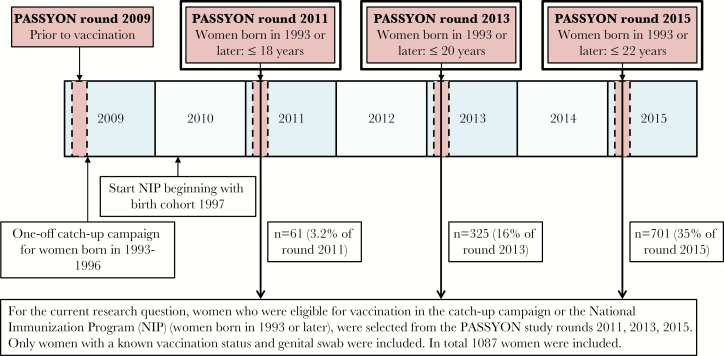
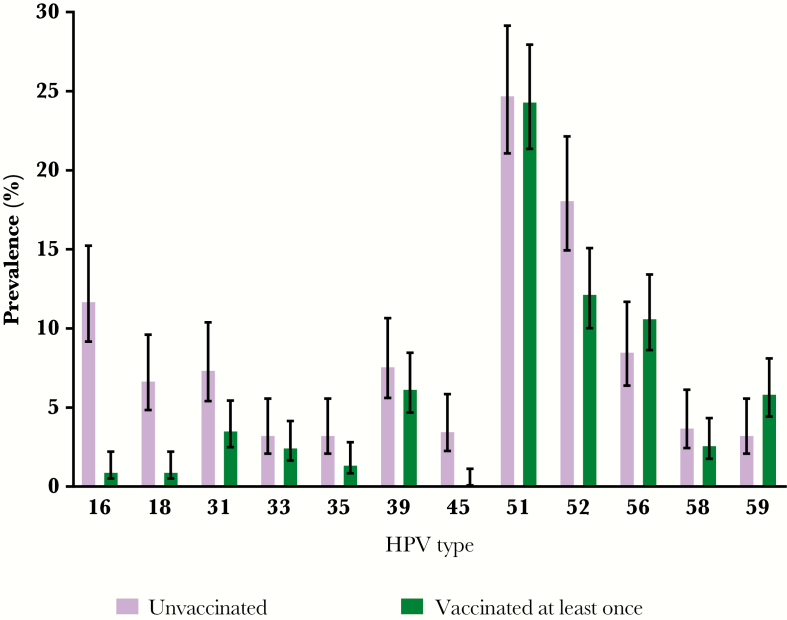
Methods: We included all vaccine-eligible women from the PASSYON study, a biennial cross-sectional survey in Dutch sexually transmitted infection clinics. Vaginal swabs were analyzed using a polymerase chain reaction-based assay (SPF10-LiPA25) able to detect the 12 high-risk HPV (hrHPV) types 16/18/31/33/35/39/45/51/52/56/58/59. We compared hrHPV positivity between self-reported vaccinated (≥1 dose) and unvaccinated women, and estimated VE by a logistic mixed model.
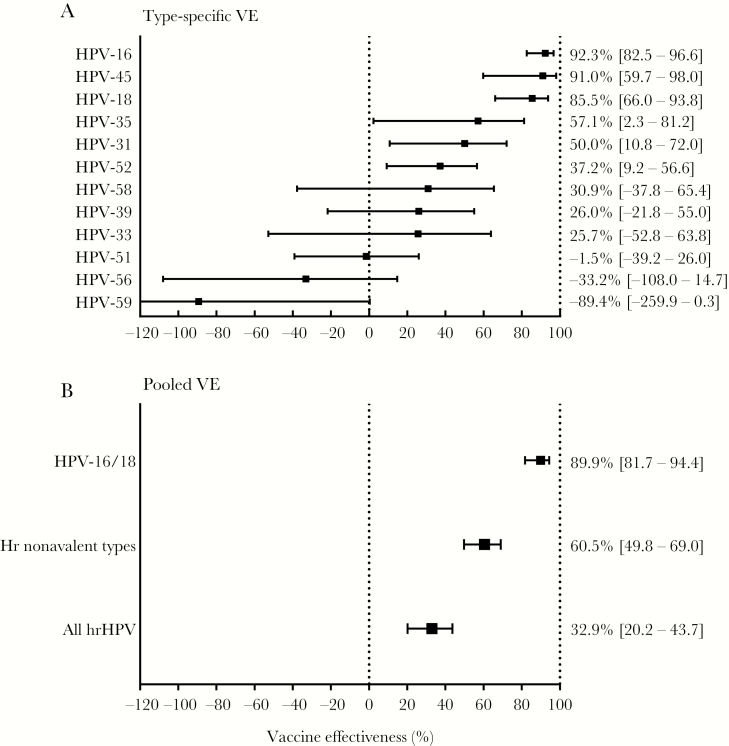
Results: We included 1087 women of which 53% were hrHPV positive and 60% reported to be vaccinated. The adjusted pooled VE against HPV-16/18 was 89.9% (81.7%-94.4%). Moreover, we calculated significant VE against nonvaccine types HPV-45 (91%), HPV-35 (57%), HPV-31 (50%), and HPV-52 (37%). Among women who were offered vaccination 5/6 years ago, we estimated similar VE against HPV-16/18 (92%) and all hrHPV types (35%) compared to women who were offered vaccination <5 years ago (83% and 33%, respectively).
Conclusion: We demonstrated high VE of the bivalent vaccine against HPV-16/18 and cross-protection against HPV-45/35/31/52. Protection against HPV-16/18 was sustained up to 6 years postvaccination.
Keywords: Cervarix; human papillomavirus; human papillomavirus vaccine; public health; vaccine effectiveness.
© The Author 2017. Published by Oxford University Press for the Infectious Diseases Society of America.
Figures
References
-
- Walboomers JM, Jacobs MV, Manos MM et al. Human papillomavirus is a necessary cause of invasive cervical cancer worldwide. J Pathol 1999; 189:12–9. - PubMed
-
- Bouvard V, Baan R, Straif K et al. ; WHO International Agency for Research on Cancer Monograph Working Group A review of human carcinogens–Part B: biological agents. Lancet Oncol 2009; 10:321–2. - PubMed
-
- de Sanjose S, Quint WG, Alemany L et al. ; Retrospective International Survey and HPV Time Trends Study Group Human papillomavirus genotype attribution in invasive cervical cancer: a retrospective cross-sectional worldwide study. Lancet Oncol 2010; 11:1048–56. - PubMed
-
- Plummer M, de Martel C, Vignat J, Ferlay J, Bray F, Franceschi S. Global burden of cancers attributable to infections in 2012: a synthetic analysis. Lancet Glob Health 2016; 4:e609–16. - PubMed
-
- Paavonen J, Naud P, Salmerón J et al. ; HPV PATRICIA Study Group Efficacy of human papillomavirus (HPV)-16/18 AS04-adjuvanted vaccine against cervical infection and precancer caused by oncogenic HPV types (PATRICIA): final analysis of a double-blind, randomised study in young women. Lancet 2009; 374:301–14. - PubMed
Publication types
MeSH terms
Substances
LinkOut - more resources
Full Text Sources
Other Literature Sources
