


Low cost and open source multi-fluorescence imaging system for teaching and research in biology and bioengineering
- PMID: 29140977
- PMCID: PMC5687719
- DOI: 10.1371/journal.pone.0187163
Low cost and open source multi-fluorescence imaging system for teaching and research in biology and bioengineering
Abstract
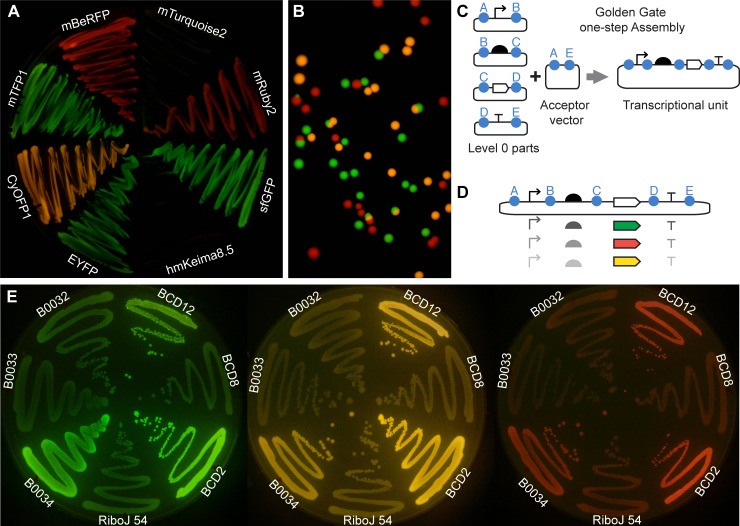
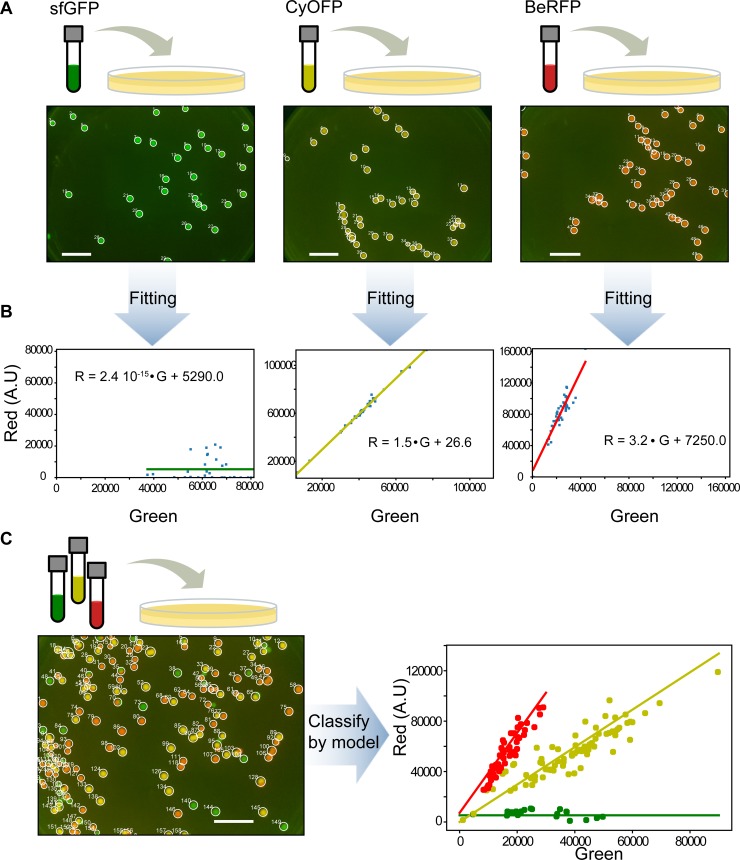
The advent of easy-to-use open source microcontrollers, off-the-shelf electronics and customizable manufacturing technologies has facilitated the development of inexpensive scientific devices and laboratory equipment. In this study, we describe an imaging system that integrates low-cost and open-source hardware, software and genetic resources. The multi-fluorescence imaging system consists of readily available 470 nm LEDs, a Raspberry Pi camera and a set of filters made with low cost acrylics. This device allows imaging in scales ranging from single colonies to entire plates. We developed a set of genetic components (e.g. promoters, coding sequences, terminators) and vectors following the standard framework of Golden Gate, which allowed the fabrication of genetic constructs in a combinatorial, low cost and robust manner. In order to provide simultaneous imaging of multiple wavelength signals, we screened a series of long stokes shift fluorescent proteins that could be combined with cyan/green fluorescent proteins. We found CyOFP1, mBeRFP and sfGFP to be the most compatible set for 3-channel fluorescent imaging. We developed open source Python code to operate the hardware to run time-lapse experiments with automated control of illumination and camera and a Python module to analyze data and extract meaningful biological information. To demonstrate the potential application of this integral system, we tested its performance on a diverse range of imaging assays often used in disciplines such as microbial ecology, microbiology and synthetic biology. We also assessed its potential use in a high school environment to teach biology, hardware design, optics, and programming. Together, these results demonstrate the successful integration of open source hardware, software, genetic resources and customizable manufacturing to obtain a powerful, low cost and robust system for education, scientific research and bioengineering. All the resources developed here are available under open source licenses.
Conflict of interest statement
Figures



References
-
- Gibney E.'Open-hardware' pioneers push for low-cost lab kit. Nature. 2016;531(7593):147–8. doi: 10.1038/531147a - DOI - PubMed
-
- Baden T, Chagas AM, Gage G, Marzullo T, Prieto-Godino LL, Euler T. Open Labware: 3-D Printing Your Own Lab Equipment. PLOS Biol. 2015;13(3):e1002086 doi: 10.1371/journal.pbio.1002086 - DOI - PMC - PubMed
-
- Pearce JM. Building Research Equipment with Free, Open-Source Hardware. Science. 2012;337(6100):1303–1304. doi: 10.1126/science.1228183 - DOI - PubMed
-
- Pearce J. M. Laboratory equipment: Cut costs with open-source hardware. Nature. 2014; 505 (7485), 618. - PubMed
MeSH terms
Grants and funding
LinkOut - more resources
Full Text Sources
Other Literature Sources
Research Materials
Miscellaneous
