


Prognostic significance of cyclin D1 protein expression and gene amplification in invasive breast carcinoma
- PMID: 29140993
- PMCID: PMC5687747
- DOI: 10.1371/journal.pone.0188068
Prognostic significance of cyclin D1 protein expression and gene amplification in invasive breast carcinoma
Abstract
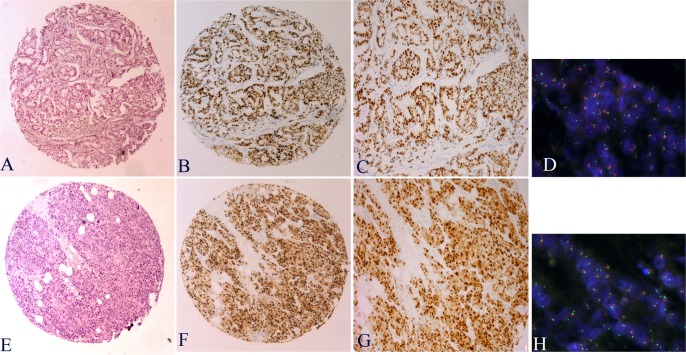
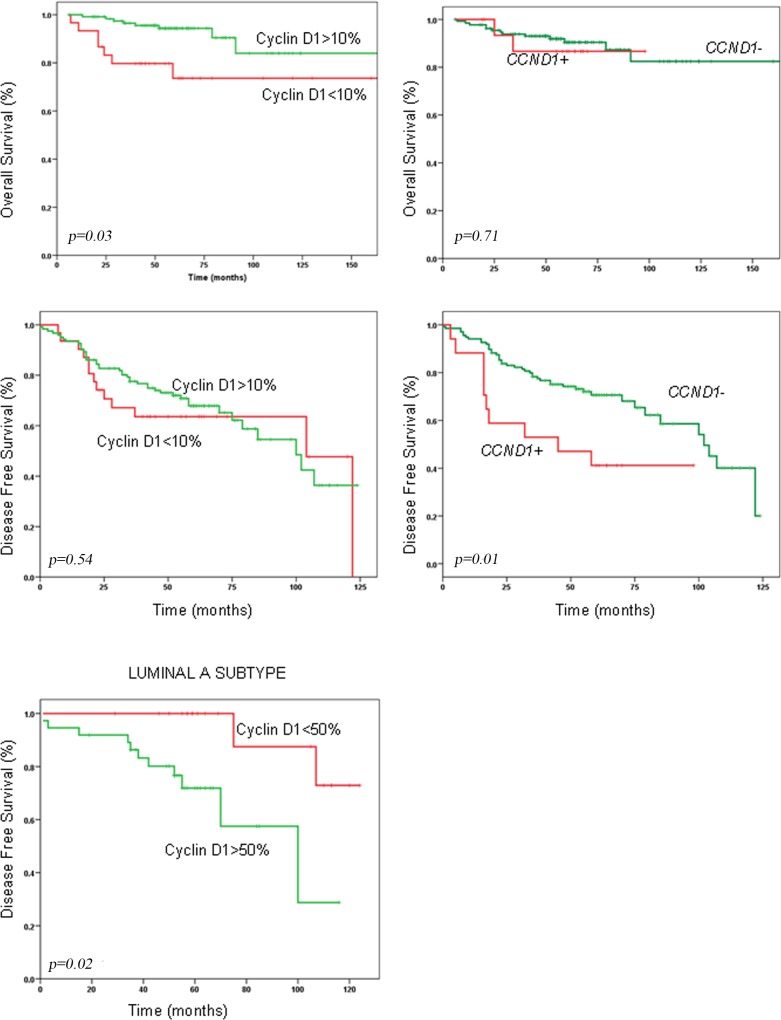
The oncogenic capacity of cyclin D1 has long been established in breast cancer. CCND1 amplification has been identified in a subset of patients with poor prognosis, but there are conflicting data regarding the predictive value of cyclin D1 protein overexpression. This study was designed to analyze the expression of cyclin D1 and its correlation with CCND1 amplification and their prognostic implications in invasive breast cancer. By using the tissue microarray technique, we performed an immunohistochemical study of ER, PR, HER2, p53, cyclin D1, Ki67 and p16 in 179 invasive breast carcinoma cases. The FISH method was performed to detect HER2/Neu and CCND1 amplification. High cyclin D1 expression was identified in 94/179 (52%) of invasive breast cancers. Cyclin D1 overexpression and CCND1 amplification were significantly associated (p = 0.010). Overexpression of cyclin D1 correlated with ER expression, PR expression and Luminal subtypes (p<0.001), with a favorable impact on overall survival in the whole series. However, in the Luminal A group, high expression of cyclin D1 correlated with shorter disease-free survival, suggesting that the prognostic role of cyclin D1 depends on the molecular subtype. CCND1 gene amplification was detected in 17 cases (9%) and correlated significantly with high tumor grade (p = 0.038), high Ki-67 protein expression (p = 0.002), and the Luminal B subtype (p = 0.002). Patients with tumors with high amplification of CCND1 had an increased risk of recurrence (HR = 2.5; 95% CI, 1.2-4.9, p = 0.01). These findings suggest that CCND1 amplification could be useful for predicting recurrence in invasive breast cancer.
Conflict of interest statement
Figures
References
-
- Malvezzi M, Bertuccio P, Levi F, La VC, Negri E. European cancer mortality predictions for the year 2013. Ann Oncol. 2013;24:792–800. doi: 10.1093/annonc/mdt010 - DOI - PubMed
-
- Cianfrocca M, Gradishar W. New molecular classifications of breast cancer. CA Cancer J Clin. 2009;59:303–13. doi: 10.3322/caac.20029 - DOI - PubMed
-
- Perou CM, Sorlie T, Eisen MB, van de Rijn M, Jeffrey SS, Rees CA, et al. Molecular portraits of human breast tumours. Nature. 2000;406:747–52. doi: 10.1038/35021093 - DOI - PubMed
-
- Sherr CJ, Roberts JM. CDK inhibitors: positive and negative regulators of G1-phase progression. Genes Dev. 1999;13:1501–12. - PubMed
-
- Zwijsen RM, Wientjens E, Klompmaker R, van der Sman J, Bernards R, Michalides RJ. CDK-independent activation of estrogen receptor by cyclin D1. Cell. 1997;88:405–15. - PubMed
MeSH terms
Substances
LinkOut - more resources
Full Text Sources
Other Literature Sources
Medical
Research Materials
Miscellaneous
