Proposal of a Pretreatment Nomogram for Predicting Local Recurrence after Intensity-Modulated Radiation Therapy in T4 Nasopharyngeal Carcinoma: A Retrospective Review of 415 Chinese Patients
- PMID: 29141396
- PMCID: PMC6192920
- DOI: 10.4143/crt.2017.359
Proposal of a Pretreatment Nomogram for Predicting Local Recurrence after Intensity-Modulated Radiation Therapy in T4 Nasopharyngeal Carcinoma: A Retrospective Review of 415 Chinese Patients
Abstract
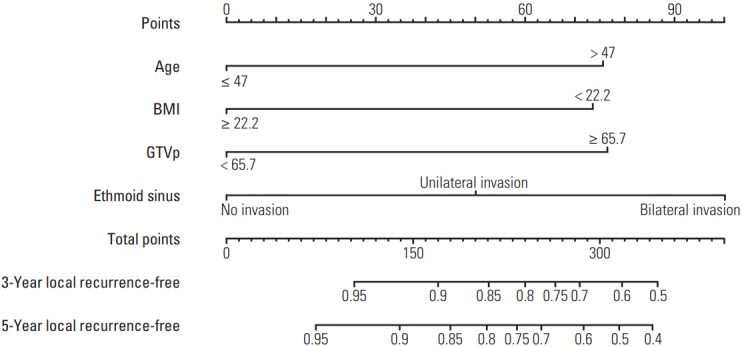
Purpose: Local relapse-free survival (LRFS) differs widely among patients with T4 category nasopharyngeal carcinoma (NPC). We aimed to build a nomogram incorporating clinicopathological information to predict LRFS in T4 NPC after definitive intensity-modulated radiation therapy (IMRT).
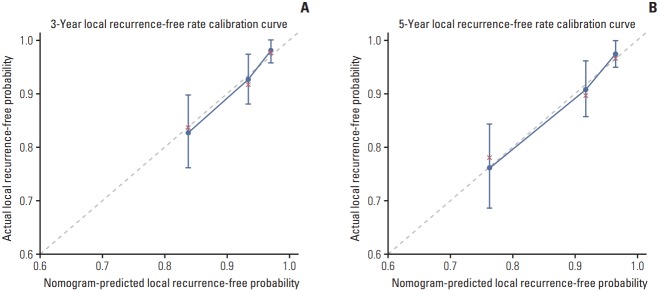
Materials and methods: Retrospective study of 415 Chinese patients with non-metastatic T4 NPC treated with definitive IMRT with or without chemotherapy at our cancer center between October 2009 and September 2013. The nomogram for LRFS at 3 and 5 years was generated based on multivariate Cox proportional hazards regression, and validated using bootstrap resampling, assessing discriminative performance using the concordance index (C-index) and determining calibration ability via calibration curves.
Results: Five-year LRFS was 88.8%. We identified and incorporated four independent prognostic factors for LRFS: ethmoid sinus invasion, primary gross tumor volume, age, and pretreatment body mass index. The C-index of the nomogram for local recurrence was 0.732 (95% confidence interval, 0.726 to 0.738), indicating excellent predictive accuracy. The calibration curve revealed excellent agreement between nomogram-predicted and observed LRFS probabilities. Risk subgroups based on total point score cutoff values enabled effective discrimination of LRFS.
Conclusion: This pretreatment nomogram enables clinicians to accurately predict LRFS in T4 NPC after definitive IMRT, and could help to facilitate personalized patient counselling and treatment strategies.
Keywords: Intensity-modulated radiation therapy; Nasopharyngeal carcinoma; Nomograms; Recurrence.
Conflict of interest statement
Conflict of interest relevant to this article was not reported.
Figures

References
-
- Jemal A, Bray F, Center MM, Ferlay J, Ward E, Forman D. Global cancer statistics. CA Cancer J Clin. 2011;61:69–90. - PubMed
-
- Chan AT. Nasopharyngeal carcinoma. Ann Oncol. 2010;21 Suppl 7:vii308–12. - PubMed
-
- Lee AW, Lin JC, Ng WT. Current management of nasopharyngeal cancer. Semin Radiat Oncol. 2012;22:233–44. - PubMed
-
- Lai SZ, Li WF, Chen L, Luo W, Chen YY, Liu LZ, et al. How does intensity-modulated radiotherapy versus conventional two-dimensional radiotherapy influence the treatment results in nasopharyngeal carcinoma patients? Int J Radiat Oncol Biol Phys. 2011;80:661–8. - PubMed
-
- Wu LR, Liu YT, Jiang N, Fan YX, Wen J, Huang SF, et al. Tenyear survival outcomes for patients with nasopharyngeal carcinoma receiving intensity-modulated radiotherapy: an analysis of 614 patients from a single center. Oral Oncol. 2017;69:26–32. - PubMed
MeSH terms
Grants and funding
LinkOut - more resources
Full Text Sources
Other Literature Sources