


Effects of Sodium Reduction and the DASH Diet in Relation to Baseline Blood Pressure
- PMID: 29141784
- PMCID: PMC5742671
- DOI: 10.1016/j.jacc.2017.10.011
Effects of Sodium Reduction and the DASH Diet in Relation to Baseline Blood Pressure
Abstract
Background: Both sodium reduction and the DASH (Dietary Approaches to Stop Hypertension) diet, a diet rich in fruits, vegetables, and low-fat dairy products, and reduced in saturated fat and cholesterol, lower blood pressure. The separate and combined effects of these dietary interventions by baseline blood pressure (BP) has not been reported.
Objectives: The authors compared the effects of low versus high sodium, DASH versus control, and both (low sodium-DASH vs. high sodium-control diets) on systolic blood pressure (SBP) by baseline BP.
Methods: In the DASH-Sodium (Dietary Patterns, Sodium Intake and Blood Pressure) trial, adults with pre- or stage 1 hypertension and not using antihypertensive medications, were randomized to either DASH or a control diet. On either diet, participants were fed each of 3 sodium levels (50, 100, and 150 mmol/day at 2,100 kcal) in random order over 4 weeks separated by 5-day breaks. Strata of baseline SBP were <130, 130 to 139, 140 to 149, and ≥150 mm Hg.
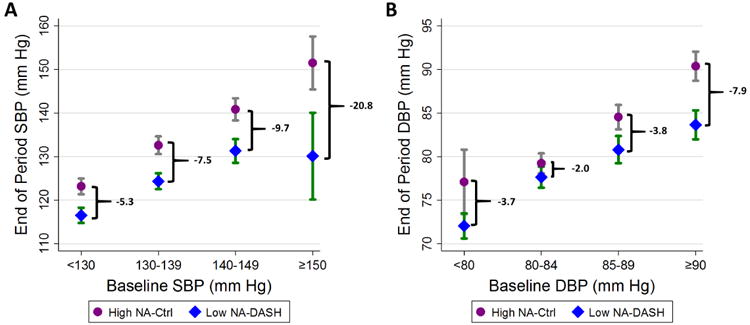
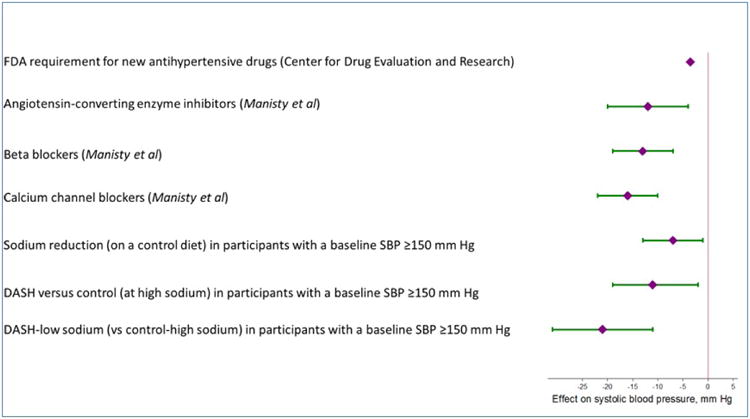
Results: Of 412 participants, 57% were women, and 57% were black; mean age was 48 years, and mean SBP/diastolic BP was 135/86 mm Hg. In the context of the control diet, reducing sodium (from high to low) was associated with mean SBP differences of -3.20, -8.56, -8.99, and -7.04 mm Hg across the respective baseline SBP strata listed (p for trend = 0.004). In the context of high sodium, consuming the DASH compared with the control diet was associated with mean SBP differences of -4.5, -4.3, -4.7, and -10.6 mm Hg, respectively (p for trend = 0.66). The combined effects of the low sodium-DASH diet versus the high sodium-control diet on SBP were -5.3, -7.5, -9.7, and -20.8 mm Hg, respectively (p for trend <0.001).
Conclusions: The combination of reduced sodium intake and the DASH diet lowered SBP throughout the range of pre- and stage 1 hypertension, with progressively greater reductions at higher levels of baseline SBP. SBP reductions in adults with the highest levels of SBP (≥150 mm Hg) were striking and reinforce the importance of both sodium reduction and the DASH diet in this high-risk group. Further research is needed to determine the effects of these interventions among adults with SBP ≥160 mm Hg. (Dietary Patterns, Sodium Intake and Blood Pressure [DASH-Sodium]; NCT00000608).
Keywords: DASH; blood pressure; diet; sodium; trial.
Copyright © 2017 American College of Cardiology Foundation. Published by Elsevier Inc. All rights reserved.
Conflict of interest statement
Figures
Comment in
-
Is a DASH of Salt All We Need?J Am Coll Cardiol. 2017 Dec 12;70(23):2849-2851. doi: 10.1016/j.jacc.2017.10.019. J Am Coll Cardiol. 2017. PMID: 29216982 No abstract available.
-
Missing ingredients for a lifestyle recipe to treat hypertension.J Thorac Dis. 2018 Feb;10(2):653-656. doi: 10.21037/jtd.2018.01.06. J Thorac Dis. 2018. PMID: 29608194 Free PMC article. No abstract available.
-
The Role of Salt Reduction in the Management of Hypertension.J Am Coll Cardiol. 2018 Apr 10;71(14):1597-1598. doi: 10.1016/j.jacc.2018.01.071. J Am Coll Cardiol. 2018. PMID: 29622170 No abstract available.
-
Reply: The Role of Salt Reduction in the Management of Hypertension.J Am Coll Cardiol. 2018 Apr 10;71(14):1598-1599. doi: 10.1016/j.jacc.2018.02.012. J Am Coll Cardiol. 2018. PMID: 29622171 Free PMC article. No abstract available.
References
-
- Appel LJ, Moore TJ, Obarzanek E, et al. DASH Collaborative Research Group. A clinical trial of the effects of dietary patterns on blood pressure. N Engl J Med. 1997;336:1117–1124. - PubMed
-
- Sacks FM, Svetkey LP, Vollmer WM, et al. DASH-Sodium Collaborative Research Group. Effects on blood pressure of reduced dietary sodium and the Dietary Approaches to Stop Hypertension (DASH) diet. N Engl J Med. 2001;344:3–10. - PubMed
-
- Van Horn L, Carson JAS, Appel LJ, et al. Recommended dietary pattern to achieve adherence to the American Heart Association/American College of Cardiology (AHA/ACC) guidelines: a scientific statement from the American Heart Association. Circulation. 2016;134:e505–e529. - PubMed
-
- Svetkey LP, Sacks FM, Obarzanek E, et al. DASH-Sodium Collaborative Research Group. The DASH Diet, Sodium Intake and Blood Pressure Trial (DASH-sodium): rationale and design. J Am Diet Assoc. 1999;99(Suppl):S96–S104. ArticlePDF (1MB) - PubMed
-
- White H. A heteroskedasticity-consistent covariance matrix estimator and a direct test for heteroskedasticity. Econometrica. 1980;48:817–838.
Publication types
MeSH terms
Substances
Associated data
Grants and funding
LinkOut - more resources
Full Text Sources
Other Literature Sources
Medical
