


Patient Health Record Systems Scope and Functionalities: Literature Review and Future Directions
- PMID: 29141839
- PMCID: PMC5707430
- DOI: 10.2196/jmir.8073
Patient Health Record Systems Scope and Functionalities: Literature Review and Future Directions
Erratum in
-
Multimedia Appendix Correction: Patient Health Record Systems Scope and Functionalities: Literature Review and Future Directions.J Med Internet Res. 2019 Sep 5;21(9):e15796. doi: 10.2196/15796. J Med Internet Res. 2019. PMID: 31489840 Free PMC article. No abstract available.
Abstract
Background: A new generation of user-centric information systems is emerging in health care as patient health record (PHR) systems. These systems create a platform supporting the new vision of health services that empowers patients and enables patient-provider communication, with the goal of improving health outcomes and reducing costs. This evolution has generated new sets of data and capabilities, providing opportunities and challenges at the user, system, and industry levels.
Objective: The objective of our study was to assess PHR data types and functionalities through a review of the literature to inform the health care informatics community, and to provide recommendations for PHR design, research, and practice.
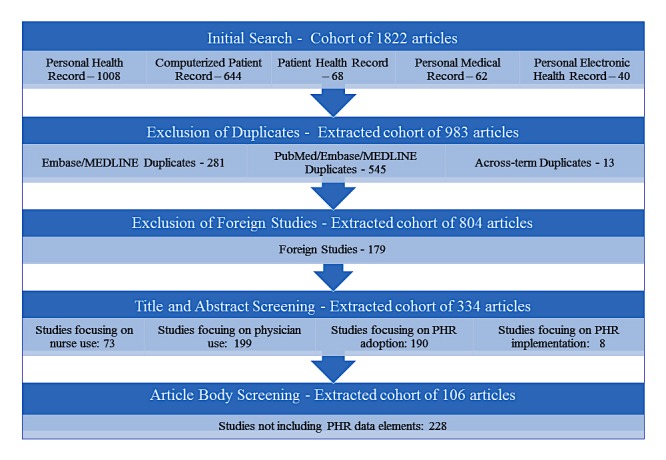
Methods: We conducted a review of the literature to assess PHR data types and functionalities. We searched PubMed, Embase, and MEDLINE databases from 1966 to 2015 for studies of PHRs, resulting in 1822 articles, from which we selected a total of 106 articles for a detailed review of PHR data content.
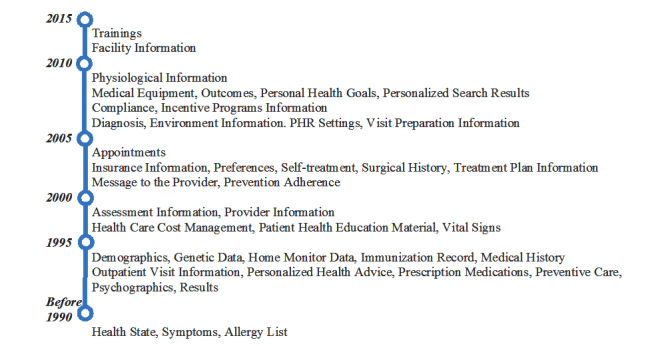
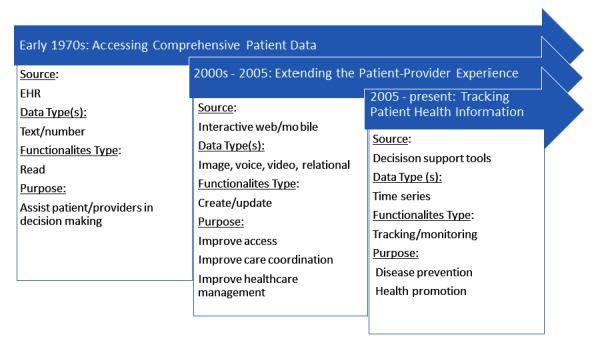
Results: We present several key findings related to the scope and functionalities in PHR systems. We also present a functional taxonomy and chronological analysis of PHR data types and functionalities, to improve understanding and provide insights for future directions. Functional taxonomy analysis of the extracted data revealed the presence of new PHR data sources such as tracking devices and data types such as time-series data. Chronological data analysis showed an evolution of PHR system functionalities over time, from simple data access to data modification and, more recently, automated assessment, prediction, and recommendation.
Conclusions: Efforts are needed to improve (1) PHR data quality through patient-centered user interface design and standardized patient-generated data guidelines, (2) data integrity through consolidation of various types and sources, (3) PHR functionality through application of new data analytics methods, and (4) metrics to evaluate clinical outcomes associated with automated PHR system use, and costs associated with PHR data storage and analytics.
Keywords: data analytics; electronic health records; health platforms; health records, personal; medical informatics; multiorganizational systems; patient-centered care; personal health record systems; review; ultralarge systems.
©Lina Bouayad, Anna Ialynytchev, Balaji Padmanabhan. Originally published in the Journal of Medical Internet Research (http://www.jmir.org), 15.11.2017.
Conflict of interest statement
Conflicts of Interest: None declared.
Figures
References
-
- Hinman E, Holloway J. The patient carried personal health record: a tool to increase patient participation in the treatment process. J Clin Comput. 1977;6(4):9.
-
- Tang PC, Ash JS, Bates DW, Overhage JM, Sands DZ. Personal health records: definitions, benefits, and strategies for overcoming barriers to adoption. J Am Med Inform Assoc. 2006;13(2):121–6. doi: 10.1197/jamia.M2025. http://europepmc.org/abstract/MED/16357345 - DOI - PMC - PubMed
Publication types
MeSH terms
LinkOut - more resources
Full Text Sources
Other Literature Sources
Medical
