. 2017 Fall;10(2):119-130.
doi: 10.17925/USOR.2017.10.02.119.

Advances in Age-related Macular Degeneration Understanding and Therapy

Affiliations

Advances in Age-related Macular Degeneration Understanding and Therapy

Joan W Miller et al. US Ophthalmic Rev. 2017 Fall.

Abstract

While the development of anti-vascular endothelial growth factor (anti-VEGF) as a therapy for neovascular age-related macular degeneration (AMD) was a great success, the pathologic processes underlying dry AMD that eventually leads to photoreceptor dysfunction, death, and vision loss remain elusive to date, with a lack of effective therapies and increasing prevalence of the disease. There is an overwhelming need to improve the classification system of AMD, to increase our understanding of cell death mechanisms involved in both neovascular and non-neovascular AMD, and to develop better biomarkers and clinical endpoints to eventually be able to identify better therapeutic targets-especially early in the disease process. There is no doubt that it is a matter of time before progress will be made and better therapies will be developed for non-neovascular AMD.

Keywords: age-related macular degeneration (AMD); anti-vascular endothelial growth factor (VEGF); biomarkers; complement inhibition; neuroprotection; statin.


Figures
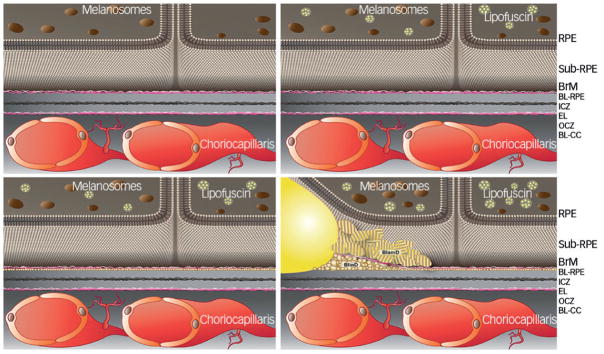
Figure 1
Figure 1. Hypothetical schematic of lipid deposit progression and drusen formation in age-related macular degeneration
Adapted from Miller JW, Age-related macular degeneration revisited—piecing the puzzle: the LXIX Edward Jackson memorial lecture, Am J Ophthalmol, 2013;155:1–35.e13. Copyright 2013 Elsevier, Inc.
Figure 2
Figure 2. Spectral domain optical coherence tomography findings showing regression of drusenoid pigment epithelium detachments after high-dose Atorvastatin (80 mg) without atrophy of retinal pigment epithelium
Adapted from Vavvas DG, Daniels AB, Kapsala ZG, et al., Regression of some high-risk features of age-related macular degeneration (AMD) in patients receiving intensive statin treatment, EbioMedicine, 2016;5:198–203. Copyright 2016 by Vavvas GD, Daniels AB, Kapsala ZG, et al.
Figure 3
Figure 3. Schematic of molecular pathways involved in death signaling
Upstream death ligands (tumor necrosis factor and FasL) bind to their corresponding receptors and initiate downstream cascades that interact and cross-talk. Cell death can be initiated by intracellular stressors as well. Note that cross-talk between death signaling and pro-survival and pro-inflammatory mechanisms occurs through Nf-kβ. Autophagy is activated under stress and helps initially to promote cell survival. Prolonged activation of autophagy leads to cell loss.
Figure 4
Figure 4. Schematic demonstrating proposed integration of cell death signaling in retinal degenerations
Age-related macular degeneration (AMD) is multifactorial in its etiology. Various upstream stressors (both from within the cell and outside the cell) activate multiple pathways that they lead eventually to cell death. Cell death is mediated in many instances through apoptosis and necrosis. This dual pathway is a redundant and complimentary system that cross-talks to each other to effectively lead to cell death. Successful neuroprotection in AMD and other degenerations would require combination therapies that can target both pathways.

References

    1. Wong WL, Su X, Li X, et al. Global prevalence of age-related macular degeneration and disease burden projection for 2020 and 2040: a systematic review and meta-analysis. Lancet Glob Health. 2014;2:e106–16. - PubMed
    1. Kramer M, Miller JW, Michaud N, et al. Liposomal benzoporphyrin derivative verteporfin photodynamic therapy. Selective treatment of choroidal neovascularization in monkeys. Ophthalmology. 1996;103:427–38. - PubMed
    1. Krzystolik MG, Afshari MA, Adamis AP, et al. Prevention of experimental choroidal neovascularization with intravitreal anti-vascular endothelial growth factor antibody fragment. Arch, Ophthalmol Chic Ill 1960. 2002;120:338–46. - PubMed
    1. Age-Related Eye Disease Study Research Group. Risk factors associated with age-related macular degeneration, A case-control study in the age-related eye disease study: Age-Related Eye Disease Study Report Number 3. Ophthalmology. 2000;107:2224–32. - PMC - PubMed
    1. Jager RD, Mieler WF, Miller JW. Age-related macular degeneration. N Engl J Med. 2008;358:2606–17. - PubMed