


Dirofilaria immitis JYD-34 isolate: whole genome analysis
- PMID: 29143663
- PMCID: PMC5688507
- DOI: 10.1186/s13071-017-2437-5
Dirofilaria immitis JYD-34 isolate: whole genome analysis
Abstract
Background: Macrocyclic lactone (ML) anthelmintics are used for chemoprophylaxis for heartworm infection in dogs and cats. Cases of dogs becoming infected with heartworms, despite apparent compliance to recommended chemoprophylaxis with approved preventives, has led to such cases being considered as suspected lack of efficacy (LOE). Recently, microfilariae collected from a small number of LOE isolates were used as a source of infection of new host dogs and confirmed to have reduced susceptibility to ML in controlled efficacy studies using L3 challenge in dogs. A specific Dirofilaria immitis laboratory isolate named JYD-34 has also been confirmed to have less than 100% susceptibility to ML-based preventives. For preventive claims against heartworm disease, evidence of 100% efficacy is required by FDA-CVM. It was therefore of interest to determine whether JYD-34 has a genetic profile similar to other documented LOE and confirmed reduced susceptibility isolates or has a genetic profile similar to known ML-susceptible isolates.
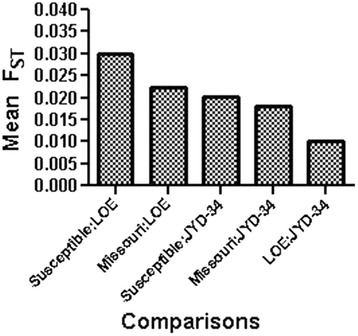
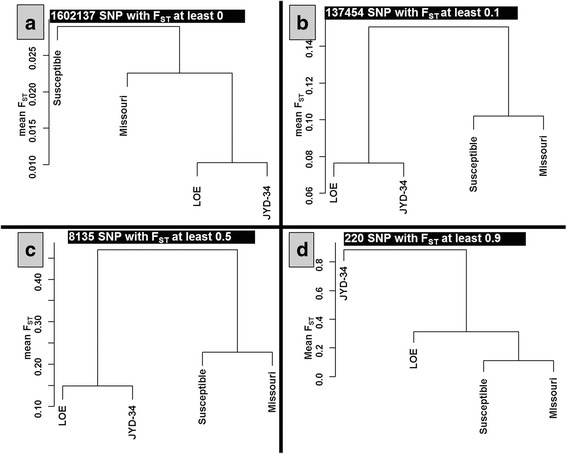
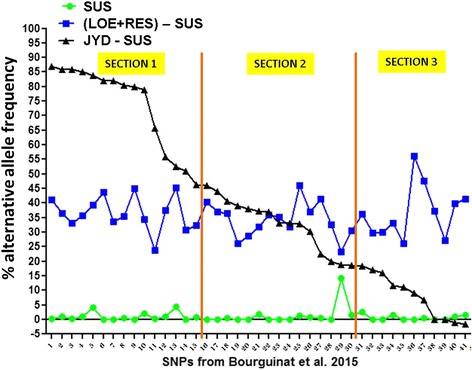
Methods: In this study, the 90Mbp whole genome of the JYD-34 strain was sequenced. This genome was compared using bioinformatics tools to pooled whole genomes of four well-characterized susceptible D. immitis populations, one susceptible Missouri laboratory isolate, as well as the pooled whole genomes of four LOE D. immitis populations. Fixation indexes (FST), which allow the genetic structure of each population (isolate) to be compared at the level of single nucleotide polymorphisms (SNP) across the genome, have been calculated. Forty-one previously reported SNP, that appeared to differentiate between susceptible and LOE and confirmed reduced susceptibility isolates, were also investigated in the JYD-34 isolate.
Results: The FST analysis, and the analysis of the 41 SNP that appeared to differentiate reduced susceptibility from fully susceptible isolates, confirmed that the JYD-34 isolate has a genome similar to previously investigated LOE isolates, and isolates confirmed to have reduced susceptibility, and to be dissimilar to the susceptible isolates.
Conclusions: These results provide additional evidence for the link between genotype and the reduced susceptibility phenotype observed in such isolates as JYD-34. Further work on other isolates showing reduced susceptibility to ML is required to demonstrate the value of genetic analysis in predicting the response to ML chemoprophylaxis. The authors suggest that genetic analysis may be useful in helping to interpret the results of in vivo efficacy testing of ML heartworm preventives against D. immitis isolates.
Keywords: Dirofilaria immitis; Heartworm preventives; JYD isolate; Macrocyclic lactone resistance; Whole genome analysis.
Conflict of interest statement
Ethics approval
All animal work performed at TRS Laboratories (Athens, Georgia, USA) was approved by the Institutional Animal Care and Use Committee, which follows all regulations of the Animal Welfare Act and is enforced by the United States Department of Agriculture
Consent for publication
Merial Inc. consents to release of this information for publication.
Competing interests
BB and YM are current employees of Merial Inc. (Duluth, Georgia, USA).
Publisher’s Note
Springer Nature remains neutral with regard to jurisdictional claims in published maps and institutional affiliations.
Figures
References
-
- Bourguinat C, Lee AC, Lizundia R, Blagburn BL, Liotta JL, Kraus MS, et al. Macrocyclic lactone resistance in Dirofilaria immitis: failure of heartworm preventives and investigation of genetic markers for resistance. Vet Parasitol. 2015;210(3-4):167–178. doi: 10.1016/j.vetpar.2015.04.002. - DOI - PubMed
MeSH terms
Substances
LinkOut - more resources
Full Text Sources
Other Literature Sources
Miscellaneous
