


Corneal clarity measurements in healthy volunteers across different age groups: Observational study
- PMID: 29145265
- PMCID: PMC5704810
- DOI: 10.1097/MD.0000000000008563
Corneal clarity measurements in healthy volunteers across different age groups: Observational study
Abstract
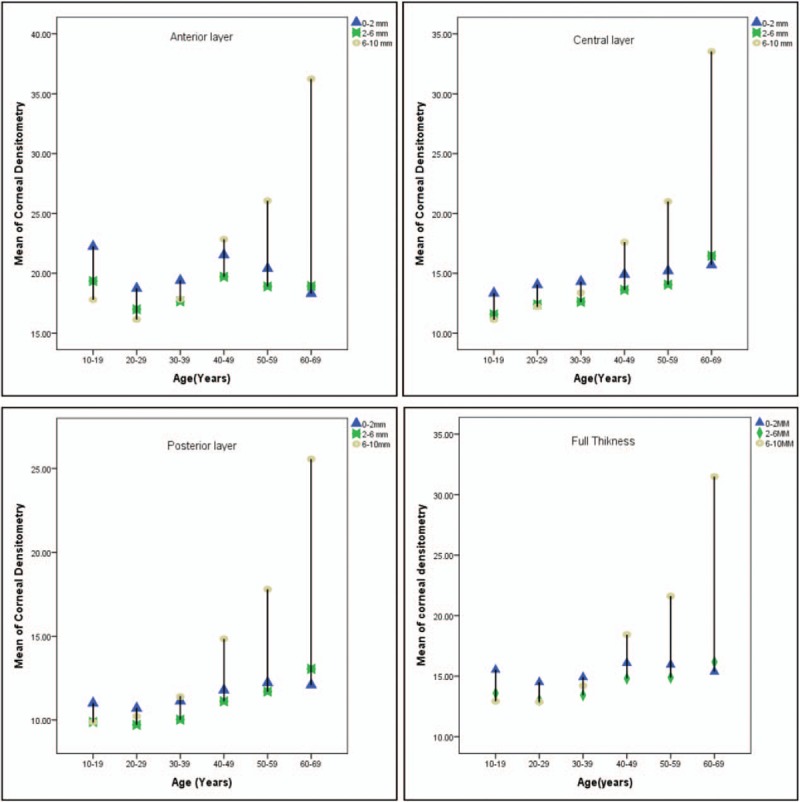
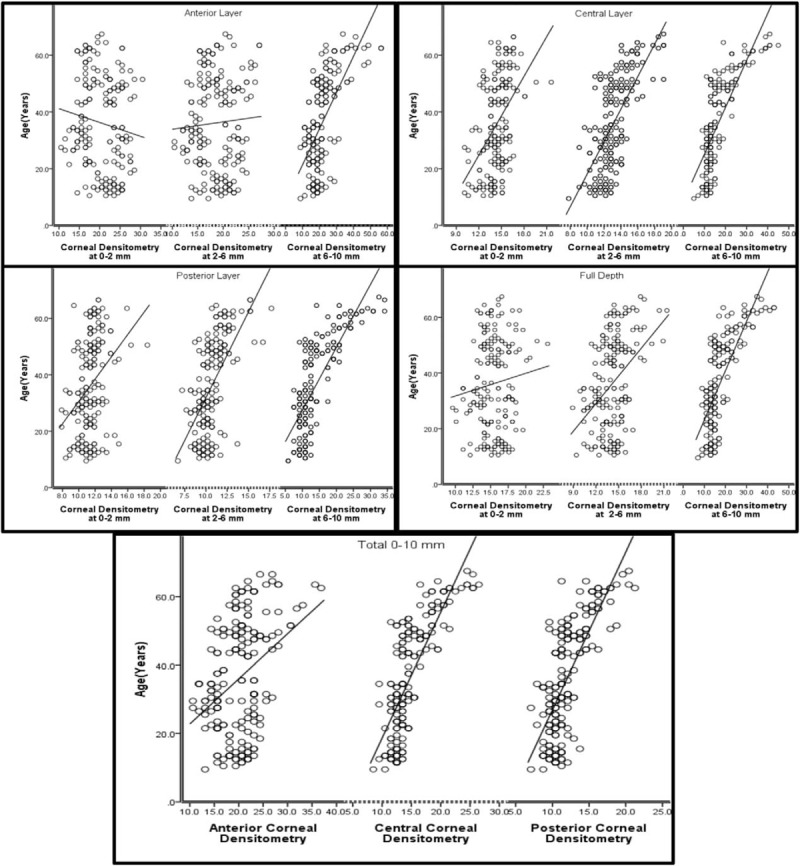
The aim of this study was to standardize and investigate the changes in corneal clarity with age. Densitometry software for the Oculus Pentacam was used to examine corneal clarity at different age groups.A total of 192 eyes from 97 healthy participants were included in this cohort comparative nonrandomized, cross-sectional study. An Oculus Pentcam was used to image the cornea of healthy participants grouped by age (between 10 and 70 years old). Data from the densitometry output have been used to determine clarity in concentric zones and different depths of the cornea.Corneal densitometry (CD) across all ages showed significant differences between groups when divided into the following layers: anterior, central, and posterior or divided into 0 to 2, 2 to 6, and 6 to 10 mm concentric zones (P < .05). The most striking decrease in clarity occurred with age in all 3 layers of the periphery (6-10 mm) (P < .05). In addition, we showed that the 10 to 19-year age group had lower clarity than the 20 to 30-age group (P < .05), and after 30 years, the cornea shows a steady progression of increased or decreased clarity.The values for CD, as well as for separate subdivisions based on layer and surface area, might provide a standard for use in further studies and clinical practice. This study established that relation between CD and age is differed when the cornea is divided into layers and zones. This study suggests that there are other factors that may play an essential role in corneal clarity as well as age.
Conflict of interest statement
The authors report no conflicts of interest.
Figures
References
-
- Maurice DM (1988) Mechanics of the cornea, in The Cornea: Transactions of the World Congress on the Cornea III, Cavanagh HD, Editor. New York: Raven Press. p. 187-193.
-
- Freegard TJ. The physical basis of transparency of the normal cornea. Eye 1997;11:465–71. - PubMed
-
- Borcherding MS, Blacik L, Sittig R, et al. Proteoglycans and collagen fibre organization in human corneoscleral tissue. Exp Eye Res 1975;21:59–70. - PubMed
Publication types
MeSH terms
LinkOut - more resources
Full Text Sources
Other Literature Sources
