. 2017 Nov 17;66(45):1248-1251.
doi: 10.15585/mmwr.mm6645a2.

CDC Grand Rounds: Improving Medication Adherence for Chronic Disease Management - Innovations and Opportunities

CDC Grand Rounds: Improving Medication Adherence for Chronic Disease Management - Innovations and Opportunities

Andrea B Neiman et al. MMWR Morb Mortal Wkly Rep. .

Abstract

Adherence to prescribed medications is associated with improved clinical outcomes for chronic disease management and reduced mortality from chronic conditions (1). Conversely, nonadherence is associated with higher rates of hospital admissions, suboptimal health outcomes, increased morbidity and mortality, and increased health care costs (2). In the United States, 3.8 billion prescriptions are written annually (3). Approximately one in five new prescriptions are never filled, and among those filled, approximately 50% are taken incorrectly, particularly with regard to timing, dosage, frequency, and duration (4). Whereas rates of nonadherence across the United States have remained relatively stable, direct health care costs associated with nonadherence have grown to approximately $100-$300 billion of U.S. health care dollars spent annually (5,6). Improving medication adherence is a public health priority and could reduce the economic and health burdens of many diseases and chronic conditions (7).


Conflict of interest statement

Conflict of Interest: Dr. Ho reports grants from Veterans Health Administration during the conduct of the study; personal fees from Janssen, Inc., personal fees from American Heart Association, outside the submitted work. Dr. Garber reports grants from Agency for Healthcare Research and Quality during the conduct of the study.

Figures

FIGURE
FIGURE
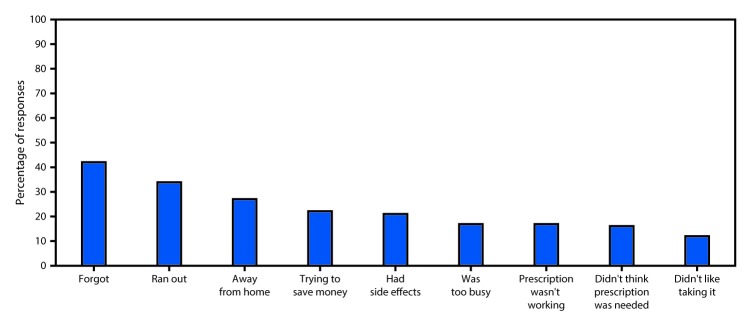
Self-reported reasons* for nonadherence to recommended medication regimens — United States, 2013 Source: Medication Adherence in America: A National Report 2013. Adapted with permission. https://www.ncpanet.org/pdf/reportcard/AdherenceReportCard_Abridged.pdf. * Participants could provide more than one response, and as such, categories are not mutually exclusive.

References

    1. Vrijens B, De Geest S, Hughes DA, et al. ; ABC Project Team. A new taxonomy for describing and defining adherence to medications. Br J Clin Pharmacol 2012;73:691–705. 10.1111/j.1365-2125.2012.04167.x - DOI - PMC - PubMed
    1. DiMatteo MR. Variations in patients’ adherence to medical recommendations: a quantitative review of 50 years of research. Med Care 2004;42:200–9. 10.1097/01.mlr.0000114908.90348.f9 - DOI - PubMed
    1. Cutler DM, Everett W. Thinking outside the pillbox—medication adherence as a priority for health care reform. N Engl J Med 2010;362:1553–5. 10.1056/NEJMp1002305 - DOI - PubMed
    1. Osterberg L, Blaschke T. Adherence to medication. N Engl J Med 2005;353:487–97. 10.1056/NEJMra050100 - DOI - PubMed
    1. Iuga AO, McGuire MJ. Adherence and health care costs. Risk Manag Healthc Policy 2014;7:35–44 . 10.2147/RMHP.S19801 - DOI - PMC - PubMed

Substances