


Hospital-associated methicillin-resistant Staphylococcus aureus: A cross-sectional analysis of risk factors in South African tertiary public hospitals
- PMID: 29145465
- PMCID: PMC5690649
- DOI: 10.1371/journal.pone.0188216
Hospital-associated methicillin-resistant Staphylococcus aureus: A cross-sectional analysis of risk factors in South African tertiary public hospitals
Abstract
Introduction: Hospital-associated methicillin-resistant S. aureus (HA-MRSA) remains a significant cause of morbidity and mortality worldwide. We conducted a study to determine risk factors for HA-MRSA in order to inform control strategies in South Africa.
Methods: We used surveillance data collected from five tertiary hospitals in Gauteng and Western Cape provinces during 2014 for analysis. A case of HA-MRSA was defined as isolation of MRSA from a blood culture 48 hours after admission and/or if the patient was hospitalised in the six months prior to the current culture. Multivariable logistic regression modelling was used to determine risk factors for HA-MRSA.
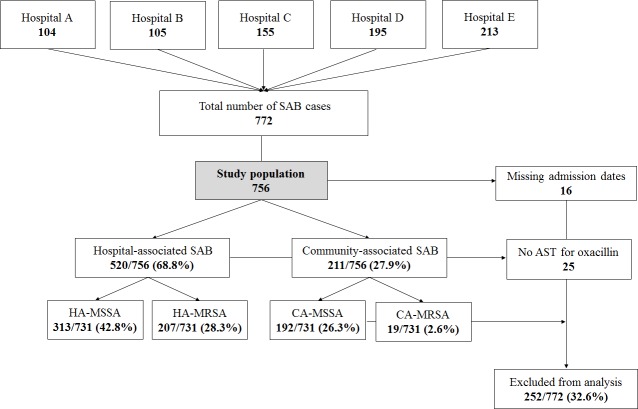
Results: Of the 9971 patients with positive blood cultures, 7.7% (772) had S. aureus bacteraemia (SAB). The overall prevalence of MRSA among those with SAB was 30.9% (231/747; 95% confidence interval [CI] 27.6%- 34.3%). HA-MRSA infections accounted for 28.3% of patients with SAB (207/731; 95% CI 25.1%- 31.7%). Burns (adjusted odds ratio [aOR] 12.7; 95% CI 4.7-34.4), age ≤1 month (aOR 8.7; 95% CI 3.0-24.6), residency at a long-term care facility (aOR 5.2; 95% CI, 1.5-17.4), antibiotic use within two months of the current SAB episode (aOR 5.1; 95% CI 2.8-9.1), hospital stay of 13 days or more (aOR 2.8; 95% CI 1.3-5.6) and mechanical ventilation (aOR 2.2; 95% CI 1.07-4.6), were independent risk factors for HA-MRSA infection.
Conclusion: The prevalence of MRSA remains high in South African tertiary public hospitals. Several identified risk factors of HA-MRSA infections should be considered when instituting infection and prevention strategies in public-sector hospitals, including intensifying the implementation of antimicrobial stewardship programmes. There is an urgent need to strengthen infection prevention and control in burn wards, neonatal wards, and intensive care units which house mechanically ventilated patients.
Conflict of interest statement
Figures
References
-
- World Health Organization. Report on the burden of endemic health care-associated infection worldwide. [Internet]. WHO Library Cataloguing-in-Publication Data; Geneva; 2011. [cited 2017 Apr 10]. Available from: http://apps.who.int/iris/bitstream/10665/80135/1/9789241501507_eng.pdf
-
- Luzzaro F, Ortisi G, Larosa M, Drago M, Brigante G, Gesu G. Prevalence and epidemiology of microbial pathogens causing bloodstream infections: results of the OASIS multicenter study. Diagn Microbiol Infect Dis. 2011; 69(4):363–9. doi: 10.1016/j.diagmicrobio.2010.10.016 - DOI - PubMed
-
- Stefani S, Chung DR, Lindsay JA, Friedrich AW, Kearns AM, Westh H, et al. Meticillin-resistant Staphylococcus aureus (MRSA): global epidemiology and harmonisation of typing methods. Int J Antimicrob Agents. 2012. April; 39(4):273–82. doi: 10.1016/j.ijantimicag.2011.09.030 - DOI - PubMed
-
- Cosgrove SE, Sakoulas G, Perencevich EN, Schwaber MJ, Karchmer AW, Carmeli Y. Comparison of mortality associated with methicillin-resistant and methicillin-susceptible Staphylococcus aureus bacteremia: a meta-analysis. Clin Infect Dis. 2003; 36(1):53–9. doi: 10.1086/345476 - DOI - PubMed
-
- Whitby M, McLaws ML, Berry G. Risk of death from methicillin-resistant Staphylococcus aureus bacteraemia: a meta-analysis. Med J Aust. 2001; 175(5):264–7. - PubMed
MeSH terms
LinkOut - more resources
Full Text Sources
Other Literature Sources
Medical
