


Antenatal care services and its implications for vital and health outcomes of children: evidence from 193 surveys in 69 low-income and middle-income countries
- PMID: 29146636
- PMCID: PMC5695442
- DOI: 10.1136/bmjopen-2017-017122
Antenatal care services and its implications for vital and health outcomes of children: evidence from 193 surveys in 69 low-income and middle-income countries
Abstract
Objectives: Antenatal care (ANC) is an essential part of primary healthcare and its provision has expanded worldwide. There is limited evidence of large-scale cross-country studies on the impact of ANC offered to pregnant women on child health outcomes. We investigate the association of ANC in low-income and middle-income countries with short- and long-term mortality and nutritional child outcomes.
Setting: We used nationally representative health and welfare data from 193 Demographic and Health Surveys conducted between 1990 and 2013 from 69 low-income and middle-income countries for women of reproductive age (15-49 years), their children and their respective household.
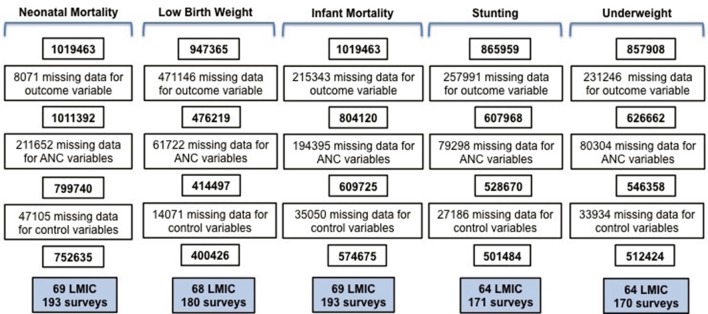
Participants: The analytical sample consisted of 752 635 observations for neonatal mortality, 574 675 observations for infant mortality, 400 426 observations for low birth weight, 501 484 observations for stunting and 512 424 observations for underweight.
Main outcomes and measures: Outcome variables are neonatal and infant mortality, low birth weight, stunting and underweight.
Results: At least one ANC visit was associated with a 1.04% points reduced probability of neonatal mortality and a 1.07% points lower probability of infant mortality. Having at least four ANC visits and having at least once seen a skilled provider reduced the probability by an additional 0.56% and 0.42% points, respectively. At least one ANC visit is associated with a 3.82% points reduced probability of giving birth to a low birth weight baby and a 4.11 and 3.26% points reduced stunting and underweight probability. Having at least four ANC visits and at least once seen a skilled provider reduced the probability by an additional 2.83%, 1.41% and 1.90% points, respectively.
Conclusions: The currently existing and accessed ANC services in low-income and middle-income countries are directly associated with improved birth outcomes and longer-term reductions of child mortality and malnourishment.
Keywords: epidemiology; perinatology.
© Article author(s) (or their employer(s) unless otherwise stated in the text of the article) 2017. All rights reserved. No commercial use is permitted unless otherwise expressly granted.
Conflict of interest statement
Competing interests: None declared.
Figures
References
-
- UN Sustainable Development Goals. Goal 3: ensure healthy lives and promote well-being for all at all ages. United Nations Sustainable Development Home page; 2017. http://www.un.org/sustainabledevelopment/health/ (accessed Aug 12 2017).
-
- WHO. Global Health Observatory (GHO) data: Neonatal Mortality. World Health Organization. 2017. http://www.who.int/gho/child_health/mortality/neonatal_text/en/ (accessed 12 Aug 2017).
-
- UNICEF. Committing to child survival: a promise renewed. Progress report 2015. United Nations Children’s Fund. 2015.
-
- Gupta A. Breastfeeding and child health. Economic and Political Weekly 2006.
MeSH terms
LinkOut - more resources
Full Text Sources
Other Literature Sources
Medical
