


Benefits and risks of Iron interventions in children (BRISC): protocol for a three-arm parallel-group randomised controlled field trial in Bangladesh
- PMID: 29146650
- PMCID: PMC5695407
- DOI: 10.1136/bmjopen-2017-018325
Benefits and risks of Iron interventions in children (BRISC): protocol for a three-arm parallel-group randomised controlled field trial in Bangladesh
Abstract
Introduction: Anaemia is a major global health problem affecting about 43% of preschool children globally and 60% of 6-24-month-old children in rural Bangladesh, half of which is attributed to iron deficiency (ID). Although WHO recommends universal supplementation with iron or home fortification with iron-containing multiple micronutrient powders (MMPs) to children under 2 years, evidence for benefits of these interventions on childhood development (a key rationale for these interventions) and harms (especially infection) remains limited. This study aims to evaluate the impact of iron or MMPs supplementation compared with placebo on (a) children's development, (b) growth, (c) morbidity from infections and (d) haematological and iron indices.
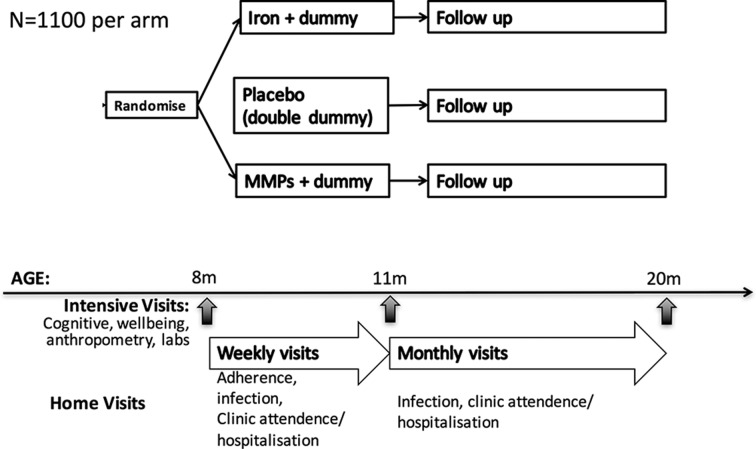
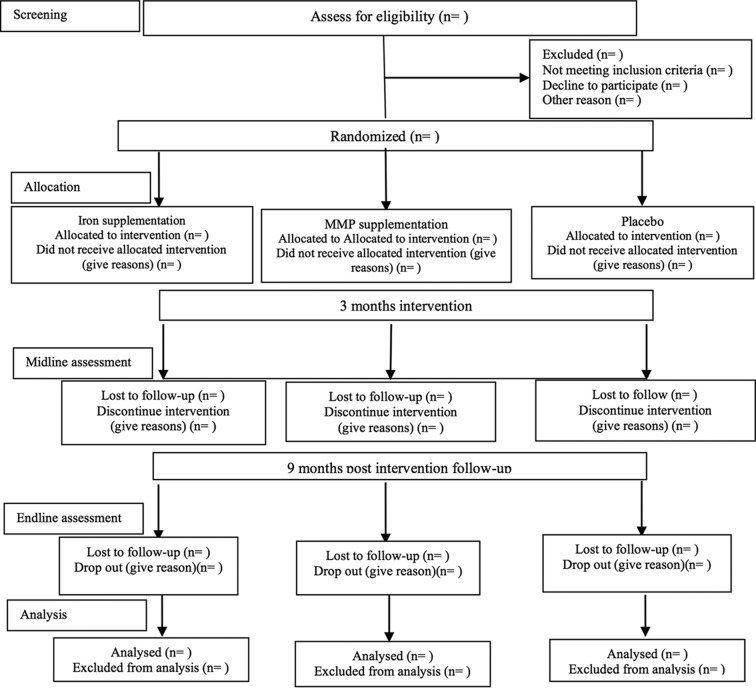
Methods and analysis: This study is a three-arm, blinded, double-dummy, parallel-group, placebo-controlled superiority trial using stratified individual block randomisation. The trial will randomise 3300 children aged 8-9 months equally to arm 1: iron syrup (12.5 mg elemental iron), placebo MMPs; arm 2: MMPs (including 12.5 mg elemental iron), placebo syrup; and arm 3: placebo syrup, placebo MNPs. Children will receive interventions for 3 months based on WHO recommendations and then be followed up for 9 months post intervention. The primary outcome is cognitive composite score measured by Bayley III. Secondary outcomes include motor and language composite score by Bayley III, behaviour rating using selected items from Wolke's rating scales and BSID-II behaviour ratings, temperament, growth, haemoglobin, anaemia and iron status, and infectious morbidity. Outcomes will be measured at baseline, at the end of 3-month intervention and after 9 months postintervention follow-up.
Ethics and dissemination: The trial has been approved by the Ethical Review Committee of icddr,b (Dhaka, Bangladesh) and the Melbourne Health Human Research Ethics Committee (Melbourne, Australia). Results of the study will be disseminated through scientific publications, presentations at international meetings and policy briefs to key stakeholders.
Trial registration number: ACTRN12617000660381;Pre-results.
Who universal trial number: U1111-1196-1125.
Keywords: anaemia; bangladesh; children; cognitive development; iron deficiency; randomized controlled trial.
© Article author(s) (or their employer(s) unless otherwise stated in the text of the article) 2017. All rights reserved. No commercial use is permitted unless otherwise expressly granted.
Conflict of interest statement
Competing interests: None declared.
Figures
References
-
- Stevens GA, Finucane MM, De-Regil LM, et al. Global, regional, and national trends in haemoglobin concentration and prevalence of total and severe anaemia in children and pregnant and non-pregnant women for 1995-2011: a systematic analysis of population-representative data. Lancet Glob Health 2013;1:e16–25. 10.1016/S2214-109X(13)70001-9 - DOI - PMC - PubMed
-
- Tofail F. Prevalence of iron deficiency anaemia among young children in rural Bangladesh. Health and Science Bulletin 2010;8:1–6.
-
- Pasricha SR, Flecknoe-Brown SC, Allen KJ, et al. Diagnosis and management of iron deficiency anaemia: a clinical update. Med J Aust 2010;193:525–32. - PubMed
Publication types
MeSH terms
Substances
LinkOut - more resources
Full Text Sources
Other Literature Sources
Medical
