Review
. 2017 Nov 16;474(23):3935-3950.
doi: 10.1042/BCJ20170377.

Holistic bioengineering: rewiring central metabolism for enhanced bioproduction

Affiliations
Review

Holistic bioengineering: rewiring central metabolism for enhanced bioproduction

Selçuk Aslan et al. Biochem J. .

Abstract

What does it take to convert a living organism into a truly productive biofactory? Apart from optimizing biosynthesis pathways as standalone units, a successful bioengineering approach must bend the endogenous metabolic network of the host, and especially its central metabolism, to support the bioproduction process. In practice, this usually involves three complementary strategies which include tuning-down or abolishing competing metabolic pathways, increasing the availability of precursors of the desired biosynthesis pathway, and ensuring high availability of energetic resources such as ATP and NADPH. In this review, we explore these strategies, focusing on key metabolic pathways and processes, such as glycolysis, anaplerosis, the TCA (tricarboxylic acid) cycle, and NADPH production. We show that only a holistic approach for bioengineering - considering the metabolic network of the host organism as a whole, rather than focusing on the production pathway alone - can truly mold microorganisms into efficient biofactories.

Keywords: NADPH production; TCA cycle; anaplerosis; central metabolism; glycolysis; metabolic engineering.


Conflict of interest statement

The Authors declare that there are no competing interests associated with the manuscript.

Figures
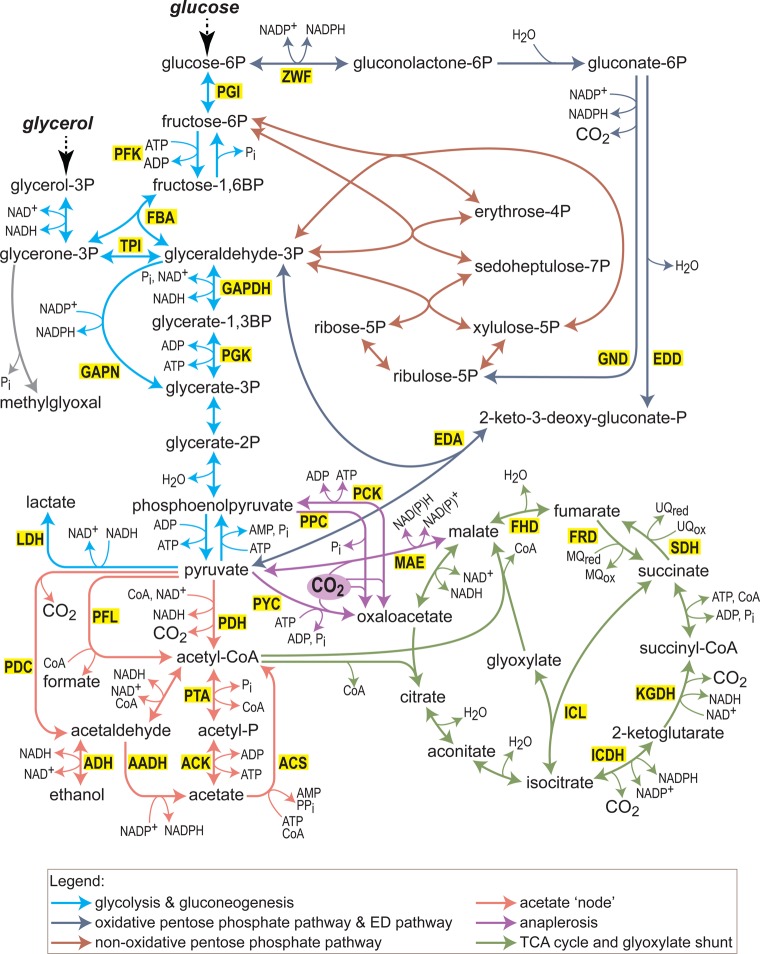
Figure 1.
Figure 1.. An overview of the structure of central metabolism in model organisms, such as E. coli, C. glutamicum, and S. cerevisiae, as discussed in the present paper.
Each organism possesses only a subset of the enzymes shown in the figure. Compartmental separation (in case of eukaryotic organisms) is not shown. Glucose and glycerol are shown as representative carbon feedstocks. We have divided central metabolism into different generalized pathways, as indicated by the colors of the arrows. Enzymes mentioned in the text are shown with a yellow background. Some anaplerotic reactions use bicarbonate instead of CO2; for the sake of simplicity, we write CO2 as the substrate of all of them. Abbreviations: ACK, acetate kinase; ACS, acetyl-CoA synthetase; ADH, alcohol dehydrogenase; AADH, acetaldehyde dehydrogenase; EDA, 2-keto-3-deoxygluconate 6-phosphate aldolase; EDD, phosphogluconate dehydratase; FBA, fructose-bisphosphate aldolase; FHD, fumarate hydratase; FRT, fumarate reductase; GAPDH, glyceraldehyde 3-phosphate dehydrogenase (phosphorylating); GAPN, non-phosphorylating glyceraldehyde 3-phosphate dehydrogenase; GND, 6-phosphogluconate dehydrogenase (decarboxylating); ICDH, isocitrate dehydrogenase; ICL, isocitrate lyase; KGDH, 2-ketoglutarate dehydrogenase; LDH, lactate dehydrogenase; MAE, malic enzyme; PKF, 6-phosphofructokinase; PGI, glucose-6-phosphate isomerase; PGK, phosphoglycerate kinase; PCK, phosphoenolpyruvate carboxykinase; PDC, pyruvate decarboxylase; PDH, pyruvate dehydrogenase; PFL, pyruvate formate-lyase; PPC, phosphoenolpyruvate carboxylase; PTA, phosphate acetyltransferase; PYC, pyruvate carboxylase; SDH, succinate dehydrogenase; TPI, triose-phosphate isomerase; ZWF, NADP+-dependent glucose-6-phosphate dehydrogenase.
Figure 2.
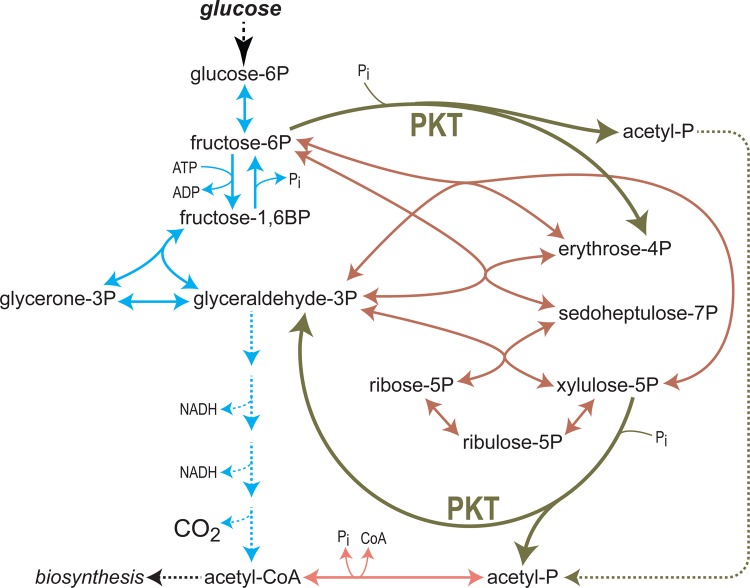
Figure 2.. PKT enables direct conversion of sugar phosphates to acetyl phosphate and thus acetyl-CoA.
The two reactions catalyzed by the PKT are shown in dark green. Note that the conversion of sugars to acetyl-CoA via PKT is carbon- and redox-neutral, while glycolysis emits CO2 and generates two NADH molecules per each acetyl-CoA produced.
Figure 3.
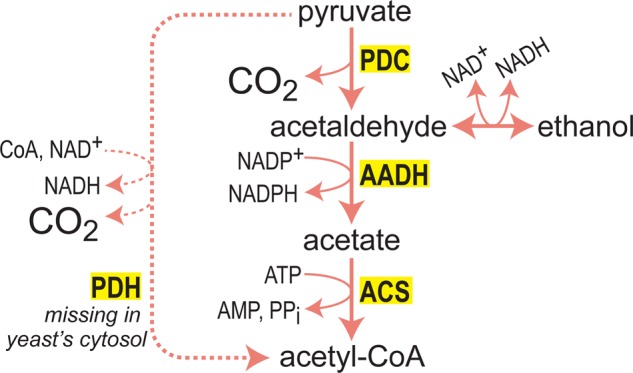
Figure 3.. A synthetic ‘pyruvate dehydrogenase shunt’ engineered in yeast for increased acetyl-CoA production.
Overexpression of AADH and ACS, in a background of high pyruvate decarboxylase activity, results in a short pathway that converts pyruvate into acetyl-CoA, as is the case for the PDH complex. The PDH shunt, however, dissipates considerably more energy by hydrolyzing ATP.
Figure 4.
Figure 4.. An overview of different anaplerotic reactions and their ATP economy.
PPC and PYK are very efficient carboxylating enzymes, but dissipate an ATP equivalent. PCK and the MAE can perform anaplerosis only at high CO2 and at low rate, but can support the conservation of an ATP equivalent, contributing to high cellular energetic state.
Figure 5.
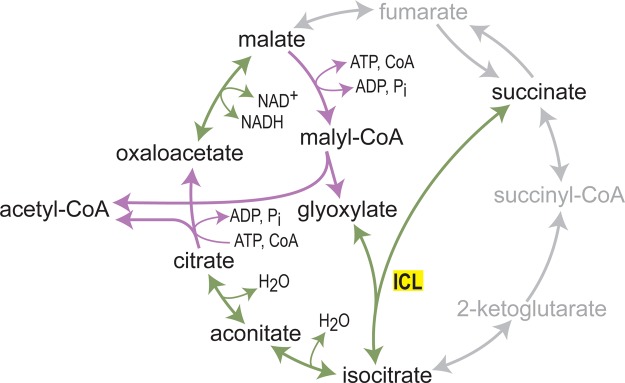
Figure 5.. A reverse glyoxylate shunt, metabolizing succinate into two acetyl-CoA molecules.
Reactions specific to this reverse activity are shown in purple: malyl-CoA synthetase and lyase, and ATP-citrate synthase.
Figure 6.
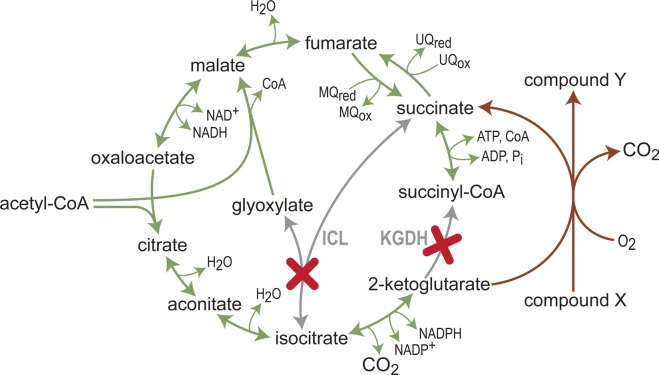
Figure 6.. Coupling cellular growth to a desired bioconversion.
A strain disrupted in isocitrate lyase (ICL) and KGDH cannot grow on a minimal medium as it is blocked in all routes for citrate/isocitrate/2-ketoglutarate recycling. Overexpression of a 2-ketoglutarate-dependent dioxygenase (brown line) provides a sink for 2-ketoglutarate and thus enables growth, while catalyzing the conversion of a feedstock compound X to a desired compound Y.

References

    1. Gu P., Su T. and Qi Q. (2016) Novel technologies provide more engineering strategies for amino acid-producing microorganisms. Appl. Microbiol. Biotechnol. 100, 2097–2105 10.1007/s00253-015-7276-8 - DOI - PubMed
    1. Chu H.S., Ahn J.-H., Yun J., Choi I.S., Nam T.-W. and Cho K.M. (2015) Direct fermentation route for the production of acrylic acid. Metab. Eng. 32, 23–29 10.1016/j.ymben.2015.08.005 - DOI - PubMed
    1. Lin Z., Zhang Y., Yuan Q., Liu Q., Li Y., Wang Z. et al. (2015) Metabolic engineering of Escherichia coli for poly(3-hydroxybutyrate) production via threonine bypass. Microb. Cell Fact. 14, 185 10.1186/s12934-015-0369-3 - DOI - PMC - PubMed
    1. Li L., Li K., Wang Y., Chen C., Xu Y., Zhang L. et al. (2015) Metabolic engineering of Enterobacter cloacae for high-yield production of enantiopure (2R,3R)-2,3-butanediol from lignocellulose-derived sugars. Metab. Eng. 28, 19–27 10.1016/j.ymben.2014.11.010 - DOI - PubMed
    1. Zhao S., Jones J.A., Lachance D.M., Bhan N., Khalidi O., Venkataraman S. et al. (2015) Improvement of catechin production in Escherichia coli through combinatorial metabolic engineering. Metab. Eng. 28, 43–53 10.1016/j.ymben.2014.12.002 - DOI - PubMed

Publication types

LinkOut - more resources