. 2018 Apr;65(2):e317-e328.
doi: 10.1111/tbed.12756. Epub 2017 Nov 16.

A G3P[13] porcine group A rotavirus emerging in China is a reassortant and a natural recombinant in the VP4 gene

Affiliations

A G3P[13] porcine group A rotavirus emerging in China is a reassortant and a natural recombinant in the VP4 gene

Z Jing et al. Transbound Emerg Dis. 2018 Apr.

Abstract

Group A rotaviruses (RVAs) are a major cause of serious intestinal disease in piglets. In this study, a novel pig strain was identified in a stool sample from China. The strain was designated RVA/Pig/China/LNCY/2016/G3P[13] and had a G3-P[13]-I5-R1-C1-M1-A8-N1-T1-E1-H1 genome. The viral protein 7 (VP7) and non-structural protein 4 (NSP4) genes of RVA/Pig/China/LNCY/2016/G3P[13] were closely related to cogent genes of human RVAs, suggesting that a reassortment between pig and human strains had occurred. Recombination analysis showed that RVA/Pig/China/LNCY/2016/G3P[13] is a natural recombinant strain between the P[23] and P[7] RVA strains, and crossover points for recombination were found at nucleotides (nt) 456 and 804 of the VP4 gene. Elucidating the biological characteristics of porcine rotavirus (PoRV) will be helpful for further analyses of the epidemic characteristics of this virus. The results of this study provide valuable information for RVA recombination and evolution and will facilitate future investigations into the molecular pathogenesis of RVAs.

Keywords: VP4; porcine group A rotavirus; reassortant; recombinant.


Figures

Figure 1
Figure 1
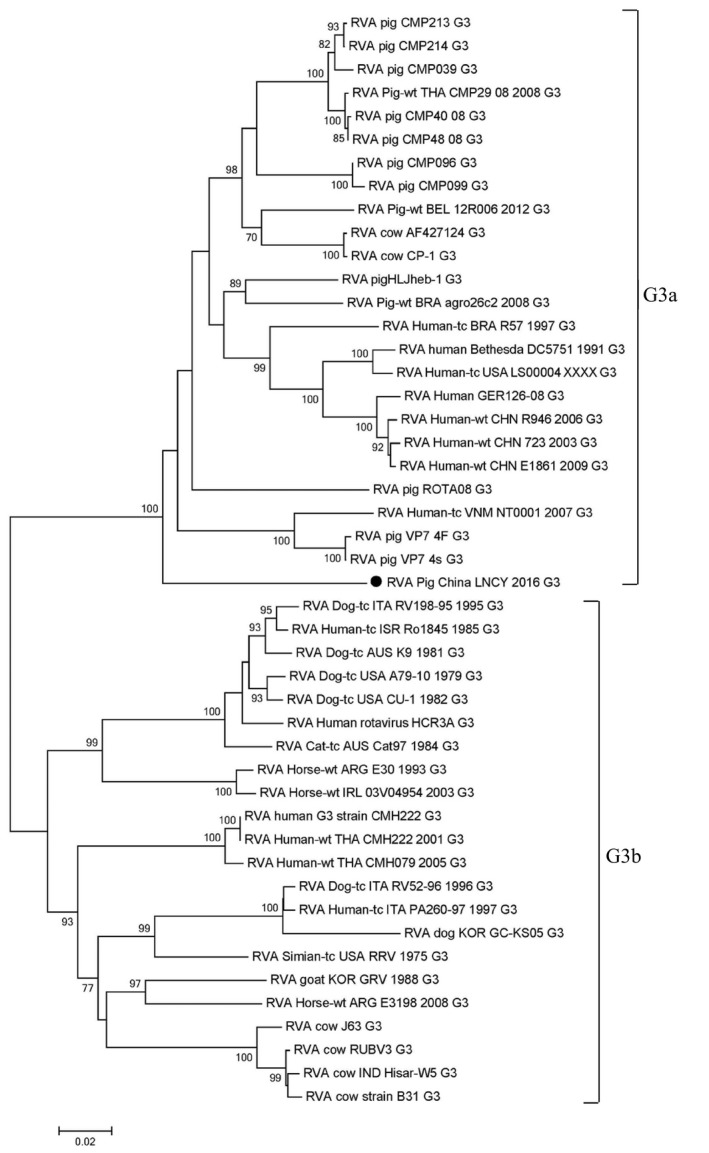
Phylogenetic analysis of RVA/Pig/China/LNCY/2016/G3P[13] based on the VP7 sequence in the G3 genotype. Phylogenetic trees were constructed using the Construct/Test Neighbour‐Joining method with MEGA 5.2 software, and tree reliability was evaluated using the bootstrap method with 1,000 replications. Only bootstrap values >70% at branch points are shown
Figure 2
Figure 2
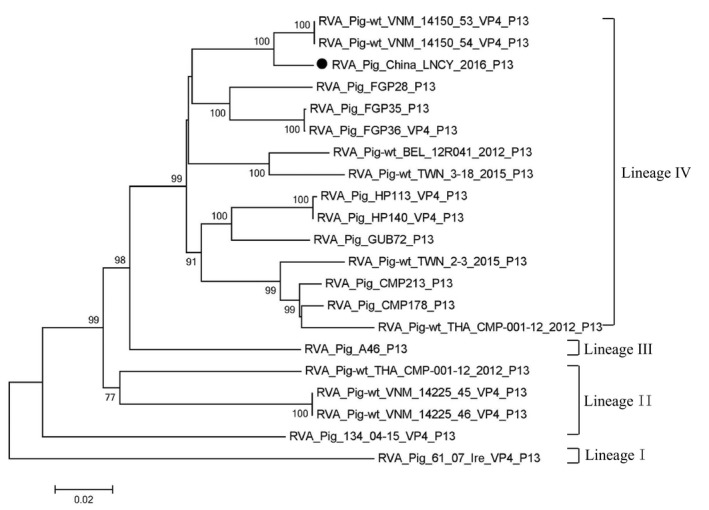
Phylogenetic analysis of RVA/Pig/China/LNCY/2016/G3P[13] based on the VP4 sequence in the P[13] genotype. Phylogenetic trees were constructed using the Construct/Test Neighbour‐Joining Tree method with MEGA 5.2 software, and tree reliability was evaluated using the bootstrap method with 1,000 replications. Only bootstrap values >70% at branch points are shown
Figure 3
Figure 3
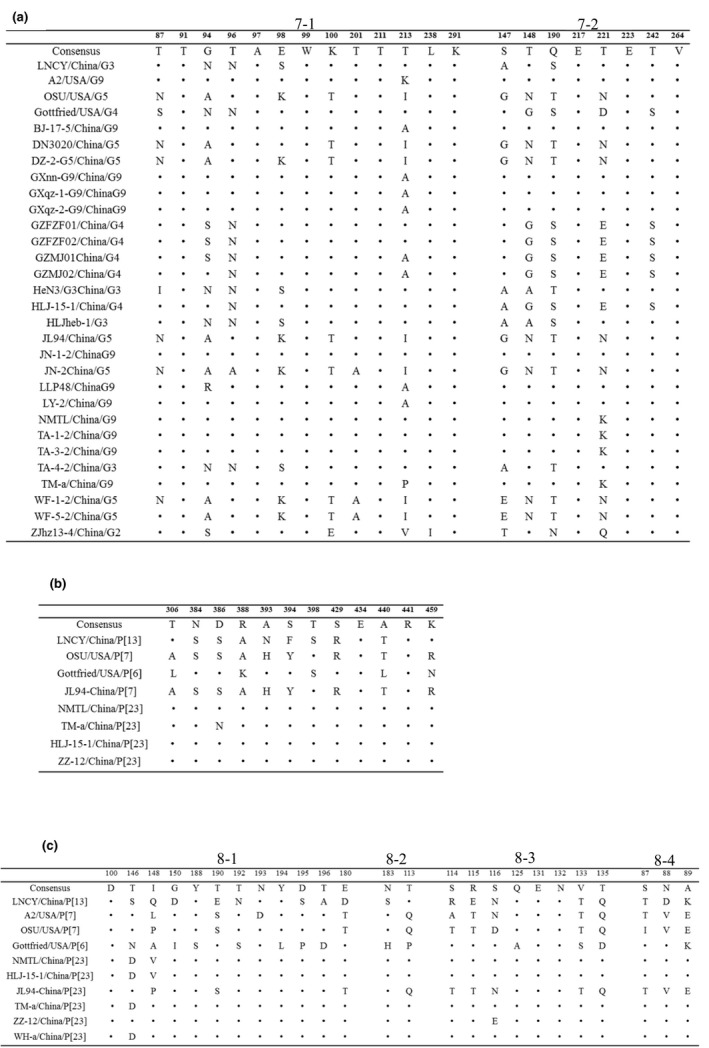
Neutralizing epitopes on the VP7 and VP4 (VP5* and VP8*) proteins in Chinese strains. (a) Neutralizing epitopes on the VP7 protein. (b) Neutralizing epitopes on the VP5* protein. (c) Neutralizing epitopes on the VP8* protein. Dots represent the same residues
Figure 4
Figure 4
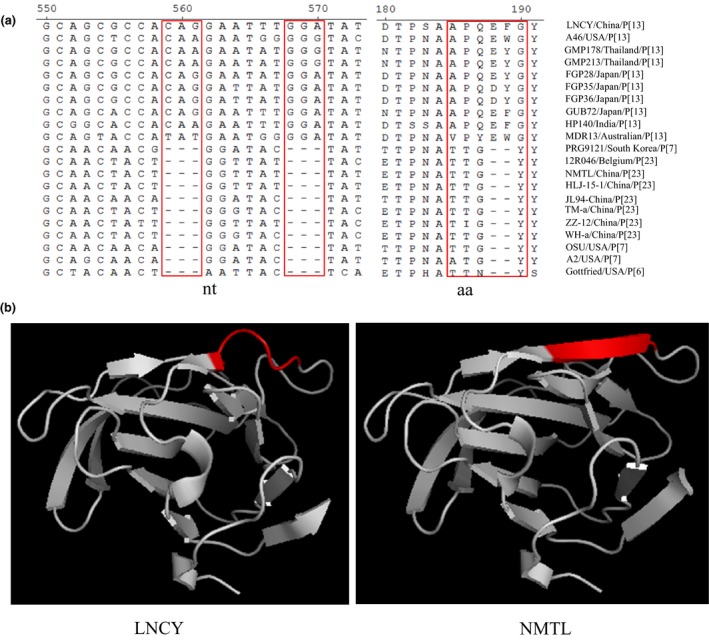
A two‐aa deletion in the VP8* protein. (a) six‐nt deletions and a two‐aa deletion in the VP8 protein of a Chinese strain. (b) Specific structures of the VP8* protein (70‐210 aa) from RVA/Pig/China/LNCY/2016/G3P[13] and RVA/Pig/China/NMTL. LNCY represents RVA/Pig/China/LNCY/2016/G3P[13], and NMTL represents RVA/Pig/China/NMTL
Figure 5
Figure 5
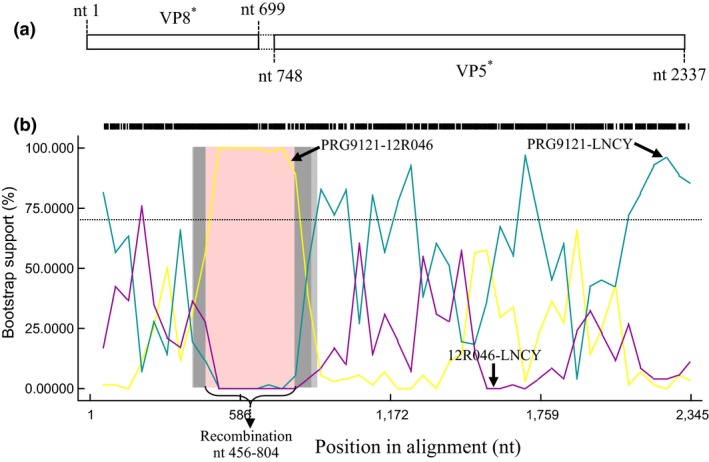
Recombination analysis of RVA/Pig/China/LNCY/2016/G3P[13] and other PoRV strains in the VP4 gene. (a) VP4 gene organization of PoRV. (b) Recombination analysis of the VP4 gene in RVA/Pig/China/LNCY/2016/G3P[13], RVA/Pig/PRG9121/2006/G9P[7] and RVA/Pig‐wt/BEL/12R046/2012/G9P[23]. LNCY represents RVA/Pig/China/LNCY/2016/G3P[13] (MF462324), PRG9121 represents RVA/Pig/PRG9121/2006/G9P[7] (JF796737), and 12R046 represents RVA/Pig‐wt/BEL/12R046/2012/G9P[23] (KM820720). Recombination crossover points are located at nt 456‐804

References

    1. Amimo, J. O. , El Zowalaty, M. E. , Githae, D. , Wamalwa, M. , Djikeng, A. , & Nasrallah, G. K. (2016). Metagenomic analysis demonstrates the diversity of the fecal virome in asymptomatic pigs in East Africa. Archives of Virology, 161, 887–897. 10.1007/s00705-016-2819-6 - DOI - PubMed
    1. Amimo, J. O. , Otieno, T. F. , Okoth, E. , Onono, J. O. , & Bett, B. (2017). Risk factors for rotavirus infection in pigs in Busia and Teso subcounties. Western Kenya. Tropi. Anim. Health Pro., 49, 105–112. 10.1007/s11250-016-1164-9 - DOI - PubMed
    1. Amimo, J. O. , Vlasova, A. N. , & Saif, L. J. (2013). Detection and genetic diversity of porcine group A rotaviruses in historic (2004) and recent (2011 and 2012) swine fecal samples in Ohio: Predominance of the G9P[13] genotype in nursing piglets. Journal of Clinical Microbiology, 51, 1142–1151. 10.1128/JCM.03193-12 - DOI - PMC - PubMed
    1. Aoki, S. T. , Settembre, E. C. , Trask, S. D. , Greenberg, H. B. , Harrison, S. C. , & Dormitzer, P. R. (2009). Structure of rotavirus outer‐layer protein VP7 bound with a neutralizing Fab. Science, 324, 1444–1447. 10.1126/science.1170481 - DOI - PMC - PubMed
    1. Banyai, K. , Esona, M. D. , Mijatovic, S. , Kerin, T. K. , Pedreira, C. , Mercado, J. , … Gentsch, J. R. (2009). Zoonotic bovine rotavirus strain in a diarrheic child. Nicaragua. J. Clin. Virol., 46, 391–393. 10.1016/j.jcv.2009.08.005 - DOI - PubMed

MeSH terms

Associated data