. 2017 Dec;23(12):1974-1981.
doi: 10.3201/eid2312.171062.

Multiple Reassorted Viruses as Cause of Highly Pathogenic Avian Influenza A(H5N8) Virus Epidemic, the Netherlands, 2016

Multiple Reassorted Viruses as Cause of Highly Pathogenic Avian Influenza A(H5N8) Virus Epidemic, the Netherlands, 2016

Nancy Beerens et al. Emerg Infect Dis. 2017 Dec.

Abstract

In 2016, an epidemic of highly pathogenic avian influenza A virus subtype H5N8 in the Netherlands caused mass deaths among wild birds, and several commercial poultry farms and captive bird holdings were affected. We performed complete genome sequencing to study the relationship between the wild bird and poultry viruses. Phylogenetic analysis showed that the viruses are related to H5 clade 2.3.4.4 viruses detected in Russia in May 2016 but contained novel polymerase basic 2 and nucleoprotein gene segments and 2 different variants of the polymerase acidic segment. Molecular dating suggests that the reassortment events most likely occurred in wild birds in Russia or Mongolia. Furthermore, 2 genetically distinct H5N5 reassortant viruses were detected in wild birds in the Netherlands. Our study provides evidence for fast and continuing reassortment of H5 clade 2.3.4.4 viruses, which might lead to rapid changes in virus characteristics, such as pathogenicity, infectivity, transmission, and zoonotic potential.

Keywords: H5N8; HPAIV; Holland; avian influenza virus; complete genome sequencing; epidemic; highly pathogenic avian influenza virus; influenza; molecular clock; outbreak; phylogenetic analysis; reassortment; respiratory infections; the Netherlands; viruses; whole-genome sequencing.


Figures
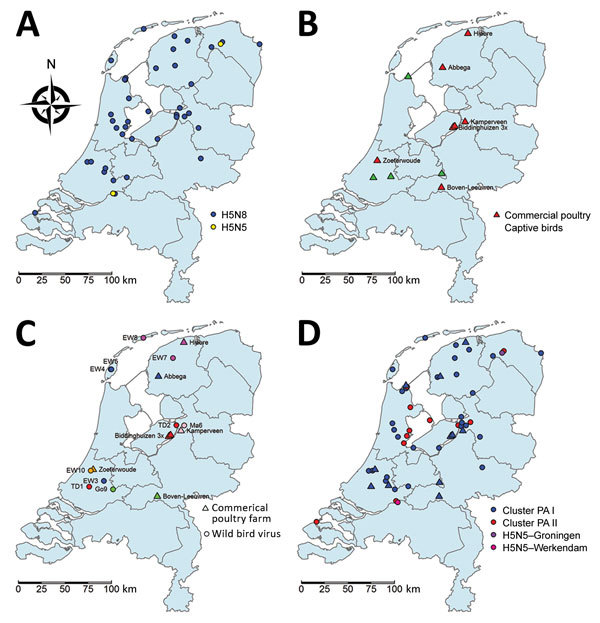
Figure 1
Figure 1
Geographic distribution of wild and captive birds and commercial poultry infected with highly pathogenic avian influenza A virus, the Netherlands, 2016. A) Location of dead wild birds infected with highly pathogenic avian influenza A virus subtypes H5N8 and H5N5; B) location of commercial poultry farms and captive birds infected with H5N8; C) location of H5N8-affected commercial poultry farms (open triangles), with the most identical wild bird viruses (open circles) shown in similar colors (wild bird virus isolates used for this analysis are numbered 1–10; Technical Appendix 1 Table 2); D) location of H5N8 viruses with gene segment PA I and PA II for commercial poultry farms and captive bird holdings and wild birds. Also shown are the H5N5 viruses isolated in Groningen and Werkendam. EW, Eurasian wigeon; Go, gray goose; Ma, mallard; PA, polymerase acidic; TD, tufted duck.
Figure 2
Figure 2
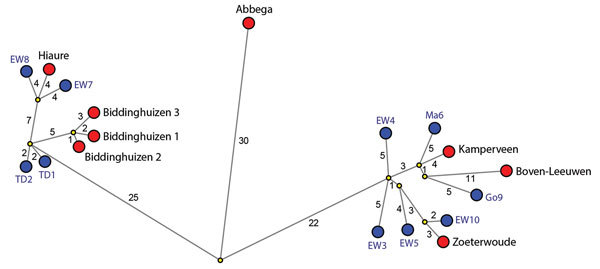
Median-joining network showing the genetic relationship between highly pathogenic avian influenza A viruses subtype H5N8 isolated from commercial poultry farms (red circles) and the most identical wild bird viruses (blue circles) found in the Netherlands, 2016. Predicted median vectors are shown in yellow. The length of the line represents the genetic distance, and the number of nucleotide changes is indicated. Wild bird virus isolates used for this analysis are numbered 1–10 (Technical Appendix 1 Table 2). GISAID EpiFlu database (https://www.gisaid.org) accession numbers are shown in Technical Appendix 1 Table 1. EW, Eurasian wigeon; Go, gray goose; Ma, mallard; TD,= tufted duck.
Figure 3
Figure 3
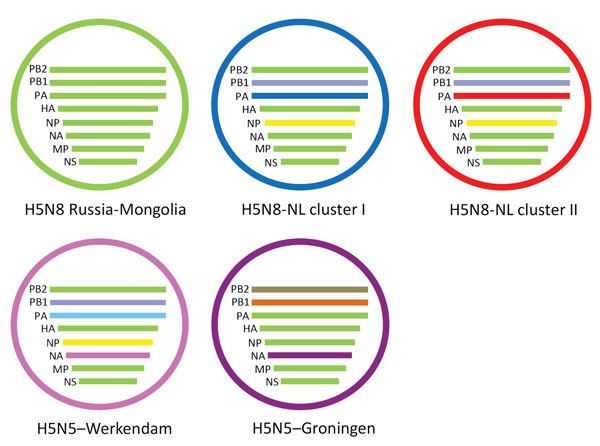
Schematic representation of the reassortant highly pathogenic avian influenza A virus subtypes H5N8 and H5N5 detected in the Netherlands, 2016. The Russia-Mongolia ancestor is shown in green. NL clusters 1 (blue) and 2 (red) viruses obtained novel PB2 and NP gene segments and 2 different PA segments. Two genetically distinct H5N5 viruses were detected, 1 in a tufted duck in Werkendam (pink) and 1 in a mute swan near Groningen (purple). HA, hemagglutinin; MP, matrix protein; NA, neuraminidase; NL, Netherlands; NP, nucleoprotein; NS, nonstructural protein; PA, polymerase acidic; PB1, polymerase basic 1; PB2, polymerase basic 2.
Figure 4
Figure 4
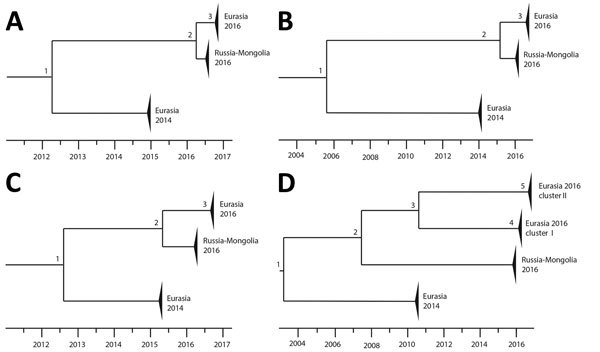
Schematic representation of the molecular dating analysis of highly pathogenic avian influenza A virus subtypes H5N8 and H5N5 detected in the Netherlands, 2016. Time-scaled phylogenetic trees are shown for 4 gene segments: A) hemagglutinin; B) polymerase basic 2; C) nucleoprotein; and D) polymerase acidic. For each of the numbered nodes, calculated time of most recent common ancestor, 95% highest posterior density interval, and posterior are listed in the Table.

References

    1. Xu X, Subbarao, Cox NJ, Guo Y. Genetic characterization of the pathogenic influenza A/Goose/Guangdong/1/96 (H5N1) virus: similarity of its hemagglutinin gene to those of H5N1 viruses from the 1997 outbreaks in Hong Kong. Virology. 1999;261:15–9. 10.1006/viro.1999.9820 - DOI - PubMed
    1. Ellis TM, Bousfield RB, Bissett LA, Dyrting KC, Luk GS, Tsim ST, et al. Investigation of outbreaks of highly pathogenic H5N1 avian influenza in waterfowl and wild birds in Hong Kong in late 2002. Avian Pathol. 2004;33:492–505. 10.1080/03079450400003601 - DOI - PubMed
    1. Olsen B, Munster VJ, Wallensten A, Waldenström J, Osterhaus AD, Fouchier RA. Global patterns of influenza a virus in wild birds. Science. 2006;312:384–8. 10.1126/science.1122438 - DOI - PubMed
    1. Kilpatrick AM, Chmura AA, Gibbons DW, Fleischer RC, Marra PP, Daszak P. Predicting the global spread of H5N1 avian influenza. Proc Natl Acad Sci U S A. 2006;103:19368–73. 10.1073/pnas.0609227103 - DOI - PMC - PubMed
    1. Reid SM, Shell WM, Barboi G, Onita I, Turcitu M, Cioranu R, et al. First reported incursion of highly pathogenic notifiable avian influenza A H5N1 viruses from clade 2.3.2 into European poultry. Transbound Emerg Dis. 2011;58:76–8. 10.1111/j.1865-1682.2010.01175.x - DOI - PMC - PubMed

MeSH terms

LinkOut - more resources