


Development of Novel Polymorphic EST-SSR Markers in Bailinggu (Pleurotus tuoliensis) for Crossbreeding
- PMID: 29149037
- PMCID: PMC5704238
- DOI: 10.3390/genes8110325
Development of Novel Polymorphic EST-SSR Markers in Bailinggu (Pleurotus tuoliensis) for Crossbreeding
Abstract
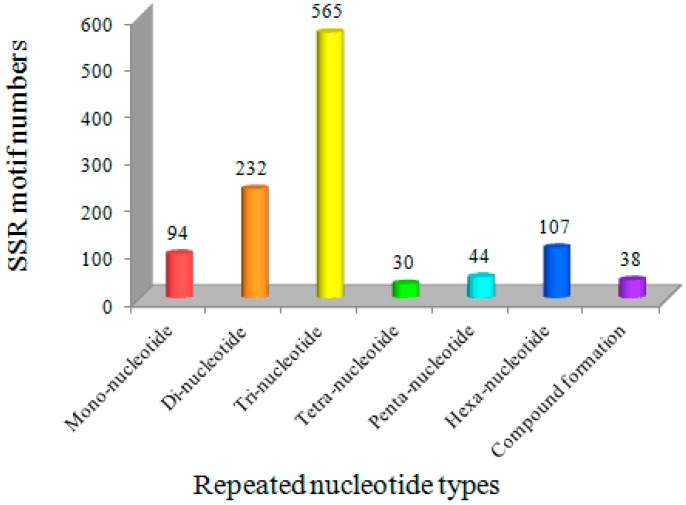
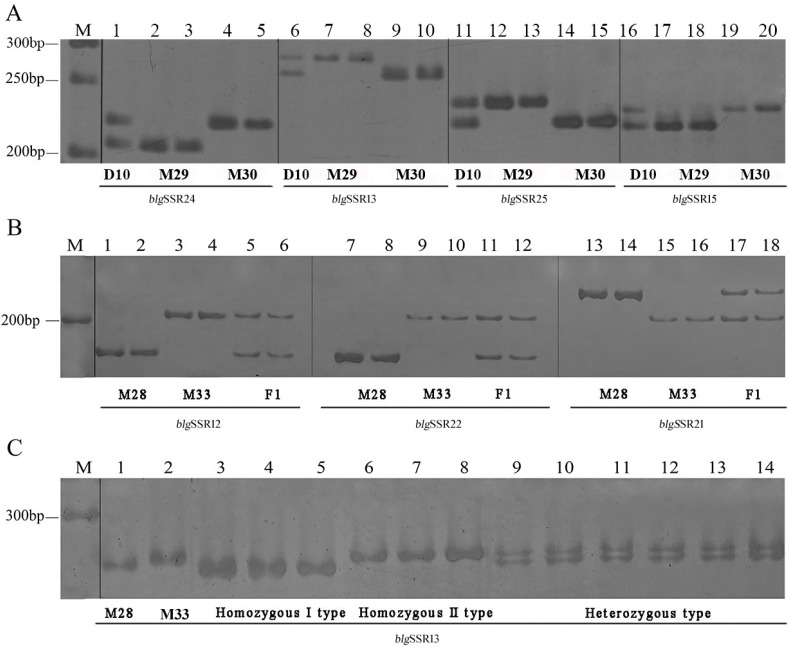
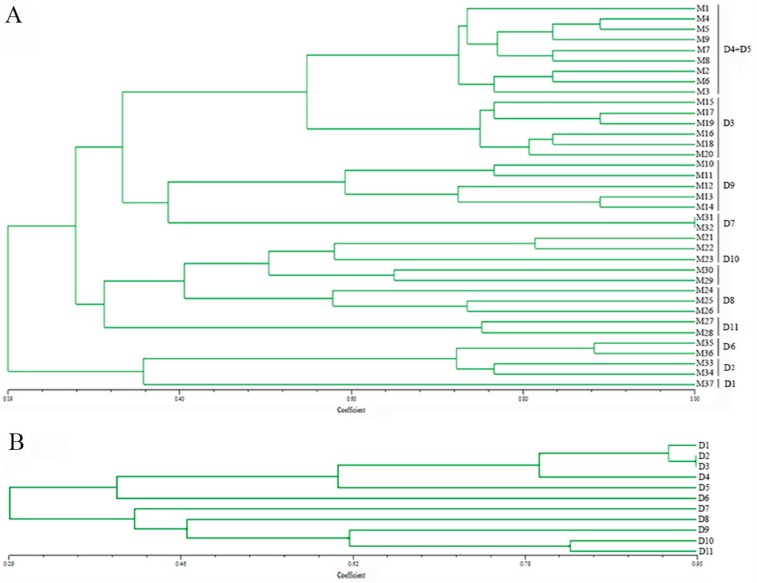
Identification of monokaryons and their mating types and discrimination of hybrid offspring are key steps for the crossbreeding of Pleurotus tuoliensis (Bailinggu). However, conventional crossbreeding methods are troublesome and time consuming. Using RNA-seq technology, we developed new expressed sequence tag-simple sequence repeat (EST-SSR) markers for Bailinggu to easily and rapidly identify monokaryons and their mating types, genetic diversity and hybrid offspring. We identified 1110 potential EST-based SSR loci from a newly-sequenced Bailinggu transcriptome and then randomly selected 100 EST-SSRs for further validation. Results showed that 39, 43 and 34 novel EST-SSR markers successfully identified monokaryons from their parent dikaryons, differentiated two different mating types and discriminated F₁ and F₂ hybrid offspring, respectively. Furthermore, a total of 86 alleles were detected in 37 monokaryons using 18 highly informative EST-SSRs. The observed number of alleles per locus ranged from three to seven. Cluster analysis revealed that these monokaryons have a relatively high level of genetic diversity. Transfer rates of the EST-SSRs in the monokaryons of closely-related species Pleurotuseryngii var. ferulae and Pleurotus ostreatus were 72% and 64%, respectively. Therefore, our study provides new SSR markers and an efficient method to enhance the crossbreeding of Bailinggu and closely-related species.
Keywords: Pleurotus tuoliensis; expressed sequence tag-simple sequence repeat; genetic diversity; monokaryon; transferability.
Conflict of interest statement
The authors declare that they have no competing financial interests.
Figures
References
-
- Kawai G., Babasaki K., Neda H. Taxonomic position of a Chinese Pleurotus “Bai-Ling-Gu”, it belongs to Pleurotus eryngii (DC., Fr.) Quél. and evolved independently in China. Mycoscience. 2008;49:75–87. doi: 10.1007/S10267-007-0392-2. - DOI
-
- Mou C.J., Cao Y.Q., Ma J.L. A new variety of Pleurotus eryngii and its cultural characters. Acta Mycol. Sin. 1987;6:153–156.
-
- Zervakis G.I., Ntougias S., Gargano M.L., Besi M.I., Polemis E., Typas M.A., Venturella G. A reappraisal of the Pleurotus eryngii complex—New species and taxonomic combinations based on the application of a polyphasic approach, and an identification key to Pleurotus taxa associated with Apiaceae plants. Fungal Biol. 2014;118:814–834. doi: 10.1016/j.funbio.2014.07.001. - DOI - PubMed
-
- Fu Y.P., Yueting Dai Y.T., Yang C.T., Wei P., Song B., Yang Y., Sun L., Zhang Z.W., Li Y. Comparative transcriptome analysis identified candidate genes related to Bailinggu mushroom formation and genetic markers for genetic analyses and breeding. Sci. Rep. 2017;7:9266. doi: 10.1038/s41598-017-08049-z. - DOI - PMC - PubMed
LinkOut - more resources
Full Text Sources
Other Literature Sources
Research Materials
Miscellaneous
