


Micronutrient Deficiencies among Breastfeeding Infants in Tanzania
- PMID: 29149073
- PMCID: PMC5707730
- DOI: 10.3390/nu9111258
Micronutrient Deficiencies among Breastfeeding Infants in Tanzania
Abstract
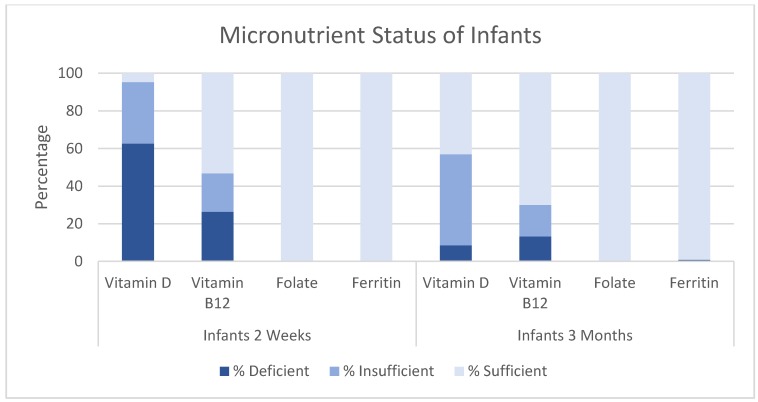
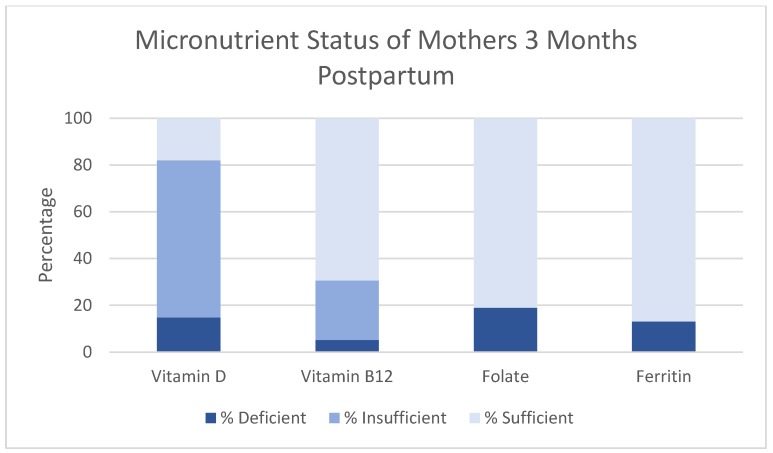
Infant mortality accounts for the majority of child deaths in Tanzania, and malnutrition is an important underlying cause. The objectives of this cross-sectional study were to describe the micronutrient status of infants in Tanzania and assess predictors of infant micronutrient deficiency. We analyzed serum vitamin D, vitamin B12, folate, and ferritin levels from 446 infants at two weeks of age, 408 infants at three months of age, and 427 mothers three months post-partum. We used log-Poisson regression to estimate relative risk of being deficient in vitamin D and vitamin B12 for infants in each age group. The prevalence of vitamin D and vitamin B12 deficiency decreased from 60% and 30% at two weeks to 9% and 13% at three months respectively. Yet, the prevalence of insufficiency at three months was 49% for vitamin D and 17% for vitamin B12. Predictors of infant vitamin D deficiency were low birthweight, urban residence, maternal education, and maternal vitamin D status. Maternal vitamin B12 status was the main predictor for infant vitamin B12 deficiency. The majority of infants had sufficient levels of folate or ferritin. Further research is necessary to examine the potential benefits of improving infants' nutritional status through vitamin D and B12 supplements.
Keywords: Tanzania; infants; micronutrients; vitamin B12; vitamin D.
Conflict of interest statement
The authors declare no conflict of interest.
Figures
References
-
- Wang H., Bhutta Z.A., Coates M.M., Coggeshall M., Dandona L., Diallo K., Franca E.B., Fraser M.F., Nancy G., Peter W., et al. Global, regional, national, and selected subnational levels of stillbirths, neonatal, infant, and under-5 mortality, 1980–2015: A systematic analysis for the Global Burden of Disease Study 2015. Lancet. 2016;388:1725–1774. doi: 10.1016/S0140-6736(16)31575-6. - DOI - PMC - PubMed
-
- UNDP Sustainable Development Goals: Goal 3: Good Health and Well Being: Goal 3 Targets. [(accessed on 30 April 2017)]; Available online: http://www.undp.org/content/undp/en/home/sustainable-development-goals/g...
-
- UN Inter-Agency Group for Child Mortality Estimation . Levels and Trends in Child Mortality. UNICEF; New York, NY, USA: 2015. [(accessed on 30 April 2017)]. Report. Available online: https://www.unicef.org/publications/files/Child_Mortality_Report_2015_We....
MeSH terms
Substances
LinkOut - more resources
Full Text Sources
Other Literature Sources
Medical
