


Predicting Nano-Bio Interactions by Integrating Nanoparticle Libraries and Quantitative Nanostructure Activity Relationship Modeling
- PMID: 29149552
- PMCID: PMC5772766
- DOI: 10.1021/acsnano.7b07093
Predicting Nano-Bio Interactions by Integrating Nanoparticle Libraries and Quantitative Nanostructure Activity Relationship Modeling
Abstract
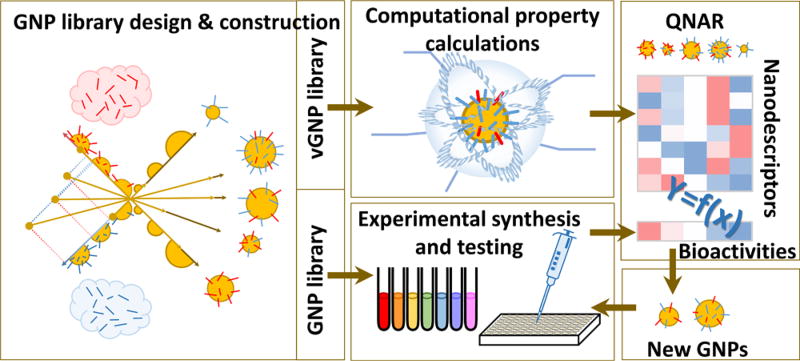
The discovery of biocompatible or bioactive nanoparticles for medicinal applications is an expensive and time-consuming process that may be significantly facilitated by incorporating more rational approaches combining both experimental and computational methods. However, it is currently hindered by two limitations: (1) the lack of high-quality comprehensive data for computational modeling and (2) the lack of an effective modeling method for the complex nanomaterial structures. In this study, we tackled both issues by first synthesizing a large library of nanoparticles and obtained comprehensive data on their characterizations and bioactivities. Meanwhile, we virtually simulated each individual nanoparticle in this library by calculating their nanostructural characteristics and built models that correlate their nanostructure diversity to the corresponding biological activities. The resulting models were then used to predict and design nanoparticles with desired bioactivities. The experimental testing results of the designed nanoparticles were consistent with the model predictions. These findings demonstrate that rational design approaches combining high-quality nanoparticle libraries, big experimental data sets, and intelligent computational models can significantly reduce the efforts and costs of nanomaterial discovery.
Keywords: QNAR modeling; cellular uptake; model predictions; nanomaterial design; nanoparticle library; virtual simulations.
Conflict of interest statement
The authors declare no competing financial interest.
Figures
References
-
- Roco MC. Nanotechnology: Convergence with Modern Biology and Medicine. Curr. Opin. Biotechnol. 2003;14:337–346. - PubMed
-
- Jones R. Nanotechnology, Energy and Markets. Nat. Nanotechnol. 2009;4:75–75. - PubMed
-
- Winkler DA, Mombelli E, Pietroiusti A, Tran L, Worth A, Fadeel B, McCall MJ. Applying Quantitative Structure-Activity Relationship Approaches to Nanotoxicology: Current Status and Future Potential. Toxicology. 2013;313:15–23. - PubMed
-
- Fourches D, Pu D, Tropsha A. Exploring Quantitative Nanostructure-Activity Relationships (QNAR) Modeling as a Tool for Predicting Biological Effects of Manufactured Nanoparticles. Comb. Chem. High Throughput Screening. 2011;14:217–225. - PubMed
-
- Hansen SF, Larsen BH, Olsen SI, Baun A. Categorization Framework to Aid Hazard Identification of Nanomaterials. Nanotoxicology. 2007;1:243–250.
Publication types
MeSH terms
Substances
Grants and funding
LinkOut - more resources
Full Text Sources
Other Literature Sources
