


Prevalence of antibiotic prescription in pediatric outpatients in Italy: the role of local health districts and primary care physicians in determining variation. A multilevel design for healthcare decision support
- PMID: 29149875
- PMCID: PMC5693576
- DOI: 10.1186/s12889-017-4905-4
Prevalence of antibiotic prescription in pediatric outpatients in Italy: the role of local health districts and primary care physicians in determining variation. A multilevel design for healthcare decision support
Abstract
Background: According to scientific literature, antibacterials are prescribed for common pediatric conditions that do not benefit from antibiotic therapy. The link between antibiotic use and bacterial resistance is well known. Antibiotic overprescribing generates high social costs and severe consequences for children. Our objectives were to analyze antibiotic prescription patterns in pediatric outpatients residing in the Lazio region (Italy), to identify physicians' characteristics associated with increased propensity for prescription, to identify the priority axes for action to improve the rational use of antibiotics.
Methods: We enrolled all children aged 13 years or less in 2014. Antibiotic prescription patterns were analyzed during a one-year follow-up period. The main outcome measures were the antibiotic prescription prevalence, and the geographic variation in antibiotic prescribing. Multilevel models were performed to analyze variation. Variation was expressed as Median Odds Ratios (MORs). If the MOR is 1.00, there is no variation between clusters. If there is considerable between-cluster variation, the MOR will be large.
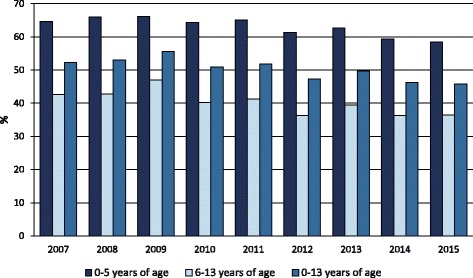
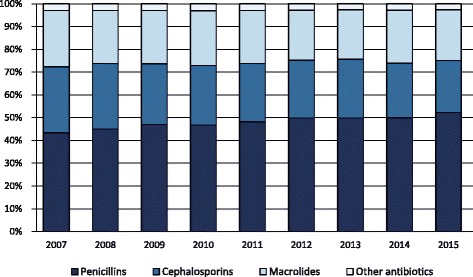
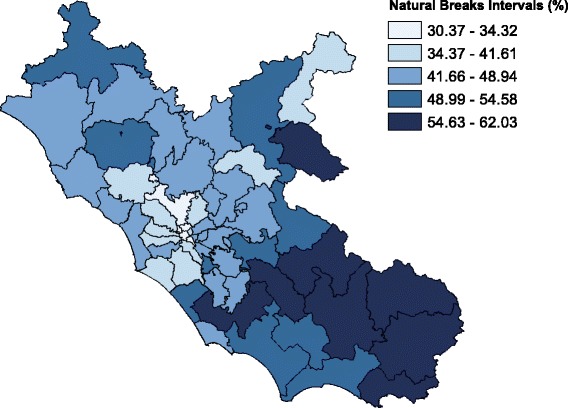
Results: We enrolled 636,911 children. Most of them were aged 6-13 years (57.3%). In 2015, the antibiotic prescription prevalence was 46% in the 0-13, 58% in the 0-5, and 37% in the 6-13 age group. Overall, penicillins were the most prescribed antibiotics, their consumption increased from 43% to 52% during the 2007-2015 period. In 2015, the antibiotic prescription prevalence ranged from 30% to 62% across local health districts (LHDs) of the region. Moreover, a significant (p < 0.001) variation was observed between physicians working in the same LHD: MORs were equal to 1.52 (1.48-1.56) and 1.46 (1.44-1.48) in the 0-5 and 6-13 age groups, respectively. The probability of prescribing antibiotics was significantly (p < 0.001) lower for more-experienced physicians.
Conclusions: Pediatric antibiotic use in the Lazio region is much higher than in other European countries. The intra-regional drug prescribing variability underlines the lack of therapeutic protocols shared at regional level and raises equity issues in access to optimal care. Both LHD managers and individual physicians should be involved in training interventions to improve the targeted use of antibiotics and mitigate the effect of contextual variables, such as the spatial-related socioeconomic status of the patient/parent binomial.
Keywords: Antibiotic prescription patterns; Geographic variation; Multilevel models; Pediatric outpatients; Preschool children.
Conflict of interest statement
Ethics approval and consent to participate
The ‘Lazio Region Ethics Committee’ formally approved our Study protocol (protocol number: 369/CE). Consent to participate is not required according to Italian regulations. In fact, this is a retrospective, observational, population-based study, which included more than 636,900 people. Data were collected from the health information systems of the Lazio Region, Italy. Patient data were anonymous, and results were reported in aggregate form only.
Competing interests
The authors declare that they have no competing interests.
Publisher’s Note
Springer Nature remains neutral with regard to jurisdictional claims in published maps and institutional affiliations.
Figures
References
-
- Ciofi degli Atti ML, Massari M, Bella A, Boccia D, Filia A, Salmaso S, SPES study group Clinical, social and relational determinants of paediatric ambulatory drug prescriptions due to respiratory tract infections in Italy. Eur J Clin Pharmacol. 2006;62(12):1055–1064. doi: 10.1007/s00228-006-0198-8. - DOI - PubMed
MeSH terms
Substances
LinkOut - more resources
Full Text Sources
Other Literature Sources
Medical
