


Declining Rates of Hospitalization for Selected Cardiovascular Disease Conditions Among Adults Aged ≥35 Years With Diagnosed Diabetes, U.S., 1998-2014
- PMID: 29150530
- PMCID: PMC6051534
- DOI: 10.2337/dc17-1259
Declining Rates of Hospitalization for Selected Cardiovascular Disease Conditions Among Adults Aged ≥35 Years With Diagnosed Diabetes, U.S., 1998-2014
Abstract
Objective: Reductions in heart attack and stroke hospitalizations are well documented in the U.S. population with diabetes. We extended trend analyses to other cardiovascular disease (CVD) conditions, including stroke by type, and used four additional years of data.
Research design and methods: Using 1998-2014 National (Nationwide) Inpatient Sample (NIS) data, we estimated the number of discharges having acute coronary syndrome (ACS) (ICD-9 codes 410-411), cardiac dysrhythmia (427), heart failure (428), hemorrhagic stroke (430-432), or ischemic stroke (433.x1, 434, and 436) as first-listed diagnosis and diabetes (250) as secondary diagnosis. Hospitalization rates for adults aged ≥35 years were calculated using estimates from the population with and the population without diabetes from the National Health Interview Survey (NHIS) and age-adjusted to the 2000 U.S. standard population. Joinpoint regression was used to analyze trends and calculate an average annual percentage change (AAPC) with 95% confidence limits (CLs).
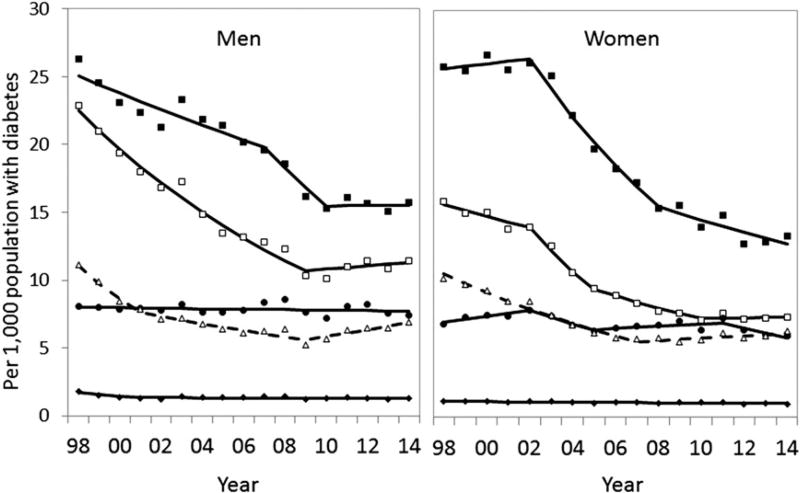
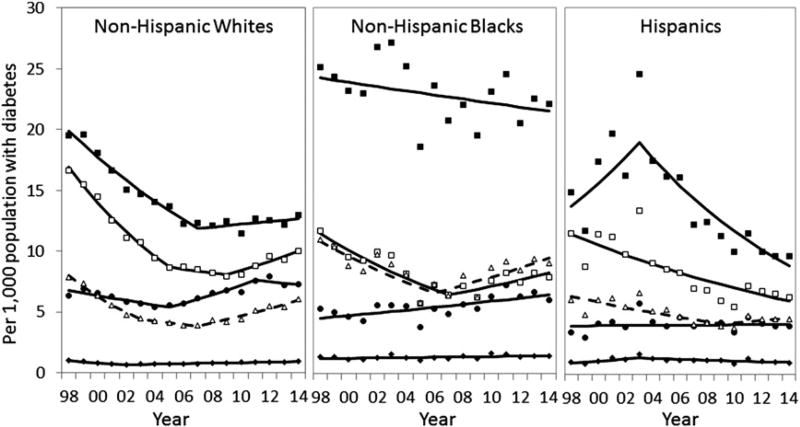
Results: From 1998 to 2014, in the population with diabetes, age-adjusted hospitalization rates declined significantly for ACS (AAPC -4.6% per year [95% CL -5.3, -3.8]), cardiac dysrhythmia (-0.7% [-1.1, -0.2]), heart failure (-3.6% [-4.6, -2.7]), hemorrhagic stroke (-1.1% [-1.4, -0.7]), and ischemic stroke (-2.9% [-3.9, -1.8]). In the population without diabetes, rates also declined significantly for these conditions, with the exception of dysrhythmia. By 2014, rates in the population with diabetes population remained two to four times as high as those for the population without diabetes, with the largest difference in heart failure rates.
Conclusions: CVD hospitalization rates declined significantly in both the population with diabetes and the population without diabetes. This may be due to several factors, including new or more aggressive treatments and reductions in CVD risk factors and CVD incidence.
© 2017 by the American Diabetes Association.
Conflict of interest statement
Figures
Comment in
-
Comment on Burrows et al. Declining Rates of Hospitalization for Selected Cardiovascular Disease Conditions Among Adults Aged ≥35 Years With Diagnosed Diabetes, U.S., 1998-2014. Diabetes Care 2018;41:293-302.Diabetes Care. 2018 Apr;41(4):e58. doi: 10.2337/dc17-2450. Diabetes Care. 2018. PMID: 29559457 No abstract available.
-
Response to Comment on Burrows et al. Declining Rates of Hospitalization for Selected Cardiovascular Disease Conditions Among Adults Aged ≥35 Years With Diagnosed Diabetes, U.S., 1998-2014. Diabetes Care 2018;41:293-302.Diabetes Care. 2018 Apr;41(4):e59. doi: 10.2337/dci17-0062. Diabetes Care. 2018. PMID: 29559458 Free PMC article. No abstract available.
References
-
- Centers for Disease Control and Prevention. National Diabetes Statistics Report, 2017. Atlanta, GA: Centers for Disease Control and Prevention, U.S. Department of Health and Human Services; 2017.
-
- Bertoni AG, Goff DC., Jr . Diabetes and cardiovascular disease. In: Venkat Narayan KM, Williams D, Gregg EW, Cowie C, editors. Diabetes Public Health: From Data to Policy. New York, NY: Oxford University Press; 2011. pp. 173–194.
MeSH terms
Grants and funding
LinkOut - more resources
Full Text Sources
Other Literature Sources
Medical
