


Effect of erythrocyte-sperm separation medium on nuclear, acrosomal, and membrane maturity parameters in human sperm
- PMID: 29150736
- PMCID: PMC5904059
- DOI: 10.1007/s10815-017-1085-1
Effect of erythrocyte-sperm separation medium on nuclear, acrosomal, and membrane maturity parameters in human sperm
Abstract
Purpose: The purpose of this study is to investigate whether erythrocyte-sperm separation medium (ESSM) has effects on human sperm motility, morphology, viability, membrane maturity, acrosome integrity, and nuclear attributes before and after cryopreservation.
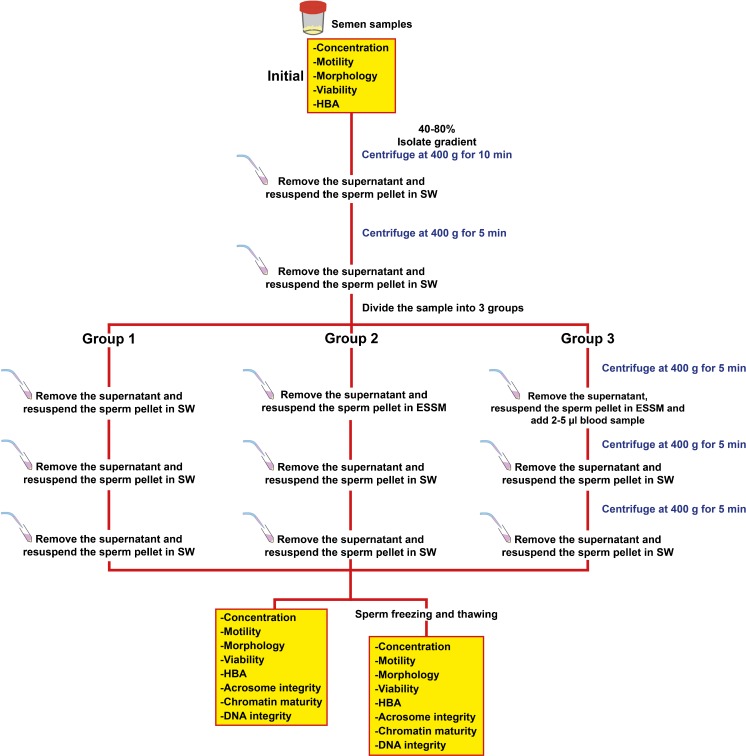
Methods: Semen samples from normozoospermic (n = 36) and oligozoospermic (n = 9) patients were analyzed. Samples from the same patient were divided into three aliquots: group 1 and group 2 were resuspended in sperm washing media and ESSM, respectively. Group 3 was resuspended in ESSM with blood sample to mimic the extensive number of erythrocytes in the testicular sperm extraction (TESE) material. All groups were evaluated for sperm concentration, motility, Kruger/Tygerberg strict morphology, viability by eosin-nigrosin staining, membrane maturity by hyaluronic acid-binding assay (HBA), acrosomal integrity by Pisum sativum lectin staining, chromatin maturity by aniline blue staining, and DNA integrity by TUNEL assay before and after cryopreservation.
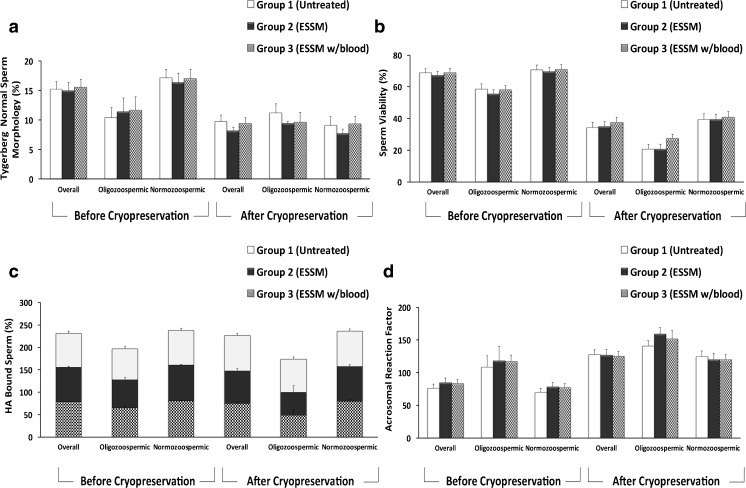
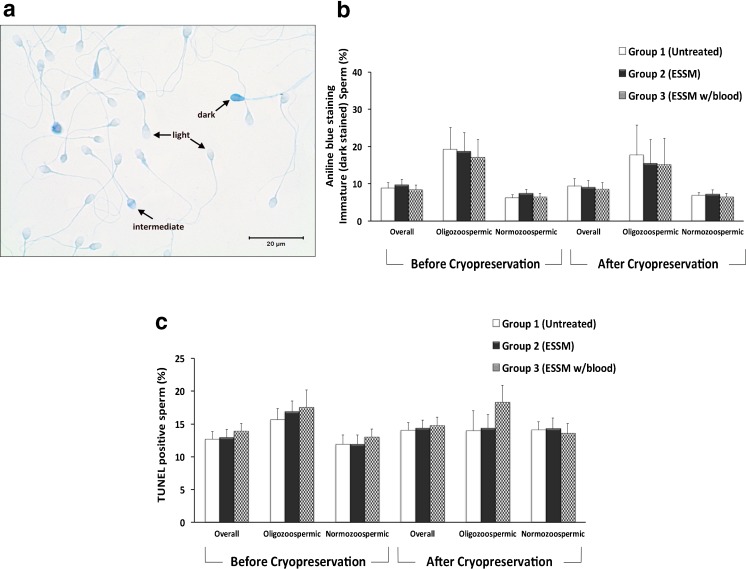
Results: No significant difference was determined between ESSM-treated and ESSM-untreated sperm samples for the sperm parameters tested (p > 0.05). After cryopreservation, total sperm motility and viability decreased regardless of ESSM used. The percentages of sperm with Tygerberg normal morphology, intact acrosome, and HA-bound sperm were found to be lower in oligozoospermic samples before cryopreservation in each group. However, no statistically significant differences were found between oligozoospermic and normozoospermic samples when all groups were compared. Thus, ESSM treatment did not cause a significant change on sperm motility, normal morphology, viability, HA-binding capacity, chromatin maturity, and DNA fragmentation.
Conclusion: ESSM can enhance the efficiency of sperm retrieval protocol and can also decrease the time required to collect spermatozoa while not affecting sperm morphogenetic properties.
Keywords: Cryopreservation; Erythrocyte-sperm separation; Human sperm maturity; Sperm parameters; TESE.
Conflict of interest statement
Conflict of interest
The authors declare that they have no conflict of interest.
Ethical approval
All procedures performed in studies involving human participants were in accordance with the ethical standards of the institutional and/or national research committee and with the 1964 Helsinki declaration and its later amendments or comparable ethical standards.
Figures
References
MeSH terms
Substances
Grants and funding
LinkOut - more resources
Full Text Sources
Other Literature Sources
Miscellaneous
