


Systematic review of infant and young child complementary feeding practices in South Asian families: the Pakistan perspective
- PMID: 29151370
- PMCID: PMC5851056
- DOI: 10.1017/S1368980017002956
Systematic review of infant and young child complementary feeding practices in South Asian families: the Pakistan perspective
Abstract
Objective: Suboptimal nutrition among children remains a problem among South Asian (SA) families. Appropriate complementary feeding (CF) practices can greatly reduce this risk. Thus, we undertook a systematic review of studies assessing CF (timing, dietary diversity, meal frequency and influencing factors) in children aged <2 years in Pakistan.
Design: Searches between January 2000 and June 2016 in MEDLINE, EMBASE, Global Health, Web of Science, OVID Maternity & Infant Care, CINAHL, Cochrane Library, BanglaJOL, POPLINE and WHO Global Health Library. Eligibility criteria: primary research on CF practices in SA children aged 0-2 years and/or their families. Search terms: 'children', 'feeding' and 'Asians' with their derivatives. Two researchers undertook study selection, data extraction and quality appraisal (EPPI-Centre Weight of Evidence).
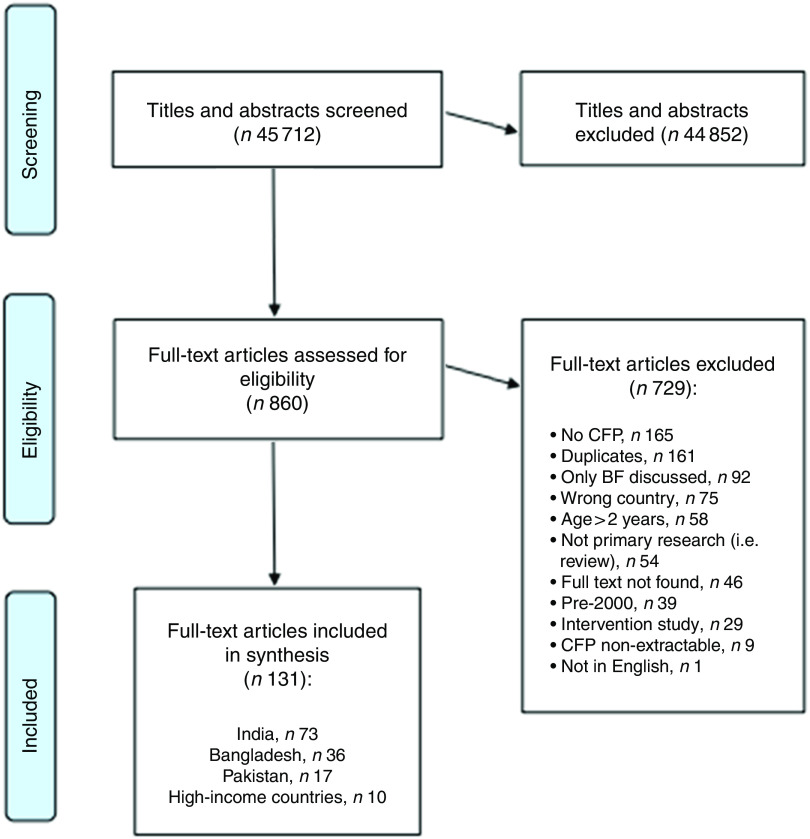
Results: From 45 712 results, seventeen studies were included. Despite adopting the WHO Infant and Young Child Feeding guidelines, suboptimal CF was found in all studies. Nine of fifteen studies assessing timing recorded CF introduced between 6 and 9 months. Five of nine observed dietary diversity across four of seven food groups; and two of four, minimum meal frequency in over 50 % of participants. Influencing factors included lack of CF knowledge, low maternal education, socio-economic status and cultural beliefs.
Conclusions: This is the first systematic review to evaluate CF practices in Pakistan. Campaigns to change health and nutrition behaviour are needed to meet the substantial unmet needs of these children.
Keywords: Child; Complementary feeding; Diet; Infant; Nutrition; Pakistan.
Figures
References
-
- UNICEF, World Health Organization, World Bank et al.. (2015) Levels and Trends in Child Mortality: Report 2015. New York: UNICEF.
-
- Agha D, Maqbool S & Anwar S (2005) Is poverty or lack of nutrition awareness the main cause of malnutrition in children? Pak Pediatr J 29, 63–67.
-
- Corvalan C, Dangour A & Uauy R (2008) Need to address all forms of childhood malnutrition with a common agenda. Arch Dis Child 93, 361–362. - PubMed
-
- UNICEF South Asia (2015) Progress Report: Six Headline Results for Children in South Asia: Stop Stunting. Kathmandu: UNICEF Regional Office for South Asia.
Publication types
MeSH terms
Grants and funding
LinkOut - more resources
Full Text Sources
Other Literature Sources
Medical
