


Combining drought and submergence tolerance in rice: marker-assisted breeding and QTL combination effects
- PMID: 29151804
- PMCID: PMC5670188
- DOI: 10.1007/s11032-017-0737-2
Combining drought and submergence tolerance in rice: marker-assisted breeding and QTL combination effects
Abstract
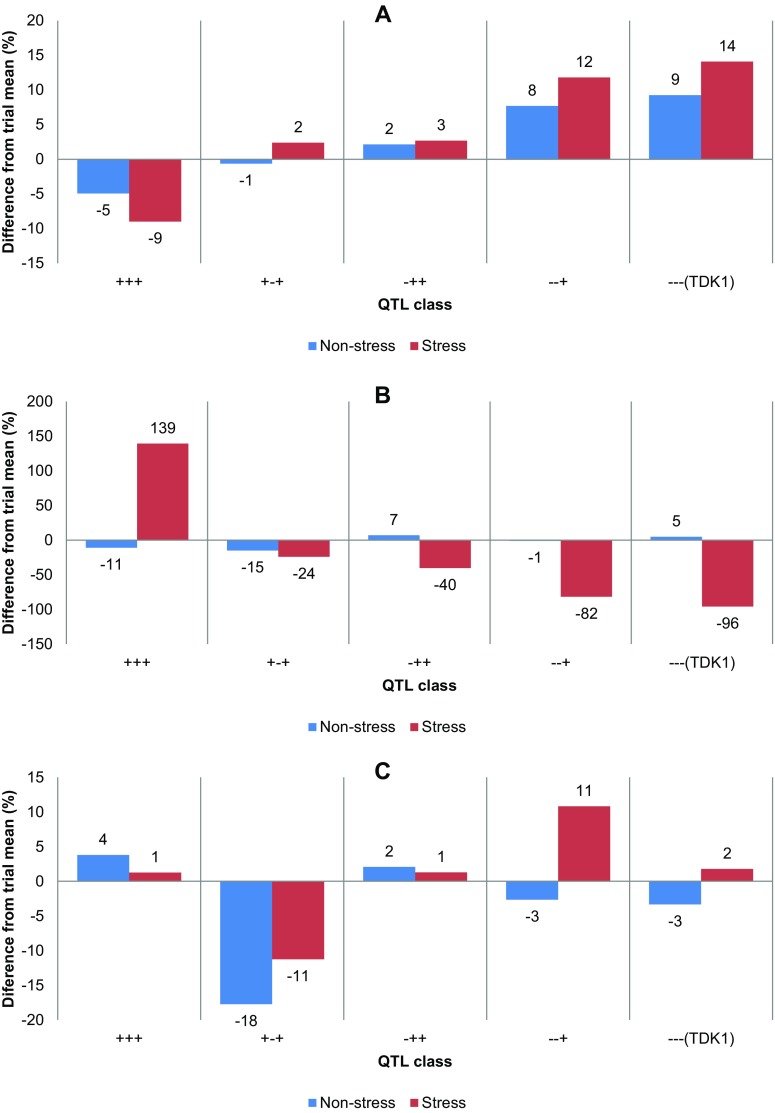
TDK1 is a popular rice variety from the Lao PDR. Originally developed for irrigated conditions, this variety suffers a high decline in yield under drought conditions. Studies have identified three quantitative trait loci (QTLs) for grain yield under drought conditions, qDTY3.1 , qDTY6.1 , and qDTY6.2 , that show a high effect in the background of this variety. We report here the pyramiding of these three QTLs with SUB1 that provides 2-3 weeks of tolerance to complete submergence, with the aim to develop drought- and submergence-tolerant near-isogenic lines (NILs) of TDK1. We used a tandem approach that combined marker-assisted backcross breeding with phenotypic selection to develop NILs with high yield under drought stress and non-stress conditions and preferred grain quality. The effect of different QTL combinations on yield and yield-related traits under drought stress and non-stress conditions is also reported. Our results show qDTY3.1 to be the largest and most consistent QTL affecting yield under drought conditions, followed by qDTY6.1 and qDTY6.2 , respectively. QTL class analysis also showed that lines with a combination of qDTY3.1 and qDTY6.1 consistently showed a higher tolerance to drought than those in which one of these QTLs was missing. In countries such as Lao PDR, where large areas under rice cultivation suffer vegetative-stage submergence and reproductive-stage drought, these lines could ensure yield stability. These lines can also serve as valuable genetic material to be used for further breeding of high-yielding, drought- and submergence-tolerant varieties in local breeding programs.
Keywords: Drought; MABB; QTL; Rice; Submergence; Yield.
Figures

References
-
- Bernier J, Kumar A, Venuprasad R, Spaner D, Atlin GN. A large-effect QTL for grain yield under reproductive-stage drought stress in upland rice. Crop Sci. 2007;47:507–516. doi: 10.2135/cropsci2006.07.0495. - DOI
-
- Dilley M, Chen RS, Deichmann U, Lerner-Lam AL, Arnold M, Agwe J, Buys P, Kjekstad O, Lyon B, Yetman G (2005) Natural disaster hotspots: a global risk analysis synthesis report. Center for Hazard and Risk Research, Columbia University, New York
-
- Dixit S, Biswal AK, Min A, Henry A, Oane RH, Raorane ML, Longkumer T, Pabuayon IM, Mutte SK, Vardarajan AR, Miro B, Govindan G, Albano-Enriquez B, Pueffeld M, Sreenivasulu N, Slamet-Loedin I, Sundarvelpandian K, Tsai Y-C, Raghuvanshi S, Hsing YC, Kumar A, Kohli A (2015a) Action of multiple intra-QTL genes concerted around a co-localized transcription factor underpins a large effect QTL. Nature Sci Rep 5:15183 - PMC - PubMed
LinkOut - more resources
Full Text Sources
Other Literature Sources
