. 2017 Oct 9;8(11):1165-1170.
doi: 10.1021/acsmedchemlett.7b00287. eCollection 2017 Nov 9.

Indolylalkyltriphenylphosphonium Analogues Are Membrane-Depolarizing Mycobactericidal Agents

Affiliations

Indolylalkyltriphenylphosphonium Analogues Are Membrane-Depolarizing Mycobactericidal Agents

Ming Li et al. ACS Med Chem Lett. .

Abstract

Agents that selectively target the mycobacterial membrane could potentially shorten treatment time for tuberculosis, reduce relapse, and curtail emergence of resistant strains. The lipophilicity and extensive charge-delocalized state of the triphenylphosphonium cation strongly favor accumulation within bacterial membranes. Here, we explored the antimycobacterial activities and membrane-targeting properties of indolylalkyltriphenylphosphonium analogues. The most active analogues preferentially inhibited growth of Mycobacterium tuberculosis H37Rv (MIC50 2-4 μM) and were bactericidal against Mycobacterium bovis BCG (MBC99 3 μM). In spite of their propensity to accumulate within membranes, we found no evidence that these compounds permeabilized mycobacterial membranes or induced cell-envelope stress. Our investigations indicated that their bacterical effects stem from sustained depolarization of mycobacterial membranes and ensuing disruptive effects on electron transfer and cell division.


Conflict of interest statement

The authors declare no competing financial interest.

Figures
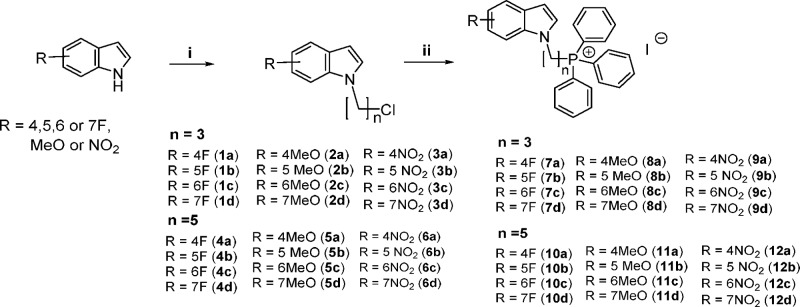
Scheme 1
Scheme 1. Synthesis of Indolylalkyltriphenylphosphonium Analogues (7ad to 12ad) and Intermediates (1ad to 6ad)
Reagents and conditions: (i) NaH, anhydrous DMF, 1-bromo-3-chloropropane or 1-bromo-5-chloropentane, 0 °C to rt; (ii) KI, triphenylphosphine, MeCN, reflux, 24–48 h.
Figure 1
Figure 1
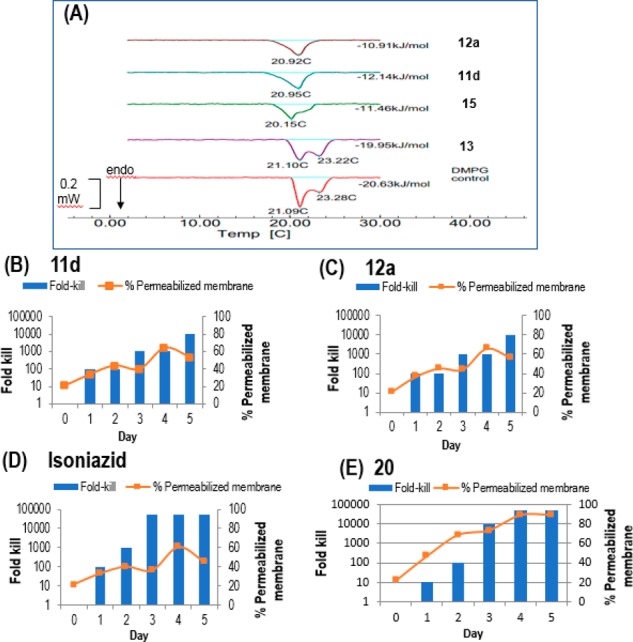
(A) Calorimetric curves in heating mode of DMPG vesicles containing 1 part test compound (11d, 12a, 13, and 15) to 10 parts DMPG. Tm (°C) and ΔH (kJ/mol) are indicated. Control DMPG vesicles showed a bifurcated endotherm with two Tm values. (B–E) Percentage of permeabilized cells and fold-kill of M. bovis BCG cultures treated with test compounds over time. 106 CFU/mL mid log phase cultures were treated with 2× MIC90 of (B) 11d (6 μM), (C) 12a (6 μM), (D) isoniazid (1.6 μM), and (E) 20 (4 μM). Samples were collected daily for determinations of CFU and % permeabilized bacteria compared to controls.
Figure 2
Figure 2
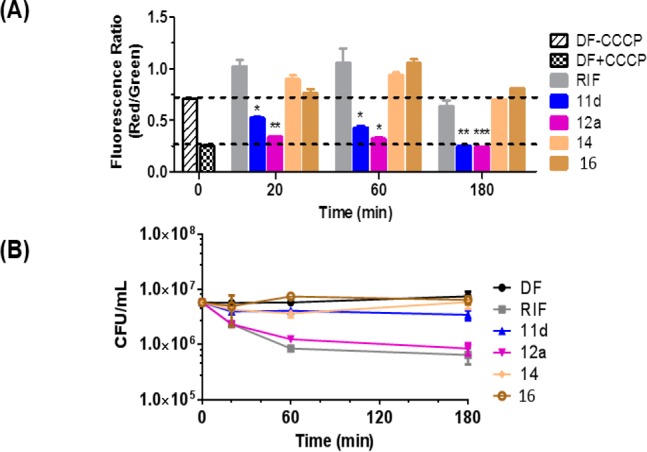
(A) Changes in membrane potential (red/green fluorescent ratio of DiOC2) of M. bovis BCG cultures treated with test compound 11d (12 μM), 12a (24 μM), 14 (24 μM), 16 (24 μM), rifampicin (RIF, 0.08 μM), and CCCP (100 μM). 11d and 12a were tested at 4× MIC90. MIC90 was redetermined for this experiment and were 3 μM (11d) and 6 μM (12a). Mean and SD of three biological replicates. Means were significantly different from drug-free (DF) controls at time zero (without CCCP) with p <0.05 (*), <0.01 (**), and <0.001 (***), Student’s t test, Graph-Pad Prism, Ver 5.0. (B) Corresponding changes in viability of treated cultures (CFU/mL) under similar conditions described in (A).
Figure 3
Figure 3
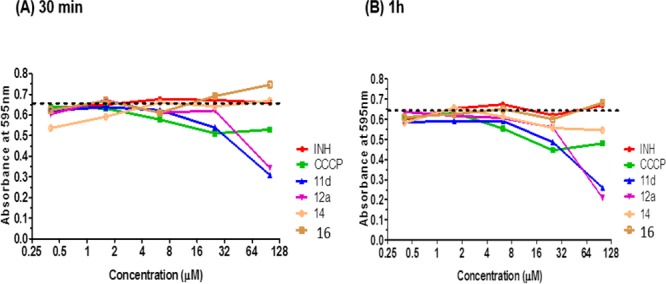
Reduction of tetrazolium dye MTT to formazan by M. bovis BCG cultures treated for (A) 30 min and (B) 1 h at various concentrations of 11d, 12a, 14, and 16, isoniazid (INH), and ionophore CCCP (positive control, 100 μM). Dashed line indicates the basal absorbance of formazan (595 nm) in drug-free cultures. Diminished reduction of MTT results in less formazan being formed (decrease in absorbance). Results shown are representative of two independent experiments.
Figure 4
Figure 4
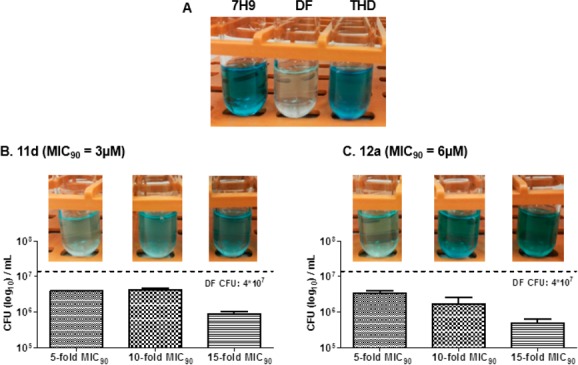
Oxygen consumption of 0.001% methylene blue containing M. bovis BCG cultures. (A) Control tubes containing methylene blue and 7H9 medium (7H9) only, medium and mid log phase M. bovis BCG without test compound (DF) and containing positive control thioridazine THD (80 μM). Cultures were incubated at 37 °C, 12 h. (B) M. bovis BCG cultures (mid log phase) containing methylene blue treated with 11d at 5× (15 μM), 10× (30 μM), and 15× (45 μM) MIC90. Cultures were incubated at 37 °C, 12 h. CFU determinations were carried out post incubation on each 11d-treated culture to determine cell viability. (C) As in (B) except that cultures were treated with 12a at 5× (30 μM), 10× (60 μM), and 15× (90 μM) MIC90.

References

    1. World Health Organization. Global tuberculosis report 2016; WHO Press: Paris, 2016.
    1. World Health Organization. Media Centre Fact Sheet, The Top 10 Causes of Death, http://www.who.int/mediacentre/factsheets/fs310/en/ (accessed January 2017).
    1. World Health Organization, Media centre Fact sheet, Tuberculosis, http://www.who.int/mediacentre/factsheets/fs104/en/ (accessed March 2017).
    1. Hurdle J. G.; O’Neill A. J.; Chopra I.; Lee R. E. Targeting bacterial membrane function: an underexploited mechanism for treating persistent infections. Nat. Rev. Microbiol. 2011, 9, 62.10.1038/nrmicro2474. - DOI - PMC - PubMed
    1. Koh J. J.; Zou H.; Mukherjee D.; Lin S.; Lim F.; Tan J. K.; Tan D. Z.; Stocker B. L.; Timmer M. S. M.; Corkran H. M.; Lakshminarayanan R.; Tan D. T. H.; Cao D.; Beuerman R. W.; Dick T.; Liu S. Amphiphilic Xanthones as a Potent Chemical Entity of Anti-microbial Agents with Membrane-Targeting Properties. Eur. J. Med. Chem. 2016, 123, 684.10.1016/j.ejmech.2016.07.068. - DOI - PubMed

LinkOut - more resources