Molecular determinants of prostate cancer metastasis
- PMID: 29152153
- PMCID: PMC5675705
- DOI: 10.18632/oncotarget.21085
Molecular determinants of prostate cancer metastasis
Abstract
Metastatic cancer remains largely incurable and fatal. The general course of cancer, from the initiation of primary tumor formation and progression to metastasis, is a multistep process wherein tumor cells at each step must display specific phenotypic features. Distinctive capabilities required for primary tumor initiation and growth form the foundation, and sometimes may remain critical, for subsequent metastases. These phenotypic features must remain easily malleable during the acquisition of additional capabilities unique and essential to the metastatic process such as dissemination to distant tissues wherein tumor cells interact with foreign microenvironments. Thus, the metastatic phenotype is a culmination of multiple genetic and epigenetic alterations and subsequent selection for favorable traits under the pressure of ever-changing tumor microenvironments. Although our understanding of the molecular programs that drive cancer metastasis are incomplete, increasing evidence suggests that successful metastatic colonization relies on the dissemination of cancer stem cells (CSCs) with tumor-regenerating capacity and adaptive programs for survival in distant organs. In the past 2-3 years, a myriad of novel molecular regulators and determinants of prostate cancer metastasis have been reported, and in this Perspective, we comprehensively review this body of literature and summarize recent findings regarding cell autonomous molecular mechanisms critical for prostate cancer metastasis.
Keywords: cancer stem cells; metastasis; molecular mechanisms; prostate cancer.
Conflict of interest statement
CONFLICTS OF INTEREST The authors claim no potential conflicts of interest.
Figures
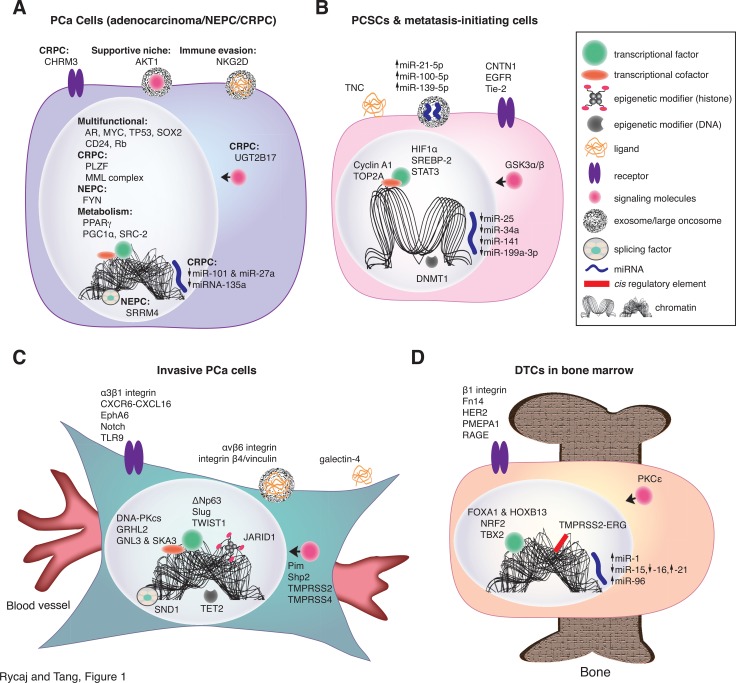
 or oncogenic (onco-miR;
  ) functions. Icons and their corresponding labels are shown in top right. See detailed discussions in the Text. (B) Molecular determinants in PCSCs and metastasis-initiating cells. PCSCs adopt many strategies in order to survive and initiate metastasis in foreign environments. For example, PCSCs express TNC, which functions in a non-canonical manner to aid in overcoming immune surveillance. CSCs transition between interchangeable states, regulated by the microenvironment, and this phenotypic plasticity (i.e., EMT, metabolic, tumor-initiating capacity) can play an important role in metastasis. Differentiation programming is dependent on unique combinations of cis and trans regulatory molecules, which cooperatively influence chromatin structure. Thus, chromatin structures differ between PCSCs and their differentiated progeny, as indicated by an “open chromatin” conformation in PCSC depicted. Tumor-suppressive miRNAs including miR-25, miR-34a, miR-141, and miR-199a-3p are generally devoid in PCSCs whereas onco-miRs such as miR-21 may be secreted by PCSCs in exosomes. Evidence suggests that CSCs are generally smaller than their differentiated progeny (compare with the cell in A). (C) Molecular determinants in invasive PCa cells. PCa cells become phenotypically more fibroblastic during the acquisition of invasive and migratory abilities, facilitating their intravasation into the blood vessels. Representative novel molecular determinants discussed in the Text are illustrated here. (D) Molecular determinants in DTCs in the bone marrow. Disseminating PCa cells may rely on unique molecules to home to more permissible distant microenvironment such as the bone. An example of dysregulation of a protein-coding gene is exemplified by TMPRSS2-ERG, which increases bone tropism of PCa cells. Once in the bone, DTCs can exploit various pathways in order to survive and initiate colonization.
References
-
- Massagué J, Obenauf AC. Metastatic colonization by circulating tumour cells. Nature. 2016;529:298–306. https://doi.org/10.1038/nature17038 - DOI - PMC - PubMed
-
- Oskarsson T, Batlle E, Massagué J. Metastatic stem cells: sources, niches, and vital pathways. Cell Stem Cell. 2014;14:306–21. https://doi.org/10.1016/j.stem.2014.02.002 - DOI - PMC - PubMed
-
- Vander Heiden MG, DeBerardinis RJ. Understanding the Intersections between Metabolism and Cancer Biology. Cell. 2017;168:657–69. https://doi.org/10.1016/j.cell.2016.12.039 - DOI - PMC - PubMed
-
- Lambert AW, Pattabiraman DR, Weinberg RA. Emerging Biological Principles of Metastasis. Cell. 2017;168:670–91. https://doi.org/10.1016/j.cell.2016.11.037 - DOI - PMC - PubMed
-
- Nieto MA, Huang RY, Jackson RA, Thiery JP. Emt: 2016. Cell. 2016;166:21–45. https://doi.org/10.1016/j.cell.2016.06.028 - DOI - PubMed
Publication types
Grants and funding
LinkOut - more resources
Full Text Sources
Other Literature Sources
Miscellaneous