. 2017 Nov 10;3(11):e1701696.
doi: 10.1126/sciadv.1701696. eCollection 2017 Nov.

Moiré excitons: From programmable quantum emitter arrays to spin-orbit-coupled artificial lattices

Affiliations

Moiré excitons: From programmable quantum emitter arrays to spin-orbit-coupled artificial lattices

Hongyi Yu et al. Sci Adv. .

Abstract

Highly uniform and ordered nanodot arrays are crucial for high-performance quantum optoelectronics, including new semiconductor lasers and single-photon emitters, and for synthesizing artificial lattices of interacting quasiparticles toward quantum information processing and simulation of many-body physics. Van der Waals heterostructures of two-dimensional semiconductors are naturally endowed with an ordered nanoscale landscape, that is, the moiré pattern that laterally modulates electronic and topographic structures. We find that these moiré effects realize superstructures of nanodot confinements for long-lived interlayer excitons, which can be either electrically or strain tuned from perfect arrays of quantum emitters to excitonic superlattices with giant spin-orbit coupling (SOC). Besides the wide-range tuning of emission wavelength, the electric field can also invert the spin optical selection rule of the emitter arrays. This unprecedented control arises from the gauge structure imprinted on exciton wave functions by the moiré, which underlies the SOC when hopping couples nanodots into superlattices. We show that the moiré hosts complex hopping honeycomb superlattices, where exciton bands feature a Dirac node and two Weyl nodes, connected by spin-momentum-locked topological edge modes.


Figures
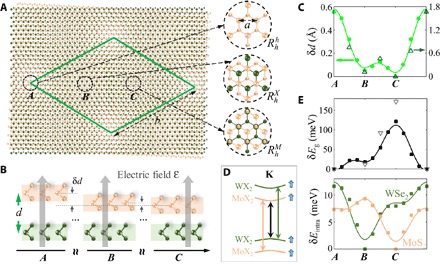
Fig. 1
Fig. 1. Moiré modulated local energy gaps and topographic height in the heterobilayer.
(A) Long-period moiré pattern in an MoX2/WX2 heterobilayer. Green diamond is a supercell. Insets are close-ups of three locals, where atomic registries resemble lattice-matched bilayers of different R-type stacking. (B and C) Dependence of interlayer distance d on the atomic registries. In (C), dots are our first-principles calculations for the MoS2/WSe2 heterobilayer, and triangles are the scanning tunneling microscopy (STM) measured variation of the local d values in a b = 8.7 nm MoS2/WSe2 moiré in the study of Zhang et al. (26). The variation in d then leads to laterally modulated interlayer bias (∝ d) in a uniform perpendicular electric field, as (B) illustrates. (D) Schematic of relevant heterobilayer bands at the K valley, predominantly localized in either the MoX2 or WX2 layer. (E) Top: Variation of the local bandgap Eg [black arrow in (D)] in the MoS2/WSe2 moiré. Bottom: Variation of the local intralayer gaps [denoted by arrows of the same color in (D)]. In (C) and (E), the horizontal axis corresponds to the long diagonal of the moiré supercell, and the vertical axis plots the differences of the quantities from their minimal values. The curves are fitting of the data points using eqs. S2 and S3 in section S1.
Fig. 2
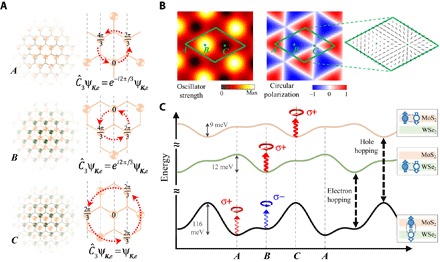
Fig. 2. Nanopatterned spin optics of moiré excitons.
(A) Left: Exciton wave packets at the locals with Rhh, RhX, and RhM registries, respectively (see Fig. 1A). Right: Corresponding C^3 transformation of electron Bloch function ψK,e, when the rotation center is fixed at a hexagon center in the hole layer. Gray dashed lines denote planes of constant phases in the envelope part of ψK,e, and red arrows denote the phase change by C^3. (B) Left: Oscillator strength of the interlayer exciton. Right: Optical selection rule for the spin-up interlayer exciton (at the K valley). The distinct C^3 eigenvalues, as shown in (A), dictate the interlayer exciton emission to be circularly polarized at A and B with opposite helicity and forbidden at C. At other locals in the moiré, the emission is elliptically polarized (see inset, where ticks denote the major axis of polarization with length proportional to ellipticity). (C) Contrasted potential landscapes for the intra- and interlayer excitons, with the optical selection rule for the spin-up species shown at the energy minima. Transitions between the inter- and intralayer excitons (that is, via electron/hole hopping) can be induced by mid-infrared light with out-of-plane polarization.
Fig. 3
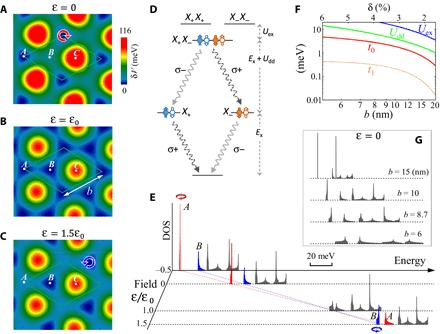
Fig. 3. Electrically tunable and strain-tunable quantum emitter arrays.
(A to C) Tuning of excitonic potential by perpendicular electric field (ε) in the R-type MoS2/WSe2 moiré. At zero field, nanodot confinements are at A points, realizing periodic array of excitonic quantum emitters, which are switched to B points at moderate field (see the main text). (D) Spin optical selection rule of quantum emitter at A. When loaded with two excitons, the cascaded emission generates a polarization-entangled photon pair. The optical selection rule is inverted when the quantum emitter is shifted to B [see (A) and (C)]. (E) Electric field tuning of exciton density of states (DOS) in the R-type MoS2/WSe2 moiré with b = 10 nm. The field dependence of V(A) and V(B) are denoted by the dotted blue and red lines on the field-energy plane. The colors of the two lowest energy peaks distinguish their different orbital compositions at A and B points in the moiré. (F) Exciton hopping integral between nearest-neighbor (NN) A and B dots in (B) (t0), between NN A dots (t1), and on-site exciton dipole-dipole (Udd) and exchange (Uex) interactions as functions of the moiré period b (see sections S4 and S5). The top horizontal axis is the corresponding lattice mismatch δ for rotationally aligned bilayer. (G) Exciton DOS at different b at zero electric field. The 20-meV scale bar applies for the energy axis in (E) and (G).
Fig. 4
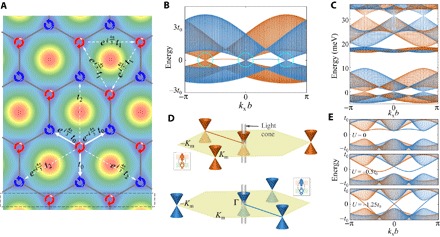
Fig. 4. Spin-orbit–coupled honeycomb lattices and Weyl nodes.
(A) Opposite photon emission polarization at A and B sites and complex hopping matrix elements for the spin-up exciton. (B) Exciton spectrum at V(A) = V(B) and moiré period b = 10 nm, from the tight-binding model with the third NN hopping. t0 = 2.11 meV, t1 = 0.25 meV, and t2 = 0.14 meV. The bands feature a Dirac node and two Weyl nodes (highlighted by dotted circles). These magnetic monopoles are linked by an edge mode at a zigzag boundary, with spin polarization reversal at the Dirac node. Spin-down (spin-up) exciton is denoted by brown (blue) color. (C) Exact exciton spectrum in this superlattice potential (see section S4). Dirac/Weyl nodes are also seen in higher energy bands. (D) Schematic of the Dirac cones for the spin-up and spin-down excitons in the moiré–Brillouin zone (m-BZ), and edge modes at a zigzag boundary. Exciton-photon interconversion can directly happen within the shown light cone. (E) The Dirac and Weyl nodes are gapped by a finite A-B site energy difference Δ = 0.5t0, whereas the edge band dispersion is tuned by changing the on-site energy of the dots on the zigzag boundary [enclosed by the dashed box in (A)] by the amount U.

References

    1. Polini M., Guinea F., Lewenstein M., Manoharan H. C., Pellegrini V., Artificial honeycomb lattices for electrons, atoms and photons. Nat. Nanotechnol. 8, 625–633 (2013). - PubMed
    1. S. Zhang, W. S. Cole, A. Paramekanti, N. Trivedi, in Annual Review of Cold Atoms and Molecules, K. W. Madison, K. Bongs, L. D. Carr, A. M. Rey, H. Zhai, Eds. (World Scientific, 2015), vol. 3, chap. 3.
    1. Wu Z., Zhang L., Sun W., Xu X.-T., Wang B.-Z., Ji S.-C., Deng Y., Chen S., Liu X.-J., Pan J.-W., Realization of two-dimensional spin-orbit coupling for Bose-Einstein condensates. Science 354, 83–88 (2016). - PubMed
    1. Qi X.-L., Zhang S.-C., Topological insulators and superconductors. Rev. Mod. Phys. 83, 1057–1110 (2011).
    1. Hasan M. Z., Kane C. L., Colloquium: Topological insulators. Rev. Mod. Phys. 82, 3045–3067 (2010).

Publication types