


Economic Burden of Informal Caregiving Associated With History of Stroke and Falls Among Older Adults in the U.S
- PMID: 29153121
- PMCID: PMC5819006
- DOI: 10.1016/j.amepre.2017.07.020
Economic Burden of Informal Caregiving Associated With History of Stroke and Falls Among Older Adults in the U.S
Abstract
Introduction: Older adults are at high risk for stroke and falls, both of which require a large amount of informal caregiving. However, the economic burden of informal caregiving associated with stroke and fall history is not well known.
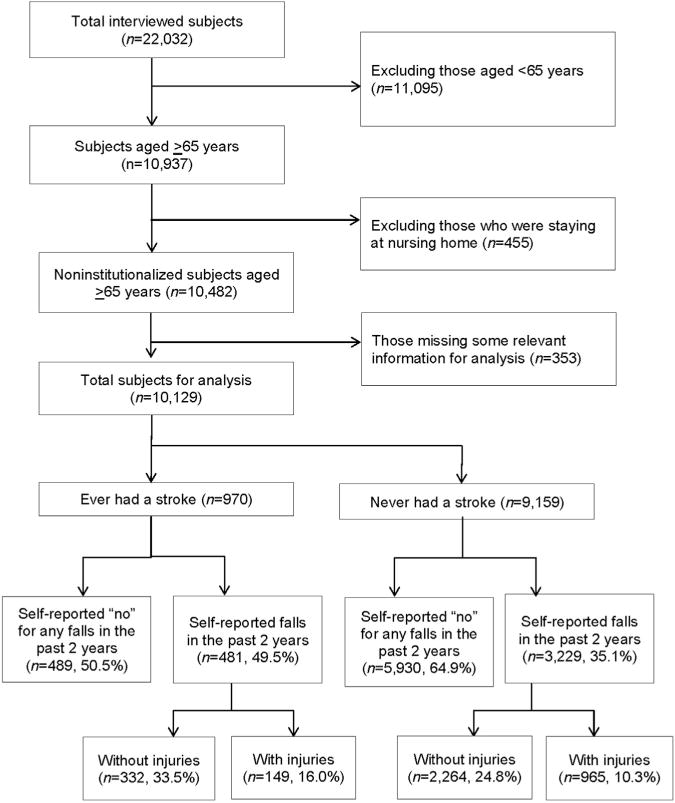
Methods: Using the 2010 Health and Retirement Study, data on non-institutionalized adults aged ≥65 years (N=10,129) in 2015-2017 were analyzed. Two-part models were used to estimate informal caregiving hours. Based on estimates from the models using a replacement cost approach, the authors derived informal caregiving hours and costs associated with falls in the past 2 years for stroke and non-stroke persons.
Results: Both the prevalence of falls overall and of falls with injuries were higher among people with stroke than those without (49.5% vs 35.1% for falls and 16.0% vs 10.3% for injurious falls, p<0.01). Stroke survivors needed more informal caregiving hours than their non-stroke counterparts, and the number of informal caregiving hours was positively associated with non-injurious falls and even more so with injurious falls. The national burden of informal caregiving (2015 U.S. dollars) associated with injurious falls amounted to $2.9 billion (95% CI=$1.1 billion, $4.7 billion) for stroke survivors (about 0.5 million people), and $6.5 billion (95% CI=$4.3 billion, $8.7 billion) for those who never had a stroke (about 3.6 million people).
Conclusions: In U.S. older adults, informal caregiving hours and costs associated with falls are substantial, especially for stroke survivors. Preventing falls and fall-related injuries, especially among stroke survivors, therefore has potential for reducing the burden of informal caregiving.
Copyright © 2017 American Journal of Preventive Medicine. All rights reserved.
Conflict of interest statement
No financial disclosures were reported by the authors of this paper.
Figures
References
-
- Mozaffarian D, Benjamin EJ, Go AS, et al. Heart disease and stroke statistics—2016 update: a report from the American Heart Association. Circulation. 2016;133(4):e38–e360. https://doi.org/10.1161/CIR.0000000000000350. - DOI - PubMed
-
- CDC. Stroke facts. www.cdc.gov/stroke/facts.htm. Published 2015. Accessed January 18, 2017.
-
- NIH Senior Health. Falls and older adults. https://nihseniorhealth.gov/falls/aboutfalls/01.html. Published 2013. Accessed January 18, 2017.
-
- Stevens JA, Ballesteros MF, Mack KA, Rudd RA, DeCaro E, Adler G. Gender differences in seeking care for falls in the aged Medicare population. Am J Prev Med. 2012;43(1):59–62. https://doi.org/10.1016/j.amepre.2012.03.008. - DOI - PubMed
-
- Hall MJ, Levant S, DeFrances CJ. Hospitalization for stroke in U.S. hospitals, 1989–2009. NCHS Data Brief. 2012;95:1–8. - PubMed
MeSH terms
Grants and funding
LinkOut - more resources
Full Text Sources
Other Literature Sources
Medical
Miscellaneous
