


Increasing HIV Testing in Inpatient Psychiatry
- PMID: 29153630
- PMCID: PMC5857211
- DOI: 10.1016/j.psym.2017.10.007
Increasing HIV Testing in Inpatient Psychiatry
Abstract
Background: People with serious mental illness (SMI) are at elevated risk of HIV infection, but do not receive HIV tests regularly. Inpatient psychiatric admissions provide opportunities for HIV testing.
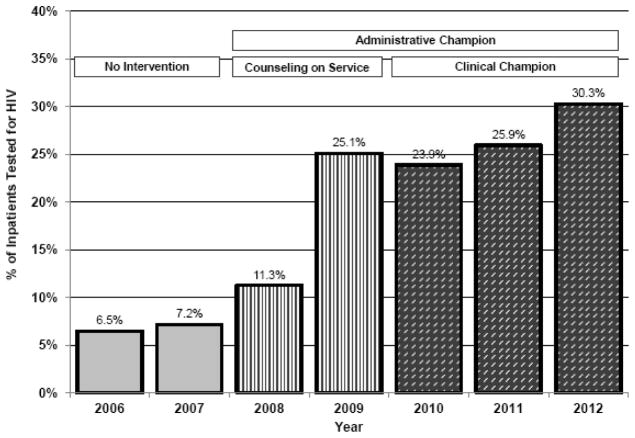
Objective: This study retrospectively examined the impact of three sequential interventions designed to increase HIV testing on an acute inpatient psychiatry service: (1) advocacy by an administrative champion, (2) an on-site HIV counselor, and (3) a clinician championing HIV testing.
Method: Demographic and HIV testing data were extracted from hospital data systems for 11,360 admissions of HIV-negative patients to an inpatient psychiatry service between 2006 and 2012. Relationships among interventions, length of stay, patient demographics, and receipt of an HIV test were examined using general estimating equation methods.
Results: In the year prior to the intervention, 7.2% of psychiatric inpatients received HIV tests. After 1 year of administrative advocacy, 11.2% received tests. Following the HIV counseling intervention, 25.1% of patients were tested. After the counseling intervention ended, continued administrative and clinical advocacy was associated with further increases in testing. In the final year studied, 30.3% of patients received HIV tests. Patients with shorter inpatient stays and those of Black or Asian race/ethnicity were less likely to be tested. Further, 1.6% of HIV tests were positive.
Conclusion: Three interventions of varying intensity were associated with a 5-fold increase in HIV testing on an acute inpatient psychiatry service. Nonetheless, 70% of inpatients were not tested. Continued efforts are needed to increase HIV testing in inpatient psychiatric settings.
Keywords: HIV testing; inpatient; psychiatry; serious mental illness..
Copyright © 2018 Academy of Consultation-Liaison Psychiatry. Published by Elsevier Inc. All rights reserved.
Figures
References
-
- Cochran G, Hruschak V, Bacci JL, Hohmeier KC, Tarter R. Behavioral, mental, and physical health characteristics and opioid medication misuse among community pharmacy patients: a latent class analysis. Res Social Adm Pharm. 2016 doi: 10.1016/j.sapharm.2016.11.005. Epub ahead of print. - DOI - PMC - PubMed
Publication types
MeSH terms
Grants and funding
LinkOut - more resources
Full Text Sources
Other Literature Sources
