Affective reactivity to daily stress and 20-year mortality risk in adults with chronic illness: Findings from the National Study of Daily Experiences
- PMID: 29154603
- PMCID: PMC5794509
- DOI: 10.1037/hea0000567
Affective reactivity to daily stress and 20-year mortality risk in adults with chronic illness: Findings from the National Study of Daily Experiences
Abstract
Objective: Daily stress processes have been previously linked to health-related outcomes, but implications for longevity remain unclear. The present study examined whether daily stress exposure and/or affective responses to daily stressors predicted mortality risk over a 20-year period. Based on the hypothesis that chronic illness confers vulnerability to deleterious effects of stress, we also examined whether its presence accentuated the association between daily stress processes and later mortality risk.
Method: Participants were 1,346 middle-aged adults from the survey of Midlife Development in the United States who also completed the National Study of Daily Experiences. Participants reported on their experiences of stress and affect for 8 consecutive evenings, and mortality data were collected over the next 20 years, using the National Death Index and other methods.
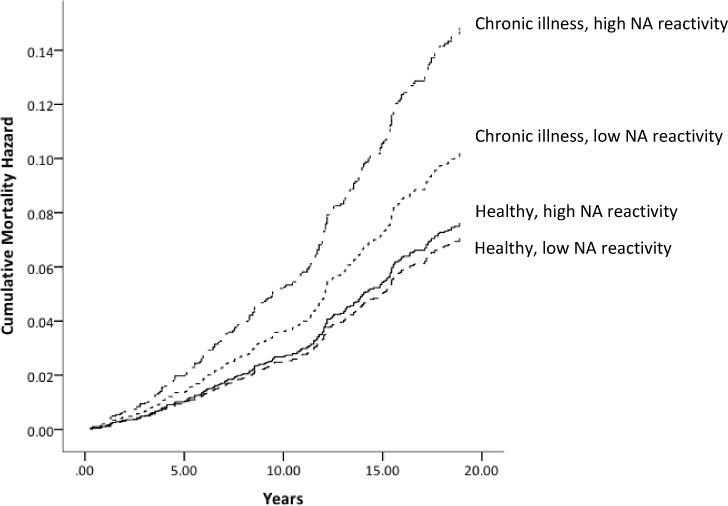
Results: There was a positive association between total number of stressors experienced across days and mortality risk. There was also a positive association between increases in negative affect on stressor days relative to nonstressor days and risk for mortality. The presence of a chronic illness moderated this association such that negative affective reactivity predicted mortality risk among individuals with at least one chronic illness but not among otherwise healthy individuals. This association was independent of sociodemographic characteristics, typical levels of negative affect on nonstressor days, and total number of endorsed stressors.
Conclusion: These results suggest that greater increases in negative affect in response to stress in everyday life may have long-term consequences for longevity, particularly for individuals with chronic illness. (PsycINFO Database Record
(c) 2018 APA, all rights reserved).
Conflict of interest statement
Conflicts of interest: none
Figures
References
-
- Almeida DM, Piazza JR, Stawksi RS, Klein LC. The speedometer of life: Stress, health and aging. In: Scaie KW, Levey R, editors. The Handbook of Psychology of Aging. New York: Elsevier; 2011. pp. 191–216.
-
- Almeida DM, Wethington E, Kessler RC. The daily inventory of stressful events: An interview-based approach for measuring daily stressors. Assessment. 2002;9(1):41–55. - PubMed
Publication types
MeSH terms
Grants and funding
LinkOut - more resources
Full Text Sources
Other Literature Sources
Medical