


Inflammatory Renin-Angiotensin System Disruption Attenuates Sensory Hyperinnervation and Mechanical Hypersensitivity in a Rat Model of Provoked Vestibulodynia
- PMID: 29155208
- PMCID: PMC5811351
- DOI: 10.1016/j.jpain.2017.10.006
Inflammatory Renin-Angiotensin System Disruption Attenuates Sensory Hyperinnervation and Mechanical Hypersensitivity in a Rat Model of Provoked Vestibulodynia
Abstract
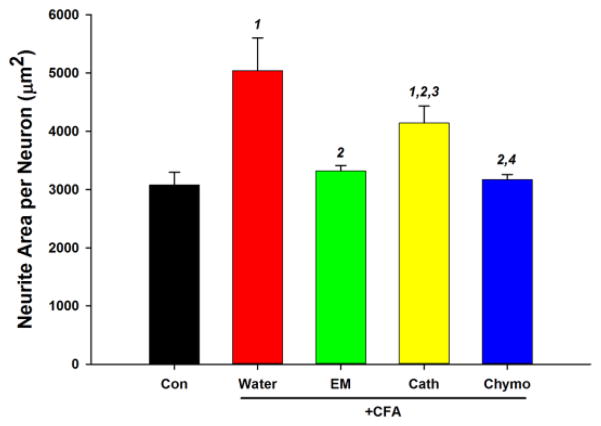
Vestibulodynia is characterized by perivaginal mechanical hypersensitivity, hyperinnervation, and abundant inflammatory cells expressing renin-angiotensin system proteins. We developed a tractable rat model of vestibulodynia to further assess the contributions of the renin-angiotensin system. Complete Freund's adjuvant injected into the posterior vestibule induced marked vestibular hypersensitivity throughout a 7-day test period. Numbers of axons immunoreactive for PGP9.5, calcitonin gene-related peptide, and GFRα2 were increased. Numbers of macrophages and T cells were also increased whereas B cells were not. Renin-angiotensin-associated proteins were abundant, with T cells as well as macrophages contributing to increased renin and angiotensinogen. Media conditioned with inflamed vestibular tissue promoted neurite sprouting by rat dorsal root ganglion neurons in vitro, and this was blocked by the angiotensin II receptor type 2 receptor antagonist PD123319 or by an angiotensin II function blocking antibody. Sensory axon sprouting induced by inflamed tissue was dependent on activity of angiotensin-converting enzyme or chymase, but not cathepsin G. Thus, vestibular Complete Freund's adjuvant injection substantially recapitulates changes seen in patients with provoked vestibulodynia, and shows that manipulation of the local inflammatory renin-angiotensin system may be a useful therapeutic strategy.
Perspective: This study provides evidence that inflammation of the rat vestibule induces a phenotype recapitulating behavioral and cytological features of human vestibulodynia. The model confirms a crucial role of the local inflammatory renin-angiotensin system in hypersensitivity and hyperinnervation. Targeting this system holds promise for developing new nonopioid analgesic treatment strategies.
Keywords: Allodynia; angiotensin II receptor type 2; axon sprouting; growth factors; hormones.
Copyright © 2017 The American Pain Society. Published by Elsevier Inc. All rights reserved.
Figures


References
-
- Alfredson H, Ohberg L, Forsgren S. Is vasculo-neural ingrowth the cause of pain in chronic Achilles tendinosis? An investigation using ultrasonography and colour Doppler, immunohistochemistry, and diagnostic injections. Knee Surg Sports Traumatol Arthrosc. 2003;11:334–338. - PubMed
-
- Anand U, Facer P, Yiangou Y, Sinisi M, Fox M, McCarthy T, Bountra C, Korchev YE, Anand P. Angiotensin II type 2 receptor (AT(2) R) localization and antagonist-mediated inhibition of capsaicin responses and neurite outgrowth in human and rat sensory neurons. Eur J Pain. 2013;17:1012–1026. - PMC - PubMed
-
- Anand U, Yiangou Y, Sinisi M, Fox M, MacQuillan A, Quick T, Korchev YE, Bountra C, McCarthy T, Anand P. Mechanisms underlying clinical efficacy of Angiotensin II type 2 receptor (AT2R) antagonist EMA401 in neuropathic pain: clinical tissue and in vitro studies. Molecular pain. 2015;11:38. - PMC - PubMed
Publication types
MeSH terms
Substances
Grants and funding
LinkOut - more resources
Full Text Sources
Other Literature Sources
