


Phyto-assisted synthesis of bio-functionalised silver nanoparticles and their potential anti-oxidant, anti-microbial and wound healing activities
- PMID: 29155403
- PMCID: PMC8676302
- DOI: 10.1049/iet-nbt.2017.0017
Phyto-assisted synthesis of bio-functionalised silver nanoparticles and their potential anti-oxidant, anti-microbial and wound healing activities
Abstract
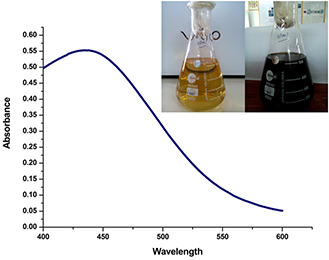
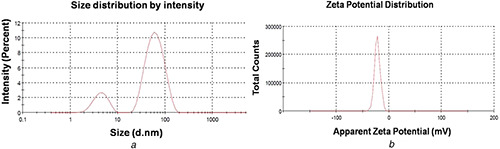
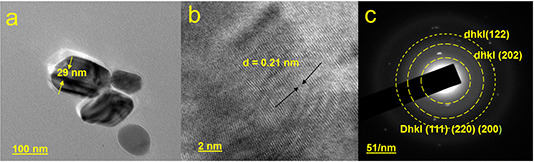
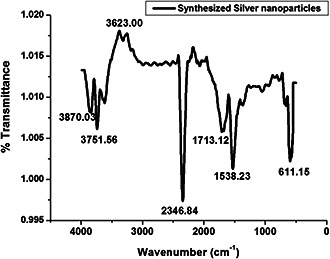
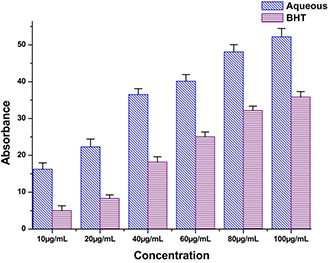
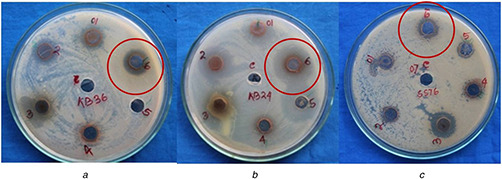
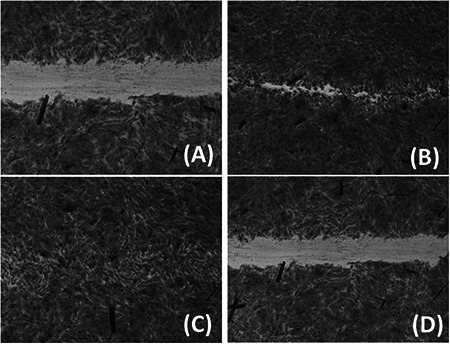
Bio- synthesis of silver nanoparticles (AgNPs) was made by using the aqueous leaf extract of Ardisia solanacea. Rapid formation of AgNPs was observed from silver nitrate upon treatment with the aqueous extract of A. solanacea leaf. The formation and stability of the AgNPs in the colloidal solution were monitored by UV-visible spectrophotometer. The mean particle diameter of AgNPs was calculated from the DLS with an average size ∼4 nm and ∼65 nm. ATR-FTIR spectroscopy confirmed the presence of alcohols, aldehydes, flavonoids, phenols and nitro compounds in the leaf which act as the stabilizing agent. Antimicrobial activity of the synthesized AgNPs was performed using agar well diffusion and broth dilution method against the Gram-positive and Gram-negative bacteria. Further, robust anti-oxidative potential was evaluated by DPPH assay. The highest antimicrobial activity of synthesized AgNPs was found against Pseudomonas aeruginosa (28.2 ± 0.52 mm) whereas moderate activity was found against Bacillus subtilis (16.1 ± 0.76), Candida kruseii (13.0 ± 1.0), and Trichophyton mentagrophytes (12.6 ± 1.52). Moreover, the potential wound healing activity was observed against the BJ-5Ta normal fibroblast cell line. Current research revealed that A. solanacea was found to be a suitable source for the green synthesis of silver nanoparticles.
Figures
References
-
- Suber L. Sondi I. Matijević E. et al.: ‘Preparation and the mechanisms of formation of silver particles of different morphologies in homogeneous solutions’, J. Colloid Interface Sci., 2005, 288, (2), pp. 489 –495 - PubMed
-
- Golubeva O.Y. Shamova O.V. Orlov D.S. et al.: ‘Study of antimicrobial and hemolytic activities of silver nanoparticles prepared by chemical reduction’, Glas. Phys. Chem., 2010, 36, (5), pp. 628 –634
-
- Song K.C. Lee S.M. Park T.S. et al.: ‘Preparation of colloidal silver nanoparticles by chemical reduction method’, Korean J. Chem. Eng., 2009, 26, (1), pp. 153 –155
-
- Le A.‐T. Tam L.T. Tam P.D. et al.: ‘Synthesis of oleic acid‐stabilized silver nanoparticles and analysis of their antibacterial activity’, Mater. Sci. Eng. C, 2010, 30, (6), pp. 910 –916
-
- Huang H. Yang Y.: ‘Preparation of silver nanoparticles in inorganic clay suspensions’, Compos. Sci. Technol., 2008, 68, (14), pp. 2948 –2953
MeSH terms
Substances
LinkOut - more resources
Full Text Sources
Other Literature Sources
Medical
Miscellaneous
