. 2017 Dec;23(13):S5-S14.
doi: 10.3201/eid2313.170946.

US Centers for Disease Control and Prevention and Its Partners' Contributions to Global Health Security

Collaborators

US Centers for Disease Control and Prevention and Its Partners' Contributions to Global Health Security

Jordan W Tappero et al. Emerg Infect Dis. 2017 Dec.

Abstract

To achieve compliance with the revised World Health Organization International Health Regulations (IHR 2005), countries must be able to rapidly prevent, detect, and respond to public health threats. Most nations, however, remain unprepared to manage and control complex health emergencies, whether due to natural disasters, emerging infectious disease outbreaks, or the inadvertent or intentional release of highly pathogenic organisms. The US Centers for Disease Control and Prevention (CDC) works with countries and partners to build and strengthen global health security preparedness so they can quickly respond to public health crises. This report highlights selected CDC global health protection platform accomplishments that help mitigate global health threats and build core, cross-cutting capacity to identify and contain disease outbreaks at their source. CDC contributions support country efforts to achieve IHR 2005 compliance, contribute to the international framework for countering infectious disease crises, and enhance health security for Americans and populations around the world.

Keywords: Centers for Disease Control and Prevention; Field Epidemiology Training Program; International Health Regulations; emergency response; global health protection; global health security; public health; vaccine-preventable diseases.


Figures
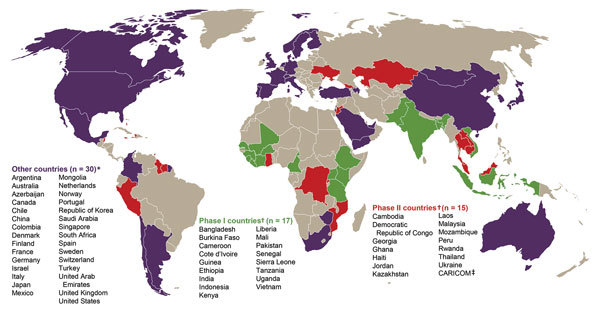
Figure 1
Figure 1
Global Health Security Agenda (GHSA) member countries as of July 25, 2017 (https://www.ghsagenda.org/members). *GHSA member countries that are not directly supported by the US government. †US government–supported GHSA member countries. CDC provides technical assistance to support country capacity assessments, the development of 5-year GHSA road maps, and annual GHSA implementation plans in Phase I, Phase II, and CARICOM nations. In the Phase I countries, CDC also provides financial support for implementation of the GHSA Action Packages. ‡CARICOM is an organization of 15 island nations. CARICOM, Caribbean Community; GHSA, Global Health Security Agenda.
Figure 2
Figure 2
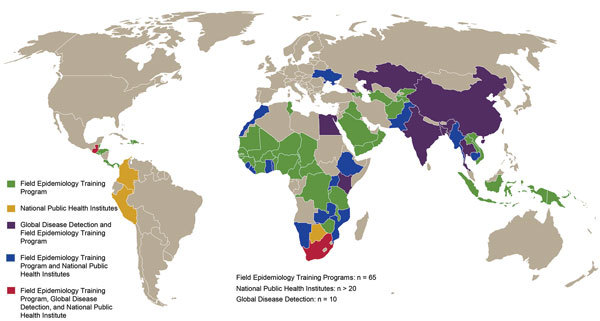
Selected programs that enhance US Centers for Disease Control and Prevention (CDC) global health protection platform. This map does not include CDC international influenza, malaria, HIV/AIDS, and immunization programs.
Figure 3
Figure 3
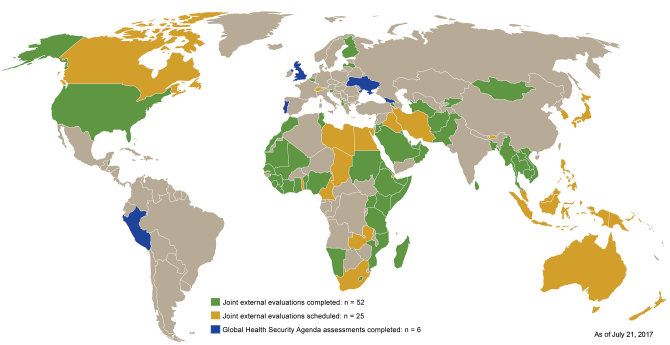
Country progress with independent Global Health Security Agenda and Joint External Evaluation assessments through 2018.

References

    1. Peiris JS, Yuen KY, Osterhaus AD, Stöhr K. The severe acute respiratory syndrome. N Engl J Med. 2003;349:2431–41. 10.1056/NEJMra032498 - DOI - PubMed
    1. Rodier G, Greenspan AL, Hughes JM, Heymann DL. Global public health security. Emerg Infect Dis. 2007;13:1447–52. 10.3201/eid1310.070732 - DOI - PMC - PubMed
    1. Fineberg HV. Pandemic preparedness and response—lessons from the H1N1 influenza of 2009. N Engl J Med. 2014;370:1335–42. 10.1056/NEJMra1208802 - DOI - PubMed
    1. Barzilay EJ, Schaad N, Magloire R, Mung KS, Boncy J, Dahourou GA, et al. Cholera surveillance during the Haiti epidemic—the first 2 years. N Engl J Med. 2013;368:599–609. 10.1056/NEJMoa1204927 - DOI - PubMed
    1. Assiri A, McGeer A, Perl TM, Price CS, Al Rabeeah AA, Cummings DA, et al. ; KSA MERS-CoV Investigation Team. Hospital outbreak of Middle East respiratory syndrome coronavirus. N Engl J Med. 2013;369:407–16. 10.1056/NEJMoa1306742 - DOI - PMC - PubMed

LinkOut - more resources