Joint External Evaluation-Development and Scale-Up of Global Multisectoral Health Capacity Evaluation Process
- PMID: 29155678
- PMCID: PMC5711324
- DOI: 10.3201/eid2313.170949
Joint External Evaluation-Development and Scale-Up of Global Multisectoral Health Capacity Evaluation Process
Abstract
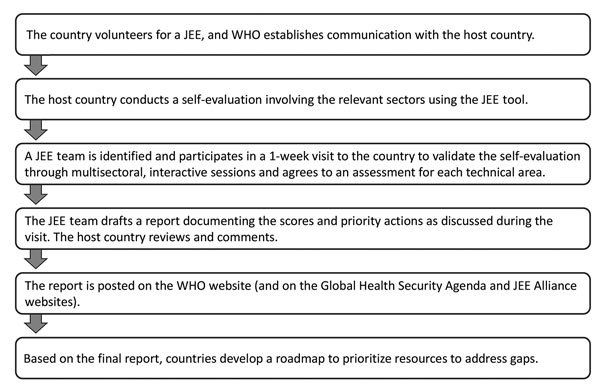
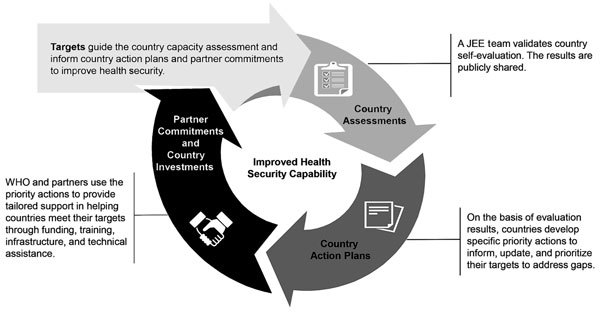
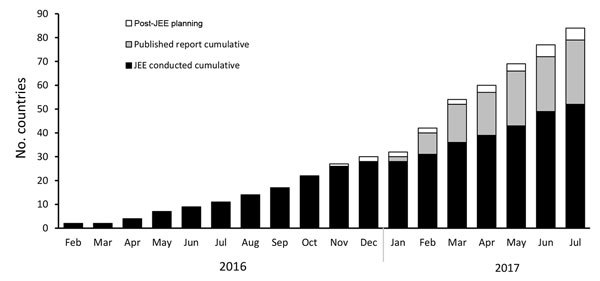
The Joint External Evaluation (JEE), a consolidation of the World Health Organization (WHO) International Health Regulations 2005 (IHR 2005) Monitoring and Evaluation Framework and the Global Health Security Agenda country assessment tool, is an objective, voluntary, independent peer-to-peer multisectoral assessment of a country's health security preparedness and response capacity across 19 IHR technical areas. WHO approved the standardized JEE tool in February 2016. The JEE process is wholly transparent; countries request a JEE and are encouraged to make its findings public. Donors (e.g., member states, public and private partners, and other public health institutions) can support countries in addressing identified JEE gaps, and implementing country-led national action plans for health security. Through July 2017, 52 JEEs were completed, and 25 more countries were scheduled across WHO's 6 regions. JEEs facilitate progress toward IHR 2005 implementation, thereby building trust and mutual accountability among countries to detect and respond to public health threats.
Keywords: Global Health Security Agenda; International Health Regulations; Joint External Evaluation; global health; global health capacity.
Figures
References
-
- World Health Organization. International Health Regulations (2005). 3rd ed. [cited 2017 Oct 6]. http://apps.who.int/iris/bitstream/10665/246107/1/9789241580496-eng.pdf
-
- World Health Organization. Implementation of the International Health Regulations (2005). Report of the Review Committee on Second Extensions for Establishing National Public Health Capacities and on IHR Implementation [cited 2017 Oct 6]. http://apps.who.int/gb/ebwha/pdf_files/WHA68/A68_22Add1-en.pdf
MeSH terms
LinkOut - more resources
Full Text Sources
Other Literature Sources
Medical