Comparative Study
. 2018 Jan 1;159(1):388-399.
doi: 10.1210/en.2017-00540.

Desacyl Ghrelin Decreases Anxiety-like Behavior in Male Mice

Affiliations
Comparative Study

Desacyl Ghrelin Decreases Anxiety-like Behavior in Male Mice

Parinaz Mahbod et al. Endocrinology. .

Abstract

Ghrelin is a 28-amino acid polypeptide that regulates feeding, glucose metabolism, and emotionality (stress, anxiety, and depression). Plasma ghrelin circulates as desacyl ghrelin (DAG) or, in an acylated form, acyl ghrelin (AG), through the actions of ghrelin O-acyltransferase (GOAT), exhibiting low or high affinity, respectively, for the growth hormone secretagogue receptor (GHSR) 1a. We investigated the role of endogenous AG, DAG, and GHSR1a signaling on anxiety and stress responses using ghrelin knockout (Ghr KO), GOAT KO, and Ghsr stop-floxed (Ghsr null) mice. Behavioral and hormonal responses were tested in the elevated plus maze and light/dark (LD) box. Mice lacking both AG and DAG (Ghr KO) increased anxiety-like behaviors across tests, whereas anxiety reactions were attenuated in DAG-treated Ghr KO mice and in mice lacking AG (GOAT KO). Notably, loss of GHSR1a (Ghsr null) did not affect anxiety-like behavior in any test. Administration of AG and DAG to Ghr KO mice with lifelong ghrelin deficiency reduced anxiety-like behavior and decreased phospho-extracellular signal-regulated kinase phosphorylation in the Edinger-Westphal nucleus in wild-type mice, a site normally expressing GHSR1a and involved in stress- and anxiety-related behavior. Collectively, our data demonstrate distinct roles for endogenous AG and DAG in regulation of anxiety responses and suggest that the behavioral impact of ghrelin may be context dependent.


Figures

Figure 1.
Figure 1.
Timeline of the experimental design. (A) All genetically modified male mice of experiments 1, 2, and 3 [Ghr KO (n = 10), Ghsr null (n = 9), and GOAT KO (n = 9)] were handled for 2 weeks. Initially, a cohort of Ghr KO and their littermate WT controls were tested to compare handling vs nonhandling. As depicted, the mice underwent a sequence of tests for anxiety-like behavior: EPM and LD box test followed finally by restraint for 30 minutes and euthanasia at 120 minutes. Blood was collected every 15 minutes during restraint for 120 minutes to measure corticosterone level. (B) Ghr KO mice and their WT littermates were handled for 2 weeks followed by mock injections plus handling daily for 1 week prior to the experimental injection. Mice were injected with saline/DAG/AG (12 per group) and tested for anxiety-like behavior in the EPM followed by euthanasia at 15 minutes to study pERK expression, respectively.
Figure 2.
Figure 2.
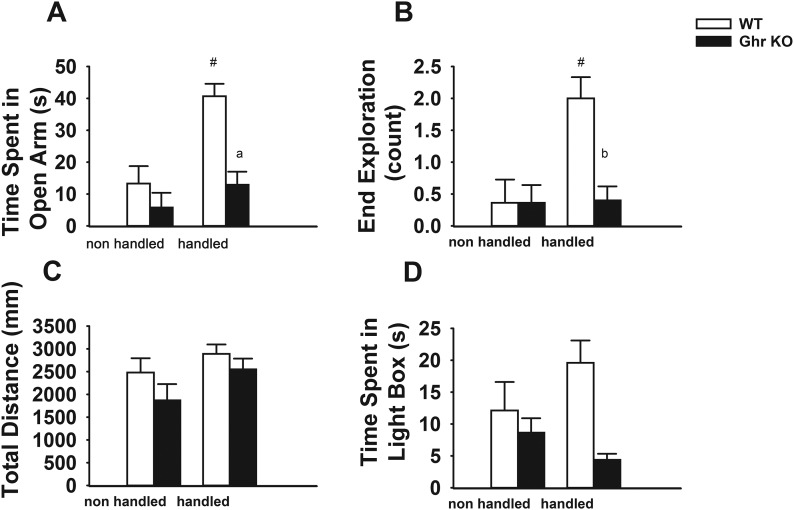
Handling mice elicits anxiety-like behavior in Ghr KO mice. (A) Time [seconds (s)] in open arm. (B) Open-arm end exploration time (count). (C) Total distance moved (millimeters) during the 5-minute EPM in Ghr KO vs WT in two handled and nonhandled groups of mice. (D) Total time in light box during the 5-minute LD box test in Ghr KO vs WT in two handled and nonhandled groups of mice. Data are presented as mean ± SEM. #Significant difference between nonhandled and handled mice; a,bsignificant differences between KO and WT mice that were handled (P < 0.01).
Figure 3.
Figure 3.
GOAT KO mice display reduced anxiety-like behavior. (A) Time [seconds (s)] in open arm. (B) Open-arm end exploration time (count). (C) Total distances moved (millimeters) in 5 minutes during EPM test in GOAT KO vs WT in a handled cohort of mice. (D) Total time in light box during 5-minute LD box test in GOAT KO vs WT handled cohort of mice. Data are presented as mean ± SEM. There was no significant difference vs WT in open-arm end exploration time (P = 0.057). a,b,cSignificant differences vs WT (P < 0.01), respectively.
Figure 4.
Figure 4.
Anxiety-like behavior similar to WT in Ghsr null μice. (A) Time [seconds (s)] in open arm. (B) Open-arm end exploration time (count). (C) Total distance moved (millimeters) during 5 minutes in EPM test in Ghsr null vs WT handled mice. (D) Total time in light box during 5-minute LD box test in Ghsr null vs WT trained group. Data are presented as mean ± SEM. aSignificant difference vs WT (P < 0.01).
Figure 5.
Figure 5.
HPA response to acute stress in disrupted Ghrelin axis mice. (A) Corticosterone (CORT) level after 30-minute restraint in Ghr KO vs WT in nonhandled mice. (B) There was no considerable difference between handled Ghr KO and WT mice. (C) Ghsr null vs WT handled mice in 60 and 120 minutes. (D) GOAT KO vs WT handled mice after 30-minute restraint. aSignificant difference in 30 minutes vs WT (P < 0.01); bsignificant difference vs WT (P < 0.01).
Figure 6.
Figure 6.
Exogenous DAG decreased anxiety-like behavior in Ghr KO mice. Effect on a 5-minute EPM test, 15 minutes after IP injection of saline, DAG, and AG in Ghr KO mice or their WT littermate controls. (A) Ghr KO mice that were treated with saline show less time in open arm in comparison with their littermate WT control mice. Ghr KO mice injected with DAG or AG spent greater time in open-arm than saline-treated Ghr KO control. aSignificant difference between saline-treated Ghr KO vs saline-treated WT (P < 0.05); b,csignificant differences between ghrelin-treated Ghr KO vs saline-treated Ghr KO (P < 0.05). (B) There were no noteworthy differences in end exploration time between either genotype or treatment. (C) DAG-treated Ghr KO mice traveled longer distances than saline-treated Ghr KO mice. aDifference between DAG-treated Ghr KO vs Ghr KO mice receiving saline (P < 0.05).
Figure 7.
Figure 7.
pERK immunohistochemistry after EPM test in EW nucleus after IP injection of saline, DAG, or AG in WT and Ghr KO mice. Ghr KO mice and their littermate WT controls receiving saline, DAG, or AG were perfused 15 minutes after EPM to study pERK expression in EW nucleus. pERK expression level was lower in WT animals that were treated with DAG in comparison with the group of WT mice that received saline injection in the EW nucleus. (A–C) pERK expression in EW of WT mice receiving saline, DAG, and AG, respectively. (D–F) pERK expression in EW of Ghr KO mice receiving saline, DAG, and AG, respectively. aSignificant difference vs WT (P ≤ 0.05).
Figure 8.
Figure 8.
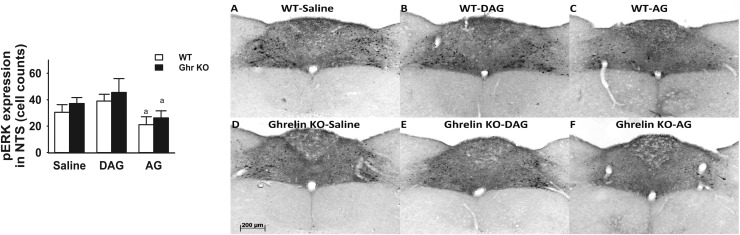
pERK immunohistochemistry after EPM test in NTS after IP injection of saline, DAG, or AG in WT and Ghr KO mice. Ghr KO mice and their littermate WT controls receiving saline, DAG, or AG were perfused 15 minutes after EPM to study pERK expression in NTS. Both WT and Ghr KO mice injected with AG showed lower pERK expression in the NTS in comparison with DAG injection. (A–C) pERK expression in NTS of WT mice receiving saline, DAG, and AG, respectively. (D–F) pERK expression in NTS of Grh KO mice receiving saline, DAG, and AG, respectively. aSignificant difference between AG and DAG (P < 0.05).

References

    1. Kojima M, Hosoda H, Date Y, Nakazato M, Matsuo H, Kangawa K. Ghrelin is a growth-hormone-releasing acylated peptide from stomach. Nature. 1999;402(6762):656–660. - PubMed
    1. Hosoda H, Kojima M, Matsuo H, Kangawa K. Ghrelin and des-acyl ghrelin: two major forms of rat ghrelin peptide in gastrointestinal tissue. Biochem Biophys Res Commun. 2000;279(3):909–913. - PubMed
    1. Müller TD, Nogueiras R, Andermann ML, Andrews ZB, Anker SD, Argente J, Batterham RL, Benoit SC, Bowers CY, Broglio F, Casanueva FF, D’Alessio D, Depoortere I, Geliebter A, Ghigo E, Cole PA, Cowley M, Cummings DE, Dagher A, Diano S, Dickson SL, Diéguez C, Granata R, Grill HJ, Grove K, Habegger KM, Heppner K, Heiman ML, Holsen L, Holst B, Inui A, Jansson JO, Kirchner H, Korbonits M, Laferrère B, LeRoux CW, Lopez M, Morin S, Nakazato M, Nass R, Perez-Tilve D, Pfluger PT, Schwartz TW, Seeley RJ, Sleeman M, Sun Y, Sussel L, Tong J, Thorner MO, van der Lely AJ, van der Ploeg LHT, Zigman JM, Kojima M, Kangawa K, Smith RG, Horvath T, Tschöp MH. Ghrelin. Mol Metab. 2015;4(6):437–460. - PMC - PubMed
    1. Yang J, Zhao T-J, Goldstein JL, Brown MS. Inhibition of ghrelin O-acyltransferase (GOAT) by octanoylated pentapeptides. Proc Natl Acad Sci USA. 2008;105(31):10750–10755. - PMC - PubMed
    1. Gutierrez JA, Solenberg PJ, Perkins DR, Willency JA, Knierman MD, Jin Z, Witcher DR, Luo S, Onyia JE, Hale JE. Ghrelin octanoylation mediated by an orphan lipid transferase. Proc Natl Acad Sci USA. 2008;105(17):6320–6325. - PMC - PubMed

Publication types

MeSH terms