. 2018;17(1):73-79.
doi: 10.1080/15384101.2017.1403681. Epub 2018 Jan 2.

The relationship between DNA single-stranded damage response and double-stranded damage response

Affiliations

The relationship between DNA single-stranded damage response and double-stranded damage response

Aiqing Ma et al. Cell Cycle. 2018.

Abstract

The damage response of DNA single-stranded breaks(SSBs) and double-stranded breaks(DSBs) are two relatively independent processes involving different signaling pathways and protein factors, but there are still many overlapping parts. All of them can activate p53 protein, then the activated p53 regulates the damage response of single-stranded breaks or double-stranded breaks in transcriptional regulation and non-transcriptional regulation. Especially, the two types of damage would compete for RPA and ATR resources in damage repair process. The research has been focused on damage response of DNA single-stranded breaks or DNA double-stranded breaks. However, when single-stranded breaks and double-stranded breaks exist simultaneously, the DNA damage response remains to be elucidated. Here, we present a hybrid numerical model of p53 response and a hybrid numerical model of DNA damage repair exploring DNA damage repair and apoptosis mechanisms when DNA single-stranded breaks and DNA double-stranded breaks exist simultaneously. Firstly, when two kinds of damage are present at the same time, the response of p53 is graded, it means that p53 responds to single-stranded breaks preferentially; Secondly, DNA single-stranded breaks are repaired preferentially, and single-stranded breaks and double-stranded breaks can be repaired simultaneously after most of single-stranded breaks having been repaired; Moreover, single-stranded breaks are more likely to cause apoptosis, because the accumulation of p53 in DNA single-stranded breaks is faster than it in DNA double-stranded breaks and single-stranded breaks has lower threshold of apoptosis.

Keywords: DNA damage response; DSB; SSB; apoptosis; damage repair; p53 response.


Figures
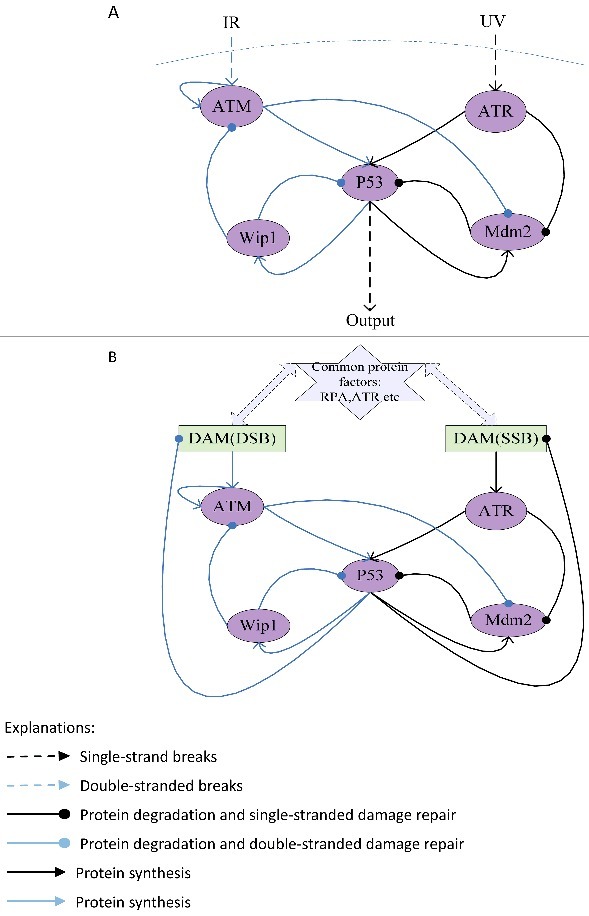
Figure 1.
Figure 1.
The network structure of p53 response (A) and the network structure of DNA damaged repaired (B) when SSB and DSB exist simultaneously.
Figure 2.
Figure 2.
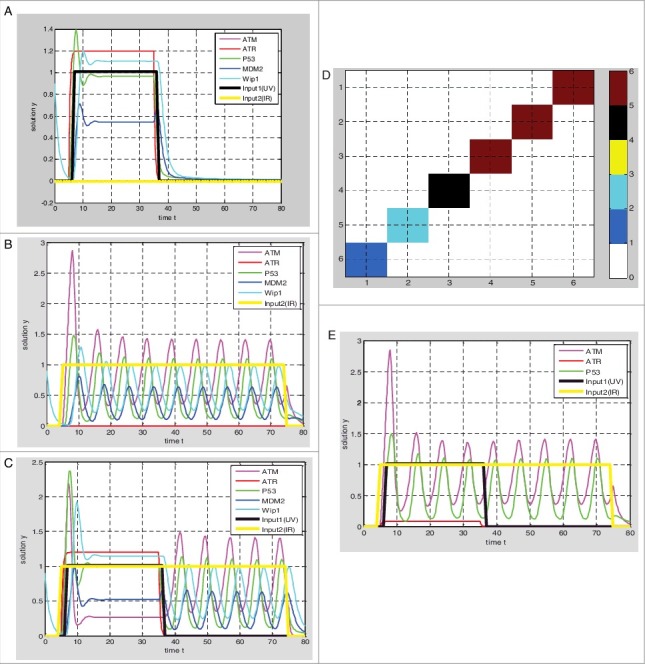
Simulations of p53 response based on hybrid Model I. (A) UV = 1, IR = 0, graded response of p53; (B) UV = 0, IR = 1, the digital impulse response of p53; (C) UV = 1, IR = 1, p53 preferentially responds to DNA single-stranded breaks; (D) the dark red block represents the graded response of the p53, the blue block represents the digital impulse response of p53, the green block and the black block represent the transition state, the ATR protein production rate decreasing from 3 to 0, when the ATR production rate is reduced to 0–0.5, the p53 responds to double-stranded breaks firstly, and in the range of 1.5–3 p53 responds to single-stranded breaks firstly; (E) when ATR production rates are 0.2, p53 responds to DNA double-stranded breaks firstly.
Figure 3.
Figure 3.
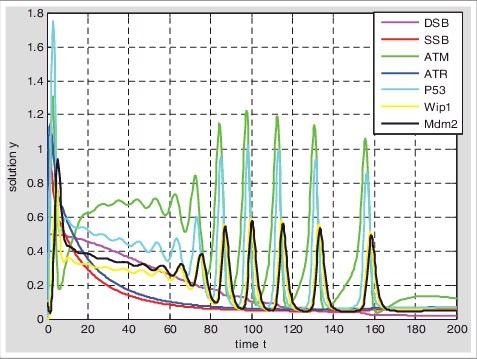
Simulations of DNA damage repaired response based on hybrid Model II. Setting the initial value of single-stranded damage is 1 and double-stranded damaged is 0.5.With the activation of p53(blue) the single strand breaks(red) and double-strand breaks(pink) were repaired competitively.
Figure 4.
Figure 4.
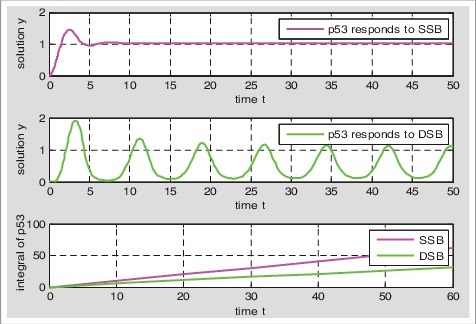
Accumulation rate ofp53 about single-stranded breaks and double-stranded breaks respectively: We calculate the D1, D2 values when t is 0,10,20,30,40,50,60, respectively. The changing rate of D1(D2) is the rate of p53 accumulation.

References

    1. Byun TS, Pacek M, Yee MC, et al.. Functional uncoupling of MCM helicase and DNA polymerase activities activates the ATR-dependent checkpoint. Genes Dev. 2005;19:1040–1052. doi:10.1101/gad.1301205. PMID:15833913 - DOI - PMC - PubMed
    1. Costanzo V, Shechter D, Lupardus PJ, et al.. An ATR- and Cdc7-dependent DNA damage checkpoint that inhibits initiation of DNA replication. Mol Cell. 2003;11:203–213. doi:10.1016/S1097-2765(02)00799-2. PMID:12535533 - DOI - PubMed
    1. Zou L, Elledge SJ. Sensing DNA damage through ATRIP recognition of RPA-ssDNA complexes. Science. 2003;300:1542–1548. doi:10.1126/science.1083430. PMID:12791985 - DOI - PubMed
    1. Chiruvella KK, Liang Z, Wilson TE. Repair of double-strand breaks by end joining. Cold Spring Harb Perspect Biol. 2013;5:a012757. doi:10.1101/cshperspect.a012757. PMID:23637284 - DOI - PMC - PubMed
    1. Karanam K, Kafri R, Loewer A, et al.. Quantitative live cell imaging reveals a gradual shift between DNA repair mechanisms and a maximal use of HR in mid S phase. Mol Cell. 2012;47:320–329. doi:10.1016/j.molcel.2012.05.052. PMID:22841003 - DOI - PMC - PubMed

Substances

LinkOut - more resources