Review
. 2017 Nov 21;5(1):90.
doi: 10.1186/s40425-017-0294-6.

Prospects for combined use of oncolytic viruses and CAR T-cells

Affiliations
Review

Prospects for combined use of oncolytic viruses and CAR T-cells

Adam Ajina et al. J Immunother Cancer. .

Abstract

With the approval of talimogene laherparepvec (T-VEC) for inoperable locally advanced or metastatic malignant melanoma in the USA and Europe, oncolytic virotherapy is now emerging as a viable therapeutic option for cancer patients. In parallel, following the favourable results of several clinical trials, adoptive cell transfer using chimeric antigen receptor (CAR)-redirected T-cells is anticipated to enter routine clinical practice for the management of chemotherapy-refractory B-cell malignancies. However, CAR T-cell therapy for patients with advanced solid tumours has proved far less successful. This Review draws upon recent advances in the design of novel oncolytic viruses and CAR T-cells and provides a comprehensive overview of the synergistic potential of combination oncolytic virotherapy with CAR T-cell adoptive cell transfer for the management of solid tumours, drawing particular attention to the methods by which recombinant oncolytic viruses may augment CAR T-cell trafficking into the tumour microenvironment, mitigate or reverse local immunosuppression and enhance CAR T-cell effector function and persistence.

Keywords: Adoptive cell transfer; CAR T-cell; Chimeric antigen receptor; Combination strategies; Oncolytic virus; Solid tumours; Synergism.


Conflict of interest statement

Ethics approval and consent to participate

Not applicable.

Consent for publication

Not applicable.

Competing interests

JM is chief scientific officer of Leucid Bio, a spinout company focussed on CAR T-cell and gamma delta T-cell immunotherapies for malignant disease. AA does not have any conflicts of interest to declare.

Publisher’s Note

Springer Nature remains neutral with regard to jurisdictional claims in published maps and institutional affiliations.

Figures
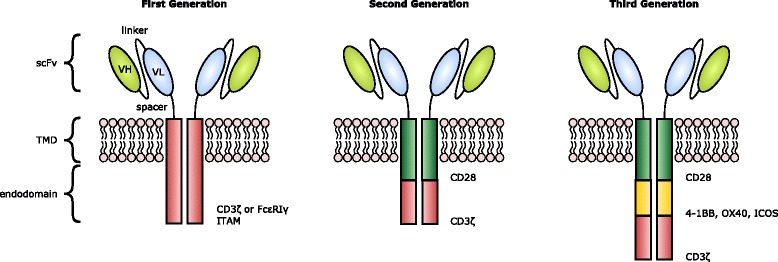
Fig. 1
Fig. 1
CAR design. CARs exist as dimers and consist of an ectodomain (typically comprising an scFv for target binding joined to an extracellular spacer e.g. IgG1 CH2CH3); a transmembrane domain (TMD); and a signalling endodomain. CAR design has evolved from first generation constructs linking the scFV to a CD3ζ or FcεRIγ-derived immunoreceptor tyrosine-based activation motif (ITAM) to second and third generation constructs, where the CARs endodomain contains one or two or more additional costimulatory molecules (such as CD28, 4-1BB, ICOS or OX40) [37]. Fourth generation CAR T-cells (not illustrated) termed TRUCKs are further modified with a constitutive or inducible expression cassette for a transgenic protein (such as IL-12), which is released by the CAR T-cells following receptor binding [101]
Fig. 2
Fig. 2
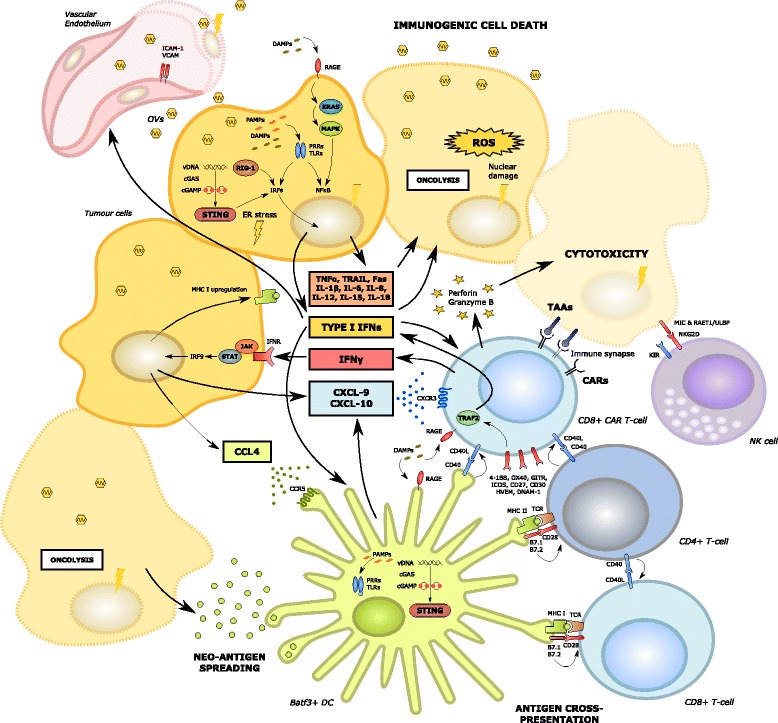
Oncolytic virus mediated enhanced anti-tumoral immunity, including enhanced CAR T-cell recruitment and effector function. Oncolytic viral infection of tumour cells induces immunogenic cell death (ICD) and a type I interferon response via release of PAMPs and DAMPs (such as HMGB1) acting on Toll-like receptors and RAGE. In addition, ER stress is induced by cGAS-cGAMP-STING pathway activation, ultimately leading to the phosphorylation of IRF and the transcription of type I interferons [13]. The local production of cytokines relevant to the activation of the innate immune system may be augmented by their delivery using recombinant oncolytic viral vectors. Activated DCs are recruited by the local production of CCL-4. In turn, DCs secrete CXCL-9 and 10 which attract CD8+ T-cells including CAR T-cells via CXCR3 [75]. Tumour cells with an intact interferon-sensing JAK-STAT pathway are also able to produce CXCL-9 and 10 and are induced to upregulate class I MHC [77]. Oncolysis induces neo-antigen spreading, enhanced DC function and antigen cross-presentation leading to the activation of anti-tumoural CD8+ and CD4+ T-cells within the TME [75]. The latter interact with CAR T-cells in a supportive manner, potentially via the expression of CD40 and other co-stimulatory molecules [141]. Oncolytic viral infection of local vascular endothelial cells may also induce the upregulation of adhesion molecules such as ICAM and VCAM
Fig. 3
Fig. 3
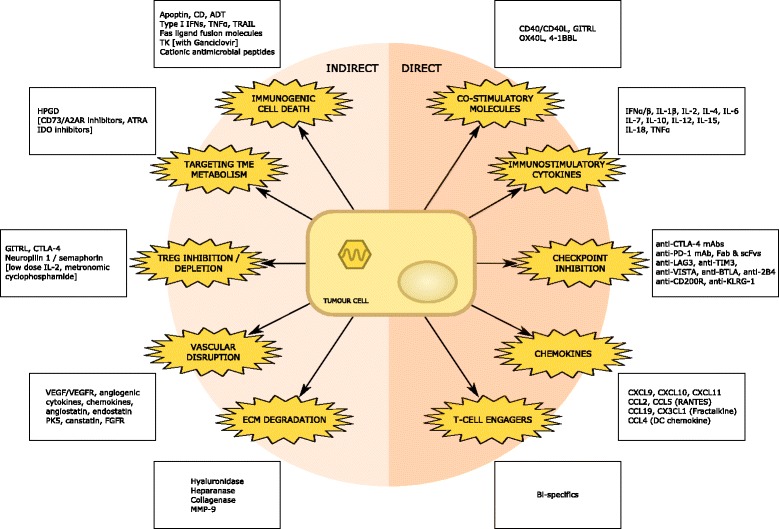
Recombinant oncolytic viruses with transgenes conferring direct and indirect synergism with CAR T-cell adoptive cell transfer. A large variety of oncolytic viruses have been engineered to express transgenes capable of augmenting responses to CAR T-cell therapies applied to solid tumours. These entities may either directly or indirectly enhance CAR T-cell efficacy by modulating their recruitment and entry within the TME, their activation and ability to kill tumour cells, their proliferative capacity, longevity and capacity to adopt a central memory phenotype. Many of these strategies attempt to target the immunosuppressive agents illustrated in Fig. 4 or augment many of the immunostimulatory characteristics highlighted in Fig. 2. Items enclosed in square brackets are pharmaceutical agents that may be synergistically combined with OVs & CARs
Fig. 4
Fig. 4
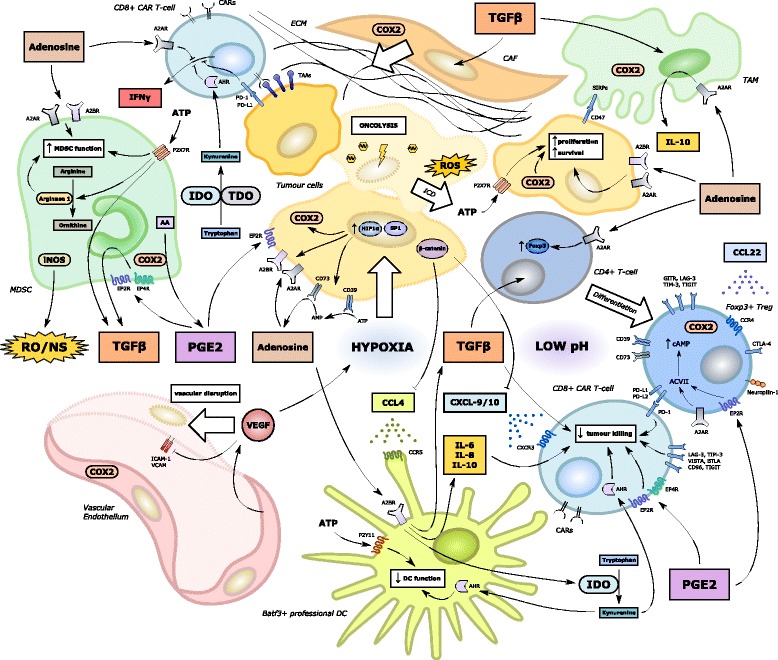
Immunosuppressive influences on CAR-T cell effector function within the tumour microenvironment. A large number of molecular and cellular players have been implicated in the development of an immunosuppressive milieu non-conducive to anti-tumoural T-cell recruitment, trafficking and effector function. Successful implementation of CAR T-cell therapy for solid tumours will necessitate the targeting of many of these players. Key environmental factors include: intra-tumoural hypoxia (exacerbated by VEGF); low pH (in part due to tumour cell lactic acid production); deficiencies of critical or semi-critical amino acids (e.g. tryptophan via IDO1/TDO or arginine via arginase 1 respectively); high levels of ATP and adenosine; increased COX activity and production of PGE2; high levels of immunosuppressive cytokines such as TGFβ and IL-10; upregulation of immune checkpoints on tumour cells and immune cells (particularly PD-L1, LAG-3 and TIM-3); the presence of a relatively impenetrable ECM; and high levels of reactive oxygen and nitrogen species [58]. Many of these factors either directly limit CAR T-cell function or augment the differentiation, recruitment, proliferation and immunosuppressive function of local immune cells within the TME such as Tregs, MDSCs, TAMs and CAFs [14]. DCs are also rendered dysfunctional and whilst CARs can target TAAs or TSAs independent of DC cross-priming, CAR T-cell trafficking and effector function are likely to be negatively impacted by DC dysfunction and loss of CXCL-9/10 chemokine signalling particularly [75]. In addition, high levels of VEGF and hypoxia may limit CAR T-cell entry by causing local disruption of the vascular endothelium and the downregulation of cell surface adhesion molecules [223] to aid CAR T-cell rolling and intra-tumoural migration

References

    1. Andtbacka RH, et al. Talimogene Laherparepvec improves durable response rate in patients with advanced melanoma. J Clin Oncol. 2015;33(25):2780–2788. doi: 10.1200/JCO.2014.58.3377. - DOI - PubMed
    1. Grimaldi AM, Marincola FM, Ascierto PA. Single versus combination immunotherapy drug treatment in melanoma. Expert Opin Biol Ther. 2016;16(4):433–441. doi: 10.1517/14712598.2016.1128891. - DOI - PubMed
    1. Talimogene Laherparepvec in Combination with Neoadjuvant Chemotherapy in Triple Negative Breast Cancer. Available from: https://clinicaltrials.gov/show/NCT02779855. Accessed 5 June 2017.
    1. Talimogene Laherparepvec and Radiation Therapy in Treating Patients with Newly Diagnosed Soft Tissue Sarcoma That Can Be Removed by Surgery. Available from: https://clinicaltrials.gov/show/NCT02923778. Accessed 5 June 2017.
    1. A Study of T-VEC (Talimogene Laherparepvec) With or Without Radiotherapy for Melanoma, Merkel Cell Carcinoma, or Other Solid Tumors. Available from: https://clinicaltrials.gov/show/NCT02819843. Accessed 5 June 2017.

Publication types

Substances