Review
. 2017 Dec;154(6):F93-F110.
doi: 10.1530/REP-17-0374. Epub 2017 Nov 20.

Intracytoplasmic sperm injection: state of the art in humans

Affiliations
Review

Intracytoplasmic sperm injection: state of the art in humans

G D Palermo et al. Reproduction. 2017 Dec.

Abstract

Among infertile couples, 25% involve both male and female factors, while male factor alone accounts for another 25% due to oligo-, astheno-, teratozoospermia, a combination of the three, or even a complete absence of sperm cells in the ejaculate and can lead to a poor prognosis even with the help of assisted reproductive technology (ART). Intracytoplasmic sperm injection (ICSI) has been with us now for a quarter of a century and in spite of the controversy generated since its inception, it remains in the forefront of the techniques utilized in ART. The development of ICSI in 1992 has drastically decreased the impact of male factor, resulting in millions of pregnancies worldwide for couples who, without ICSI, would have had little chance of having their own biological child. This review focuses on the state of the art of ICSI regarding utility of bioassays that evaluate male factor infertility beyond the standard semen analysis and describes the current application and advances in regard to ICSI, particularly the genetic and epigenetic characteristics of spermatozoa and their impact on reproductive outcome.


Conflict of interest statement

The authors declare that there is no conflict of interest that could be perceived as prejudicing the impartiality of this review.

Figures
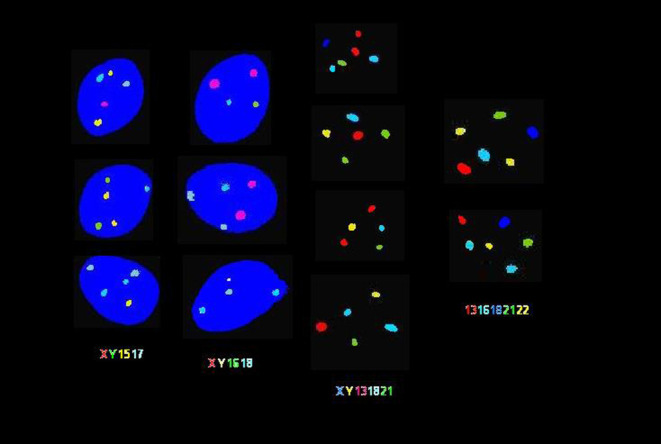
Figure 1
Figure 1
Fluorescent in-situ hybridization (FISH) analysis of ejaculated human spermatozoa. FISH analysis was carried out using 4 different probe sets. In the 2 columns on the left, sperm chromatin stained with 4′,6-diamino-2-phenylindole (DAPI) appears in blue. As indicated from left to right: spermatozoa were assessed by probe sets for chromosomes X/Y/15/17, X/Y/16/18, X/Y/13/18/21 and 13/16/18/21/22 in various colors. As depicted in each cell, disomy is indicated by the appearance of multiple fluorescent signals in the same color. Spermatozoa exhibiting various occurrences of gonosomal and autosomal disomy are shown.
Figure 2
Figure 2
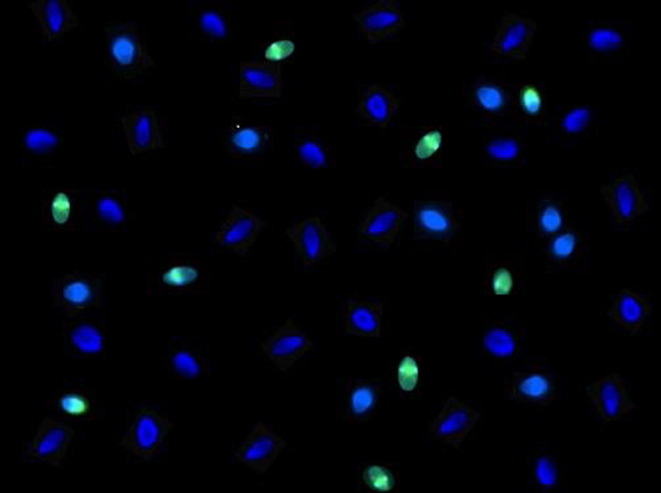
Terminal deoxynucleotidyl transferase dUTP nick-end labeling (TUNEL) immunofluorescent staining of human spermatozoa for detection of DNA fragmentation. Sperm cells which fluoresce green indicate the presence of DNA fragmentation that occurs during the late stages of apoptosis, detected by the action of the TdT enzyme. Spermatozoa are considered TUNEL positive if approximately 40% or more of the head is fluorescent. Spermatozoa without compromised chromatin integrity are shown in blue using DAPI counterstain. Five hundred sperm cells per sample are assessed using fluorescent microscopy in order to determine the sperm chromatin fragmentation, with a threshold of ≤15% TUNEL positivity considered normal.
Figure 3
Figure 3
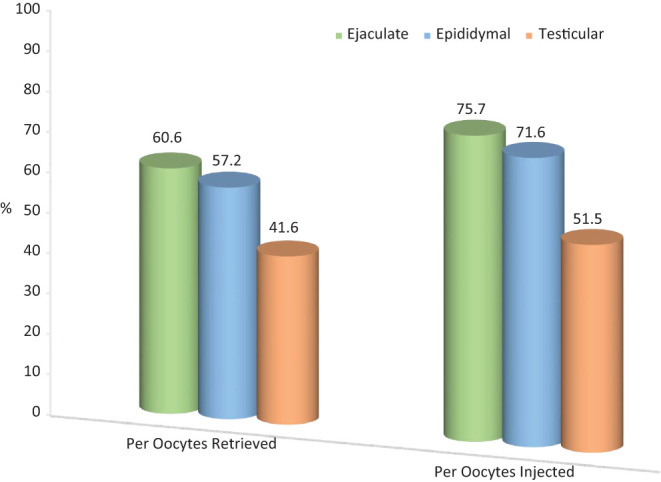
Comparison of fertilization rates according to spermatozoa source. Ejaculated specimens yielded a fertilization rate comparable to the epididymal and both were superior to testicular spermatozoa per oocytes retrieved (χ2, 2 × 3, 2 df; P < 0.0001). A similar pattern was observed once the fertilization rate was calculated based on the number of metaphase II oocytes injected (χ2, 2 × 3, 2 df; P < 0.0001).
Figure 4
Figure 4
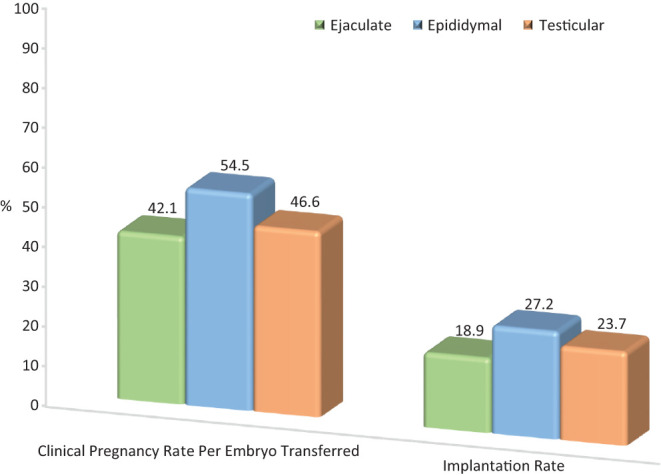
Comparison of pregnancy and implantation rates according to spermatozoa source. Embryos generated from epididymal spermatozoa had the highest pregnancy rate followed by testicular and ejaculated spermatozoa (χ2, 2 × 3, 2df; P < 0.0001). Embryo implantation rate was highest with epididymal, followed by testicular and ejaculated specimen (χ2, 2 × 3, 2 df; P < 0.0001).
Figure 5
Figure 5
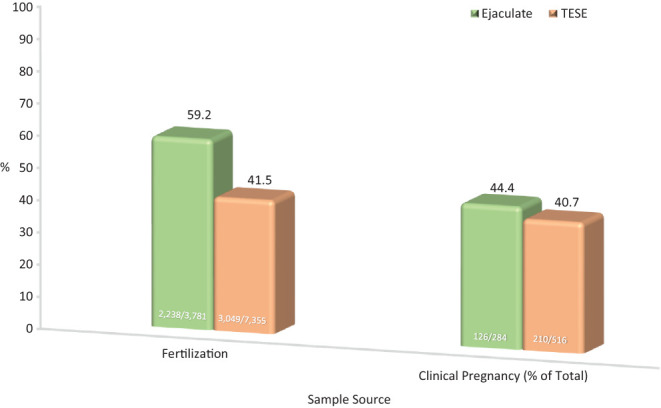
Comparison of fertilization and clinical pregnancy rates in cases with few spermatozoa identified. In 986 cycles, extremely few spermatozoa were seen after high-speed centrifugation. Samples were searched for injectable spermatozoa in drops under oil for up to several hours by multiple embryologists until all oocytes were injected. Oocytes injected with ejaculate spermatozoa demonstrated a higher fertilization rate compared to those injected with testicular specimen (χ2, 2 × 2, 1 df; P < 0.0001). Clinical pregnancy rates remained comparable between the two sperm sources.

References

    1. Aitken RJ, De Iuliis GN, McLachlan RI. 2009. Biological and clinical significance of DNA damage in the male germ line. International Journal of Andrology 32 46–56. ( 10.1111/j.1365-2605.2008.00943.x) - DOI - PubMed
    1. Asada H, Sueoka K, Hashiba T, Kuroshima M, Kobayashi N, Yoshimura Y. 2000. The effects of age and abnormal sperm count on the nondisjunction of spermatozoa. Journal of Assisted Reproduction and Genetics 17 51–59. ( 10.1023/A:1009454114973) - DOI - PMC - PubMed
    1. Baccetti B, Burrini AG, Collodel G, Magnano AR, Piomboni P, Renieri T, Sensini C. 1989. Morphogenesis of the decapitated and decaudated sperm defect in two brothers. Gamete Research 23 181–188. ( 10.1002/mrd.1120230205) - DOI - PubMed
    1. Barros A, Sousa M, Oliveira C, Silva J, Almeida V, Beires J. 1997. Pregnancy and birth after intracytoplasmic sperm injection with totally immotile sperm recovered from the ejaculate. Fertility and Sterility 67 1091–1094. ( 10.1016/S0015-0282(97)81444-6) - DOI - PubMed
    1. Barthelemy C, Tharanne MJ, Lebos C, Lecomte P, Lansac J. 1990. Tail stump spermatozoa: morphogenesis of the defect. An ultrastructural study of sperm and testicular biopsy. Andrologia 22 417–425. ( 10.1111/j.1439-0272.1990.tb02020.x) - DOI - PubMed